
Being stuck and being lost are not the same. Lost means you can't see where you're going. Stuck means you can see it exactly, and something you haven't yet named is in the way.
That distinction matters because the way out of each is completely different. And most of the approaches high-achieving leaders reach for when they're stuck are built for people who are lost.
I want to be specific about who this is for. The senior executives and high-performing leaders I work with at this point are not short of intelligence, effort, or clarity. They know what they want. They've worked hard toward it. And yet, they can't find the way through, not because something is wrong with them, but because they're working at the wrong level.
The Iceberg Thinking Model is a structured self-reflection tool that examines the layers of thinking and feeling producing your current results, from the visible outcome down to the values and beliefs at the foundation. It was developed from systems thinking research at MIT and popularised by Peter Senge in The Fifth Discipline in 1990. The version I use is adapted specifically for high achievers in executive leadership contexts.
The reason it works where other approaches don't is simple. The brain doesn't generate behaviour from goals. It generates behaviour from whatever internal pattern is most established in a given set of conditions.¹ A goal sits above those patterns. A plan sits above them. Neither one reaches the layer that's quietly producing your current results. That's why doing more of what you're already doing doesn't shift things. The effort is real. It's aimed at the wrong layer.
This isn't a capability issue. I want to be clear about that. The most analytical people I work with are often the most stuck in this way. Not despite their intelligence. Because of it. They can build a compelling, accurate account of the situation at the level of results and behaviours. That account leaves the layer underneath it completely untouched.
What is the Iceberg Thinking Model?
The model maps where behaviour actually comes from. Most of what we observe sits above the waterline: the results we're producing and the behaviours generating them. That visible layer is roughly 10% of what's real.
The other 90% sits below. The thinking patterns running quietly in the background. The feelings that precede the behaviours we later struggle to explain. And deeper still, the strengths, values, and beliefs that have been directing everything from the foundation, often for years, without ever being brought into view.
Trying to change results without working at that depth rarely holds. The behaviour changes. The layer producing it doesn't. The old result returns,dressed slightly differently.²
The work of this model is to make the 90% visible. Not to dismantle it. To see it clearly enough to choose what continues to run, and to deliberately starve of attention what no longer serves.³
How to use the Iceberg Thinking Model
You start with your current reality and work toward your desired state. You move downward through the layers before you can move forward:
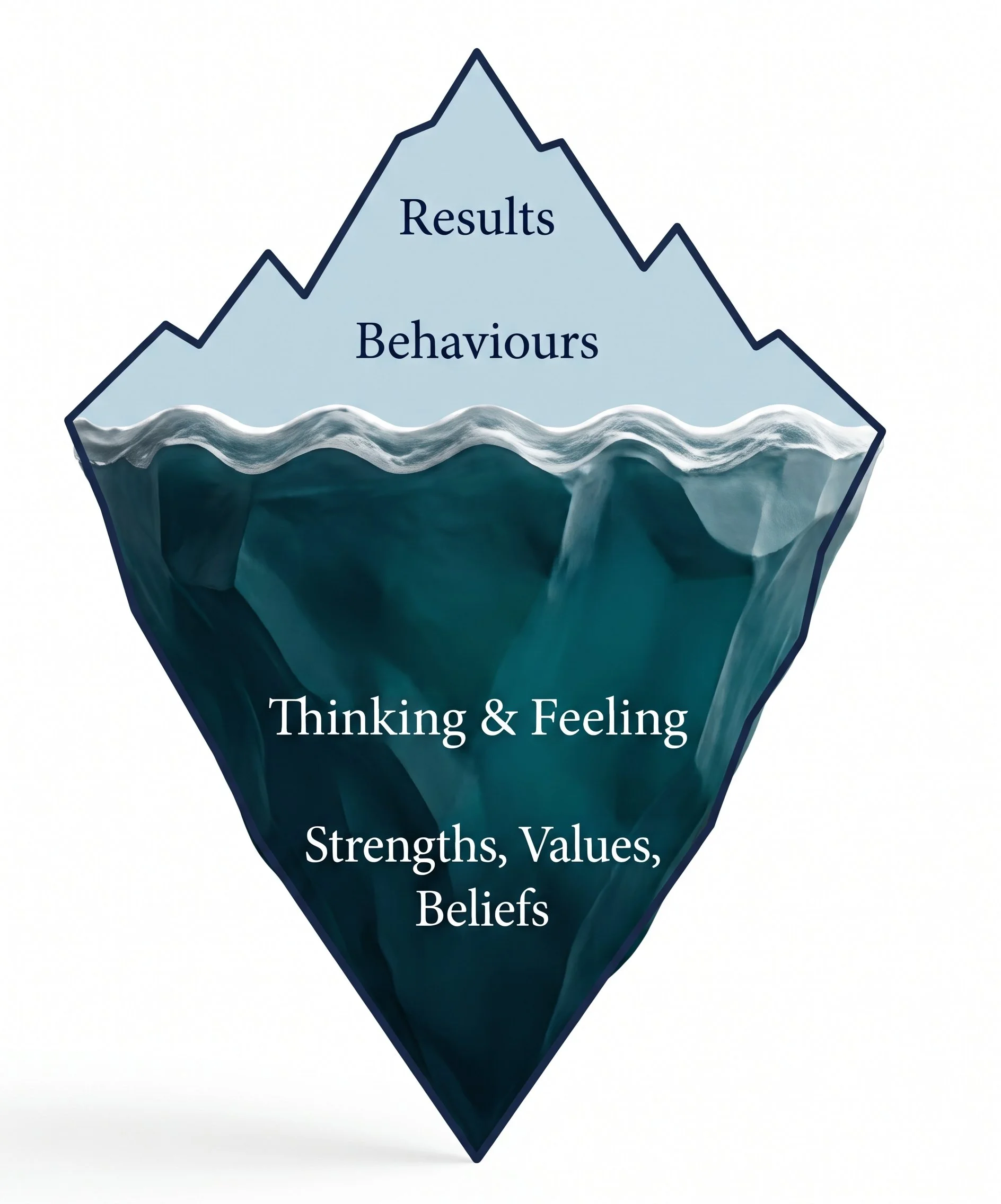
Results: start with what's actually happening right now. Not what you want to happen. The actual current result in one plain sentence. That sentence is data. It tells you exactly how the system is currently designed. Not how you intend it to be. How it is.
Behaviours: what are you consistently doing that's producing this result? Not what you intend to do. What you're actually doing, repeatedly, often without noticing. In my experience, people know the answer before I finish asking the question. They just haven't said it out loud yet.
Thinking and Feeling: this is the layer that generates the behaviours. What thoughts and emotional patterns are running just before you act the way you do? Not your rational position. What's actually there, in the moment. The brain under pressure defaults to its most established patterns.² The pattern producing the result you're trying to change doesn't arrive with a label. It feels like sound judgment. And it's quietly deciding what remains available to you.
Strengths, Values, and Beliefs: this is the foundation layer. Your strengths, values, and beliefs are the architecture from which everything else is being generated, including the pattern you're trying to shift. The question isn't what needs to be fixed. It's what's actually running, and whether it's still true for the person you are now. A belief from ten or fifteen years ago can still be directing your behaviour today. Not because it's wrong. Because it's never been brought into view. When attention moves deliberately away from it, over time it weakens.³ What remains is what was always actually there.
This is the work of neuroscience-based coaching at senior executive level. Not adding more above the surface. Working at the layer that determines whether anything else holds.
When a team is stuck
The same four layers apply when a whole leadership team keeps producing results below what its capability would suggest. The shared pattern is running at the thinking and feeling layer. It's usually something the team has never named together. Not because they can't see it, but because the professional context has never made it safe to say out loud.
I use this model in senior leadership team coaching to create that space. The conversation isn't about the result or the behaviour. It's about what's underneath both. That conversation, held with real precision, is where collective executive performance becomes available rather than managed.
Try this yourself
You don't need a coach to start.
Begin at the results layer. Write the actual current result in one sentence. Then ask what you're consistently doing. Then what thinking and feeling is driving that. Then go to the foundation: what do you believe about yourself that makes this entire pattern make complete sense?
Most people can get through the first three layers with enough honesty and quiet. The fourth, the belief layer, is where I most often see people benefit from a thinking partner. Not because the answer isn't there. Because the brain is specifically calibrated to protect that layer from direct examination.⁴ It will generate excellent reasons why you don't need to look there. A skilled thinking partner notices when that's happening and asks the question the analytical mind won't ask itself.
What is the belief at the foundation that's making your current result the only one available?
If you want the worksheet with all the questions and steps to complete the exercise, contact me and I’ll share.
In short
The Iceberg Thinking Model is a four-layer self-reflection tool that examines the thinking, feeling, and beliefs producing a leader's current results.
Working from the visible result through behaviours and internal patterns down to the strengths, values, and beliefs at the foundation allows senior leaders to identify where genuine change is available.
The model draws from Peter Senge's systems thinking research at MIT and is used in leadership coaching to reach the level that goal-level and plan-level work doesn't address.
References
Graybiel, A.M. (2008). Habits, rituals, and the evaluative brain. Annual Review of Neuroscience, 31, 359-387. [EXTERNAL LINK: ]
Arnsten, A.F.T. (2009). Stress signalling pathways that impair prefrontal cortex structure and function. Nature Reviews Neuroscience, 10, 410-422.
Hebb, D.O. (1949). The Organization of Behavior. Wiley & Sons.
Eisenberger, N.I. & Lieberman, M.D. (2004). Why rejection hurts: a common neural alarm system for physical and social pain. Trends in Cognitive Sciences, 8(7), 294-300.
Senge, P.M. (1990). The Fifth Discipline: The Art and Practice of the Learning Organization. Doubleday/Currency.
Meadows, D.H. (2008). Thinking in Systems: A Primer. Chelsea Green Publishing.
