
The "Work Smarter" Myth Cracked (7/18): Habit Formation & Automaticity
You're a competent PM, experienced in your role. Yet every morning you stare at your task list for ten minutes, paralysed by the decision of where to start. Email arrives constantly, and you process each message randomly, composing responses from scratch even when answering identical questions you've handled dozens of times. During Sponsor calls, you jot notes wherever you happen to click, then spend precious time later reconstructing what was actually discussed. At day's end, you simply stop when exhaustion overwhelms you, with no closure ritual and no capture system. Predictably, you wake at 2am remembering forgotten commitments.
These aren't strategic decisions requiring expertise. They're routine behaviours you've performed hundreds of times. Yet every repetition demands fresh cognitive energy as if approaching them for the first time.
This isn't a discipline problem. It's a neuroscience problem. Your brain hasn't converted these frequent behaviours into automatic habits, so your prefrontal cortex handles them manually every single time, burning precious glucose with each decision.
The Neuroscience of Automaticity
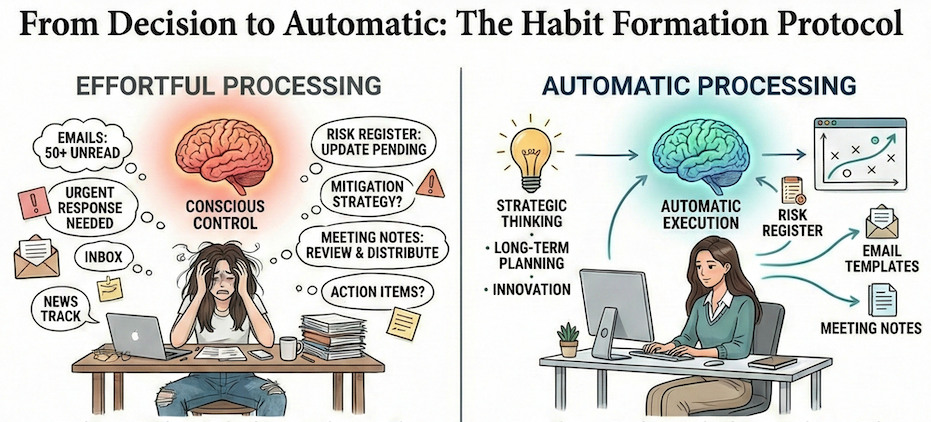
When you first learn a new behaviour, your prefrontal cortex (the conscious decision-making region behind your forehead) controls every step. This requires massive mental energy. Each action demands attention, deliberation, and conscious execution.
But with sufficient repetition of the same behaviour in the same context, control shifts to the basal ganglia—a cluster of structures deep in your brain designed for efficient automatic processing. This is habit formation. Once a behaviour becomes automatic through this transition, it requires roughly 5% of the cognitive energy it consumed initially.
Your brain creates neural pathways for frequently repeated behaviours. Each repetition strengthens these pathways through myelination and solidified synaptic connections. Eventually, the behaviour fires automatically in response to specific cues without conscious decision required.
This operates through the habit loop:
Cue: Trigger initiating the behaviour (time of day, location, emotional state, preceding action)
Routine: The behaviour itself, executed as an automatic sequence
Reward: What your brain receives from completing the behaviour
Once this loop establishes (typically requiring 21-66 days depending on complexity), the basal ganglia runs it automatically. You encounter the cue, the routine executes, you experience the reward—all without conscious deliberation.
Why Most PMs Waste Cognitive Capacity on Routine Decisions
Most overwhelmed PMs manually decision-make their way through tasks that should be completely automatic:
"Should I update the risk register now or later?" "Which template should I use for this site communication?" "When should I do my weekly review?" "How should I structure this Sponsor update?" "What information do I need to capture from this call?"
These decisions consume cognitive energy every single time. Multiply by daily repetitions across dozens of routine behaviours, and you've exhausted your prefrontal cortex before addressing anything genuinely strategic.
The empowered PM builds systems that run on autopilot. Routine behaviours execute automatically without decision, freeing cognitive capacity for strategic thinking that actually benefits from conscious deliberation.
This distinction defines the difference between operationally busy and strategically valuable. Busy PMs burn mental energy repeatedly deciding how to execute routine work. Strategic PMs converted those routines into automatic habits long ago, preserving cognitive capacity for work requiring genuine expertise.
The Habit Formation Protocol
Step 1: Identify High-Frequency Routine Behaviours
Begin by listing behaviours you repeat at least weekly that don't require strategic judgment. These are automation candidates. The goal is capturing every repeated behaviour currently consuming decision-making energy unnecessarily. Such as:
Communication behaviours include email processing routines, standard update communications, Sponsor status reports, risk notifications, site escalation messages, meeting follow-up protocols. Each happens repeatedly following similar structure, yet most PMs recreate them from scratch each occurrence.
Project management behaviours include daily project review sequences, weekly timeline updates, risk register reviews, budget variance tracking, action item follow-up, meeting preparation routines. These repeat constantly, yet without deliberate habit formation they consume fresh decision-making energy every time.
Information management behaviours encompass note-taking from calls, document filing conventions, reference material organisation, information retrieval protocols. These happen multiple times daily, usually inconsistently, creating cognitive load through repeated micro-decisions about structure and location.
List fifteen to twenty behaviours you repeat at least weekly. Be specific. Not "manage risks" but "review risk register every Monday morning, identify new risks, update existing risk status, escalate high-priority items to Sponsor."
Specificity matters because you're designing automatic sequences, not vague intentions. Your basal ganglia encodes precise behavioural patterns, not general concepts.
This audit reveals how much cognitive energy you currently waste on routine decisions. Most overwhelmed PMs discover they're making hundreds of unnecessary decisions weekly about behaviours that should be completely automatic.
Step 2: Design Optimal Routines Before Building Habits
Before making something automatic, ensure you're automating the right behaviour. A poorly designed habit formed is harder to break than preventing formation initially. This design phase is critical.
For each routine behaviour identified in Step 1, define three elements precisely:
What's the optimal sequence of steps? Document specific actions in order, including decision points and their criteria. For email processing, this might be: open inbox, scan for genuine urgencies requiring immediate response, process Sponsor emails next, then internal stakeholder emails, then informational emails, archive or delete everything processed. The sequence matters because your basal ganglia will encode it exactly as practised.
What's the trigger or cue initiating this routine? Habits operate on the cue-routine-reward loop. The cue signals your brain to execute the automatic sequence. Without a consistent cue, the behaviour won't become automatic regardless of repetition. For email processing, the cue might be sitting down at your desk after morning coffee. For risk register review, the cue might be opening your calendar Monday morning and seeing the blocked time. Make cues concrete and consistent.
What's the reward reinforcing the habit loop? This doesn't require external treats or praise—intrinsic rewards work powerfully. For email processing, the reward might be inbox at zero and confidence all critical communications are handled. For risk register review, the reward might be certainty you're aware of all project threats. The reward signals to your brain that this loop merits remembering and repeating.
Document all three elements for each routine behaviour. This documentation becomes your habit implementation plan. Without it, you're hoping habits form accidentally through vague repetition. With it, you're engineering automatic behaviours deliberately.
Step 3: Implement Habits Using If-Then Plans
Generic intentions to "do better" or "be more organised" fail because they don't create specific neural pathways. If-then plans work because they link situations to actions explicitly, creating the cue-action association your basal ganglia requires.
The structure is simple: "If Situation X occurs, then I will perform Behaviour Y." The specificity creates neural pathways triggering automatically when the situation arises. After sufficient repetition, you don't consciously think "should I do my routine?" You encounter the cue and the routine executes automatically.
For communication habits, create if-then plans like: "If I receive a Sponsor email requiring response, then I will pause for the physiological sigh protocol, review their strategic context card, and draft response using the strategic communication template." Initially this requires deliberate execution. After four to six weeks, it becomes automatic. You see Sponsor email, your brain automatically initiates the sequence.
For project management habits: "If it's Monday at nine a.m., then I will spend thirty minutes reviewing all project risk registers, document new risks identified, update existing risk status, and flag anything requiring Sponsor communication." The time-based cue triggers the entire sequence automatically once the habit forms.
For information management: "If I finish a Sponsor call, then I immediately capture notes using the standard template, file them in the project folder, and add any action items to the tracking system." The completion of the call is the cue, the routine executes automatically.
Write your if-then plans explicitly. Keep them visible during formation. Review them weekly to check for needed adjustments. Most importantly, practise them consistently. Every time you encounter the cue, execute the routine. Inconsistent practice prevents habit formation because your basal ganglia requires repeated exposure to encode the pathway.
Step 4: Protect Habit Formation from Decision Fatigue
Habit formation requires prefrontal cortex energy initially, before control shifts to basal ganglia. This creates vulnerability: when you're stressed, tired, or cognitively depleted, you're more likely to skip the new routine and fall back on old patterns.
Protect your habit formation practice by implementing new habits during periods of relative stability, not during project crises. If you're trying to establish a daily project review habit whilst simultaneously managing three urgent site escalations, your depleted prefrontal cortex won't have capacity for consistent practice. The habit won't form.
Similarly, limit how many new habits you build simultaneously. Your conscious capacity for maintaining new behaviours is limited. Attempting to establish five new routines simultaneously typically results in none sticking. Instead, focus on one to two habits at a time. Once they've transitioned to automatic execution requiring minimal conscious effort, add the next ones.
Use environmental design to reduce decision friction during habit formation. If your new routine requires specific tools or information, prepare them in advance. Trying to execute a new email processing routine when you can't find your template library adds friction making skipping more likely. Remove obstacles before they become excuses.
Track your consistency without judgment. Simple tracking like marking a calendar when you execute the routine creates accountability and provides positive feedback. Seeing a string of consistent days activates reward pathways supporting continued practice. Missing occasional days is normal—what matters is overall consistency over weeks.
Step 5: Recognise Formation and Maintain Habits
You'll know a habit has formed when you execute the behaviour without conscious decision-making. You sit down at your desk after morning coffee and find yourself processing email according to your routine without having decided to do so. Monday at nine a.m. arrives and you're reviewing risk registers before consciously remembering it's your scheduled time. The cue triggers the routine automatically.
At this point, the behaviour requires minimal cognitive energy and continues functioning even under stress. This is the payoff for your formation investment. The routine that initially demanded careful attention now runs automatically, freeing that attention for strategic thinking genuinely requiring it.
However, formed habits still require occasional maintenance. Significant context changes can disrupt even established habits. If your morning routine changes, the cue for your email processing habit might not trigger. Rebuild the habit with the new cue rather than hoping it continues spontaneously.
Similarly, long work breaks can weaken habits. After a two-week holiday, you might need to consciously re-engage routines for a few days before they resume automatic execution. This is normal. The neural pathways haven't disappeared—they just need reactivation.
Periodically audit your habits to ensure they're still optimal. What worked well six months ago might need updating based on changed project dynamics or new tools. Better to consciously redesign and form a new improved habit than continue an outdated routine automatically.
Most importantly, continue creating new habits. The goal isn't forming five perfect routines and stopping. The goal is progressively converting more routine work into automatic behaviours, continuously freeing cognitive capacity for increasingly complex strategic thinking.
Senior PMs who appear effortlessly organised have simply automated more of their routine work through deliberate habit formation.
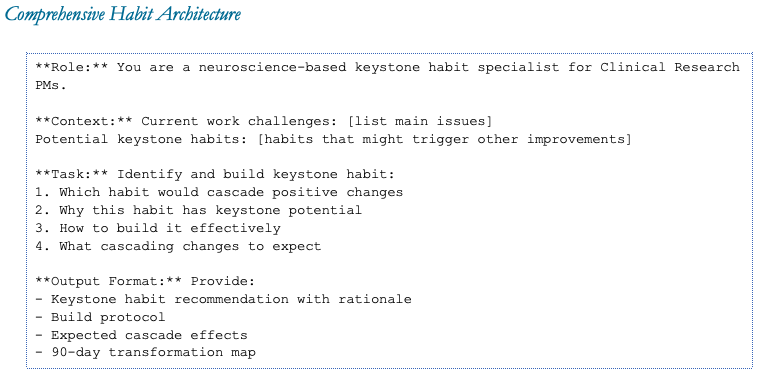
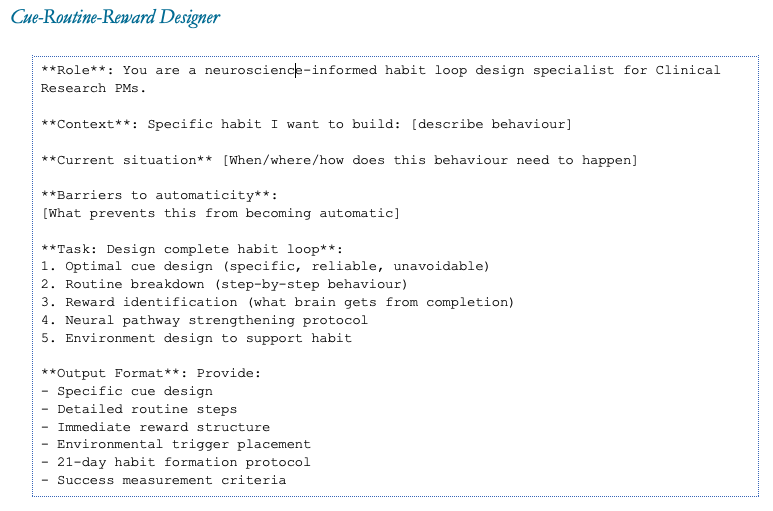
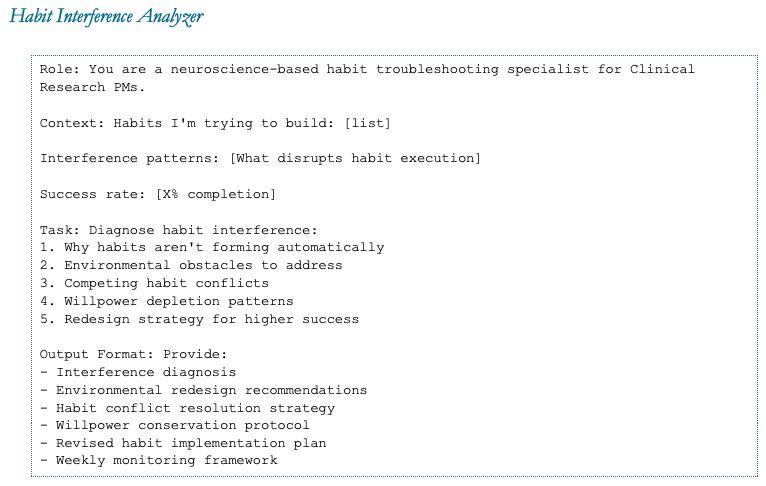
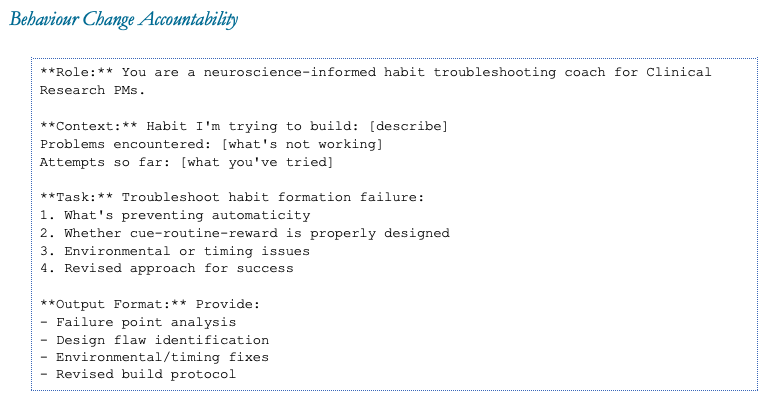
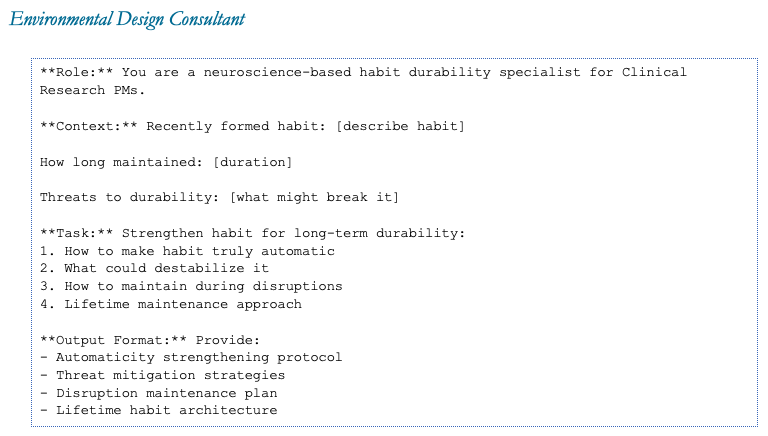
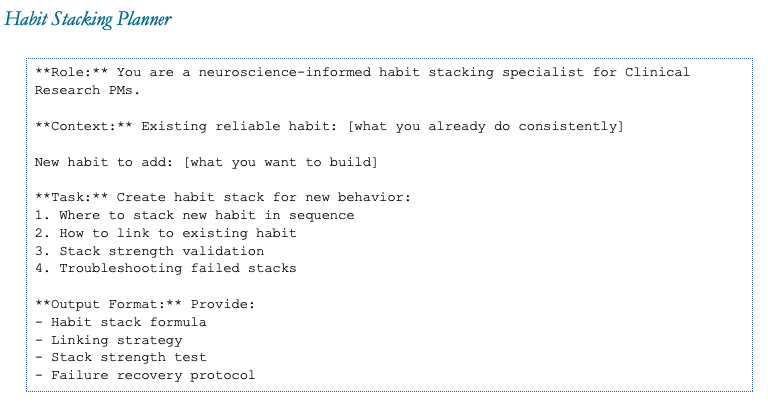
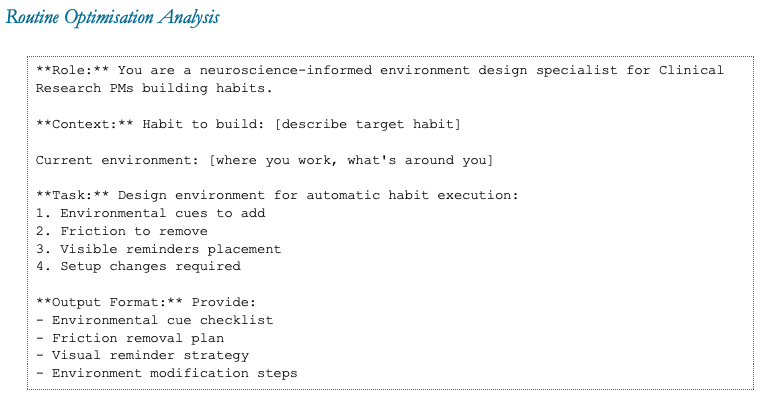
Gen AI prompts to reduce the admin burden
below you can see some examples of generative AI prompts to help you follow the protocol:
Real-World Application: Lola's Transformation
Lola was competent but perpetually behind. Every task required fresh decision-making. Should he update the risk register now or after lunch? Which template for this site communication? How to structure the Sponsor update? When to review yesterday's progress? These weren't strategic decisions requiring expertise—they were routine tasks he'd done hundreds of times. Yet every repetition demanded mental energy as if approaching them fresh.
His days followed an exhausting pattern. Each morning, Lola stared at his task list for ten minutes, paralysed by where to start. Email arrived constantly, and he processed each message randomly as it appeared, composing every response from scratch even when answering identical questions handled dozens of times. During Sponsor and site calls, he'd jot notes wherever he clicked in scattered documents, then spend precious time later reconstructing what was actually said. At day's end, he simply stopped working when exhaustion overwhelmed, with no closure ritual and no system capturing what still needed attention. Predictably, he'd wake at 2am remembering forgotten commitments.
The breaking point came during a critical Sponsor call. Three days earlier, the Sponsor had asked Lola to compile recruitment projections for their Board presentation. Lola remembered the conversation clearly but had written the action item on a sticky note that subsequently disappeared under a stack of documents. When the Sponsor asked for the projections on the call, Lola felt his stomach drop. He'd completely forgotten. The Sponsor's frustration was unmistakable.
Lola's manager introduced him to habit formation as a cognitive energy solution. The approach wasn't about working harder or being more disciplined. It was about converting routine behaviours into automatic sequences requiring almost no conscious effort, freeing cognitive capacity for strategic thinking genuinely needing his expertise.
Lola designed his first habit deliberately using the cue-routine-reward structure. The cue was an existing reliable behaviour—sitting down at his desk with morning coffee. The routine was seven minutes following an identical sequence every morning: open project dashboard, review yesterday's completions, check today's milestones, identify three priorities, note any blockers. The reward was immediate clarity and elimination of mid-morning "what should I be doing?" anxiety.
The first week felt awkward. Lola needed an alarm reminder and wanted to skip the routine to jump straight into email like he always had. Days eight through fourteen, the routine started feeling natural. Lola noticed his anxiety reduced significantly on days he completed it. Days fifteen through twenty-one marked the transition. The routine began feeling automatic, and skipping it felt wrong rather than tempting. By day thirty, Lola's brain simply executed the sequence with zero conscious effort. Sitting down with coffee automatically triggered the seven-minute review without any decision required.
Month two layered a second habit onto the first: post-call note capture. The cue was immediately after hanging up from any Sponsor or site call. The routine took three minutes using a standard template: key decisions, action items with clear owners and dates, open questions, follow-up needed. The reward was never again scrambling to remember "what did they say?" and increased Sponsor credibility when Lola could reference previous conversations precisely. Building on month one's success, this habit followed the same progression and became automatic by day twenty-one.
Month three introduced the end-of-day brain dump. The cue was closing his laptop. The routine required five minutes: capture all open loops in his task management system, note tomorrow's top three priorities, clear his mental desktop completely. The reward was immediate—no more 2am wake-ups, peaceful evenings, clear tomorrow starts. Interestingly, this third habit formed faster than the first two because Lola was already operating with two automatic routines providing structure for the new one.
Six months after beginning his habit-building programme, Lola had established six automatic routines requiring zero cognitive effort: morning project review, post-call note capture, end-of-day brain dump, weekly project health check on Fridays, template-based email batch processing in dedicated thirty-minute windows, monthly stakeholder relationship review. None demanded conscious decision-making anymore. They simply happened automatically in response to their cues.
The transformation was quantifiable. Lola estimated he'd previously spent ninety-plus minutes daily on routine task decisions: "Should I do this now? How should I structure this? When should I follow up?" That cognitive capacity was now available for strategic thinking. His forgotten commitment rate dropped to zero because his automatic systems captured everything. His Sponsor noticed the change, commenting that Lola had become much more reliable and strategic in his approach. Perhaps most importantly, Lola stopped experiencing work anxiety after hours because his brain trusted the systems to hold everything until morning.
Lola reflected on the transformation: "I used to think systems and routines were rigid and limiting. Now I understand they're liberating. My brain isn't wasting energy on 'should I update the risk register now or later?' It just happens automatically at the right time, every time. The energy I save through automation gets applied to actually solving problems and building relationships. I'm working the same hours but accomplishing twice as much because I'm not burning mental energy on repetitive decisions. Habit formation changed everything."
Your Implementation Plan
This Week: Identify one routine behaviour you repeat at least daily. Not a complex strategic task, but something procedural you do repeatedly yet somehow still requires fresh decision-making every time. Perhaps how you process email, capture meeting notes, or review project status. Choose just one behaviour for now.
Design the habit deliberately with three elements: the cue that will trigger it, the routine sequence you'll follow, and the reward your brain receives from completing it. Execute it once today to test whether the sequence works smoothly. If it feels clunky, adjust before committing to repetition.
This Month: Focus entirely on that single habit. Execute it daily, using external reminders like calendar alerts if needed since the behaviour isn't automatic yet. Track completion with simple check marks so you can see your consistency pattern.
The first seven days will feel awkward and require conscious effort. That's completely normal. If friction points appear where the routine feels unnecessarily difficult, adjust the sequence now rather than fighting through resistance. The goal is making the routine sustainable, not proving your willpower.
Around day fifteen to twenty-one, you'll notice the routine starting to feel automatic, requiring less conscious decision to initiate. Don't add a second habit until this first one genuinely feels automatic. Trying to build multiple habits simultaneously almost always results in none sticking because your conscious capacity for maintaining new behaviours is limited.
This Quarter: Systematically build your comprehensive routine system by adding one new habit per month. Each month, layer a new automatic behaviour onto your existing foundation. Since your previous habits now run without conscious effort, you have mental capacity to focus on forming the next one.
By month three, you'll have three automatic routines requiring almost zero cognitive effort yet handling what previously consumed hours of decision-making energy daily.
Six Months Forward: The transformation isn't dramatic day to day—it compounds. Each automated routine saves small amounts of daily cognitive capacity. Multiply by dozens of routines over months, and you've fundamentally restructured how your brain allocates its limited decision-making resources.
The energy previously wasted on "how should I handle this routine task?" becomes available for strategic thinking genuinely requiring your expertise. This is when colleagues start commenting that you seem calmer, more organised, more strategic. What they're noticing is cognitive capacity freed from routine decisions and redirected toward work that actually matters.
How This Connects to Other Strategies
Your working memory capacity determines everything about how effectively you can think strategically. Automatic behaviours formed through habit don't tax working memory at all because they run in your basal ganglia rather than requiring prefrontal cortex resources. This is Cognitive Load Theory in action. Every routine behaviour you convert to automatic execution through habit formation frees up working memory capacity previously consumed by procedural decisions.
Decision fatigue depletes your finite daily decision-making capacity with every choice you make. Habits eliminate entire categories of routine decisions, preserving that precious capacity for strategic choices where your expertise actually matters. When your morning routine executes automatically, your brain doesn't burn glucose making decisions about email sequence, priority identification, or information review structure.
Your natural energy cycles follow predictable patterns throughout each day. Habitual routines naturally align with these ultradian rhythms because you're building habits at consistent times when your energy supports them. Your morning project review habit leverages peak morning cognitive capacity. Your end-of-day brain dump habit works with depleted evening energy when procedural tasks suit your reduced capacity.
Chunking describes how your brain groups related information into single retrievable units. Habits function as chunked behaviour sequences. Your post-call note capture habit chunks four distinct actions into one automatic sequence your brain processes as a single unit requiring one decision to initiate rather than four separate decisions.
Flow state requires removing interruptions and decision friction so you can maintain deep focus on challenging work. Automatic routines create the foundation making flow possible. When your project review, communication, and documentation behaviours all run automatically, you eliminate the constant low-level decisions that fragment attention and prevent flow from developing.
Habit formation represents the ultimate "work smarter" strategy. You invest conscious effort building the routine once, deliberately and carefully. Then you execute it automatically forever, with your basal ganglia handling the sequence efficiently whilst your prefrontal cortex remains free for strategic thinking.
This isn't about discipline or willpower. It's about working with your brain's natural capacity for automaticity rather than forcing conscious decision-making on routine behaviours that don't require it. The overwhelmed PM makes hundreds of unnecessary decisions daily about routine behaviours that should be automatic, exhausting cognitive capacity before addressing any strategic work. The empowered PM systematically converts routine behaviours into habits running automatically with minimal energy, preserving cognitive capacity for strategic thinking genuinely requiring conscious deliberation.
This systematic approach to habit formation is exactly what we build in brain-based coaching for clinical research professionals—practical, neuroscience-backed protocols that free your strategic capacity by eliminating the cognitive drain of routine work.
References: Duhigg, C. (2012). The Power of Habit; Wood, W. (2019). Good Habits, Bad Habits; Rock, D. (2009). Your Brain at Work
