
The "Work Smarter" Myth Cracked (8/18): Pattern Recognition & Expertise
Ever watched a senior colleagure glance at a recruitment graph and immediately spot problems you completely missed?
You're staring at the same numbers. You've analysed the same data. Yet somehow they see the subtle plateau that signals site fatigue whilst you're thinking everything looks fine because the numbers are going up. They make a quick call and say "Site 23 needs attention" before you've even identified there's an issue.
Here's what nobody tells you: they're not smarter than you. They're not working harder. They haven't got some mystical PM intuition you lack.
They've built a pattern library in their hippocampus through thousands of experiences. Your brain stores every pattern from every experience you've had. When you encounter a new situation, your brain instantly searches this library and matches it against stored templates. This happens unconsciously and extraordinarily fast, in milliseconds. Expert PMs recognise patterns instantly that junior PMs don't see at all because their pattern library is exponentially larger.
The difference between you and that senior PM isn't intelligence or effort. It's pattern library size. You don't need a decade to build that library. Each experience creates neural pathways in your brain. Repeated similar experiences strengthen these pathways through myelination and synaptic pruning. Eventually, your brain creates pattern templates: compressed versions of "I've seen this before." When you encounter similar situations, pattern matching fires automatically without conscious effort.
This is why new PMs feel overwhelmed. You're building your pattern library from scratch. Everything requires conscious analysis. You're using working memory capacity just to process situations that senior PMs handle automatically. Senior PMs appear to make decisions "intuitively," but it's not magic. It's 10,000 hours of stored patterns their brains match unconsciously.
You can flatten the learning curve by completing a strategic pattern recognition training combined with AI amplification.
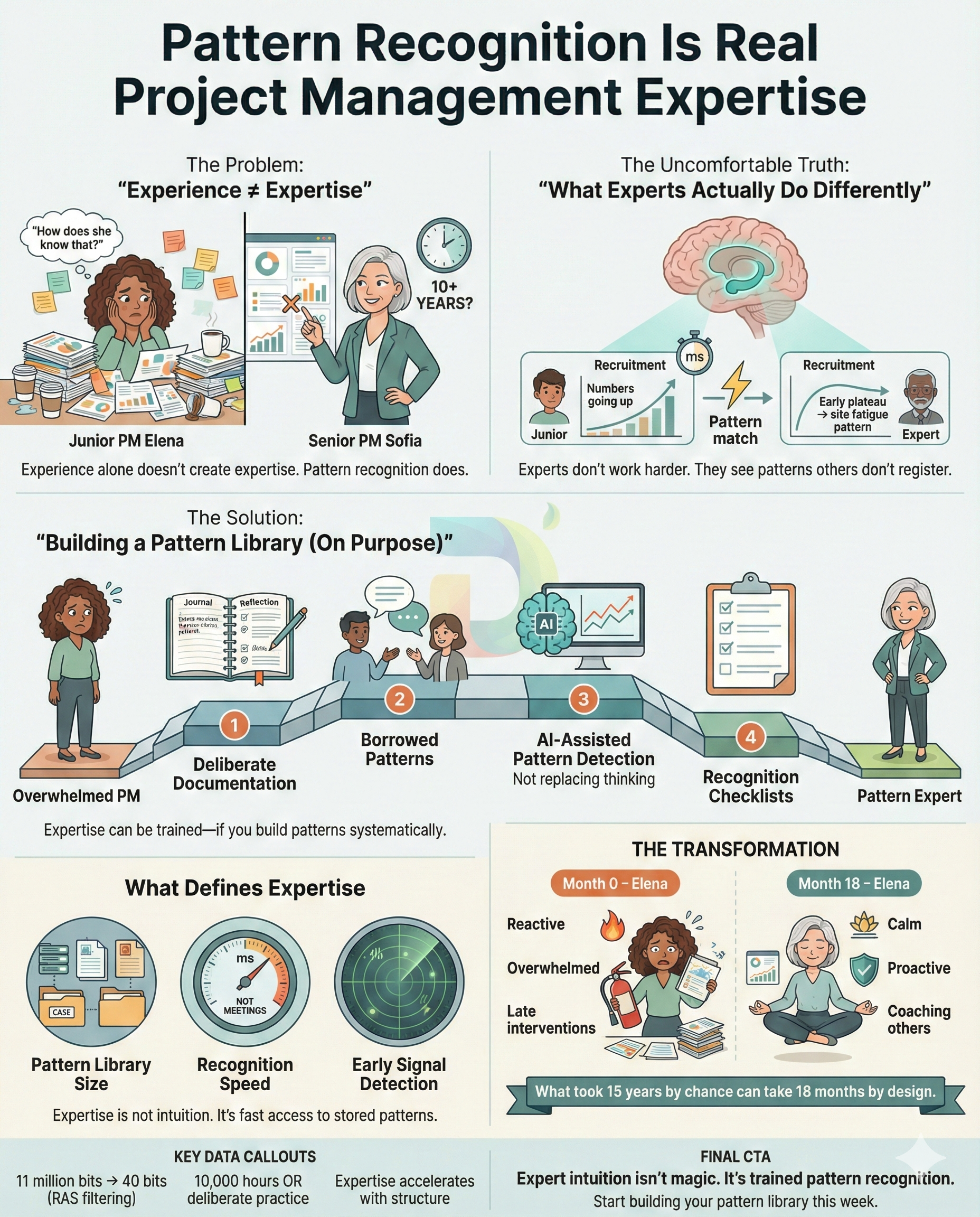
The Four-Step Pattern Recognition Protocol
Having worked on both the pharma side and the CRO side, I can see what junior PMs are missing and how transformative this context becomes when you build your pattern library deliberately.
Elena, a junior PM at a mid-sized CRO, was frustrated. Her director, Sofia, would glance at a status report and say "Site 23 needs attention" before Elena even saw a problem. How was Sofia doing this? Sofia wasn't psychic. After 15 years managing oncology trials, her brain had stored thousands of site performance patterns. Sofia's pattern library included specific templates like "sites that front-load recruitment then plateau typically have enrolment criteria confusion" and "sites with response times jumping from under three days to over seven days are experiencing PI turnover or internal resource challenges."
Elena asked Sofia to teach her. What happened next demonstrates exactly how deliberate pattern library building works.
Here's the systematic approach that compressed Sofia's 15 years into Elena's 18 months.
Whatever it is, the way you tell your story online can make all the difference.
Step 1: Capture Patterns Deliberately After Every Significant Event
After every sponsor call, site issue, or project milestone, invest ten minutes in deliberate pattern capture. This isn't optional documentation; it's expertise building. Work through four specific questions that transform experience into reusable knowledge:
Record what happened with objective facts only. Not your interpretation, just observable events. For example, "Site recruitment dropped from 2 patients per week to 0.5 patients per week over three weeks" rather than "Site lost motivation." The facts are your foundation.
Ask yourself what pattern this matches. Have you seen this before? Does it remind you of another situation? Your brain is already making these connections unconsciously; now you're making them explicit. Perhaps you recognise this as the site fatigue pattern where initial enthusiasm fades once screening difficulty reality sets in.
Document what outcome followed. Did the site recover or continue declining? What intervention worked or failed? This outcome data makes your pattern library predictive rather than just descriptive.
Identify what signals appeared early, before the situation became obvious. This is the gold. What did you notice two weeks before recruitment dropped? Perhaps the site's response time to queries had slowed, or the coordinator mentioned difficulty with one particular inclusion criterion. These early signals become your predictive indicators for future projects.
Document all four elements every time. Your hippocampus stores these patterns automatically, but explicit documentation makes them searchable and shareable.
Step 2: Download Others' Pattern Libraries Into Yours
The fastest way to build expertise is extracting someone else's pattern library. Every experienced Project Manager or Project Director has spent years accumulating patterns you haven't encountered yet. Rather than waiting a decade to see these patterns yourself, actively extract them from colleagues:
Identify three people in your organisation or network who have expertise you want to develop. Schedule thirty-minute conversations specifically focused on pattern extraction.
Don't ask vague questions like "What makes you good at this?" Instead, use concrete scenarios. Describe a situation you're facing and ask, "What pattern are you seeing that I'm missing?" When they say something like "This site will struggle," push deeper with "What signals tell you that? What pattern matches this situation?"
Listen for the structure of their thinking. Expert PMs aren't psychic; they're pattern matching at unconscious speed. When you ask them to articulate their reasoning, they make their unconscious patterns conscious and transferable.
After each conversation, add their patterns to your library with attribution. "Site Performance Pattern from Sofia: Response time slowing plus increased protocol clarifications equals coordinator overwhelm, typically precedes recruitment decline." You've just compressed Sofia's five years of experience into a pattern you can apply tomorrow.
Step 3: Use AI to Accelerate Pattern Recognition Exponentially
Traditional expertise development requires encountering thousands of situations personally. You might need ten years to see enough patterns to develop expert-level recognition. AI changes this completely by showing you patterns in data that would take years to encounter naturally.
Feed your historical project data into AI for pattern analysis. Recruitment timelines, budget variance reports, site performance metrics across multiple studies. Ask it to identify what predicts success versus struggle. The AI processes thousands of data points instantly, surfacing patterns that would take you months of manual analysis to spot.
The key is that you're not outsourcing your thinking to AI; you're using it to expand your pattern exposure rapidly. When AI identifies a pattern like "sites in academic medical centres with over 200 competing studies show recruitment acceleration after month three, while community sites peak in month two then plateau," your brain learns this pattern just as if you'd observed it personally across twenty studies.
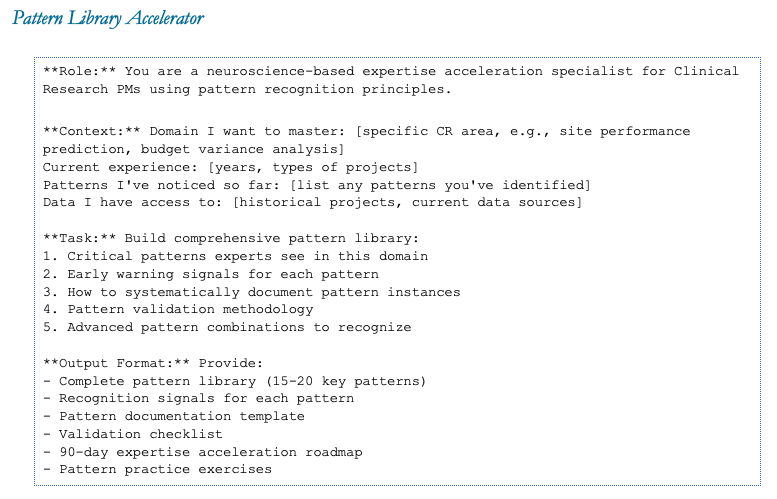
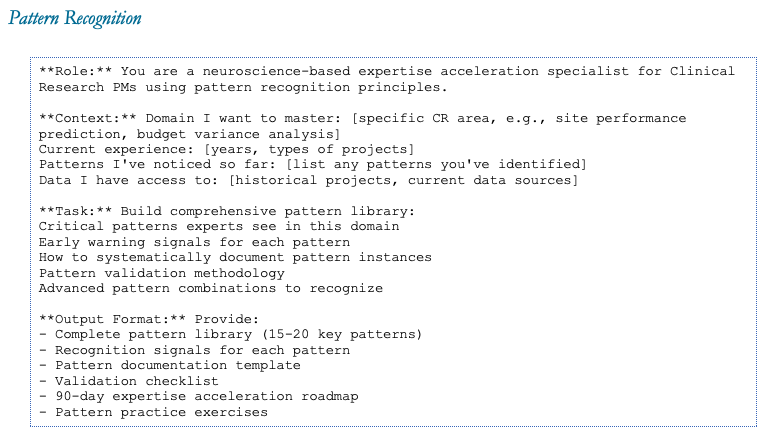
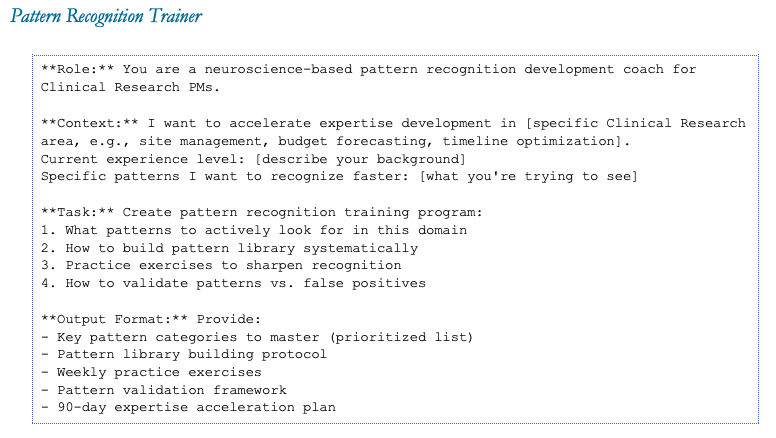
Check the AI-prompted samples below and validate AI-identified patterns against your own experience. Does this match what you've seen? Does it make logical sense given what you know about site dynamics? The best pattern library combines AI's computational power with your contextual understanding.
Step 4: Create Pattern Recognition Checklists That Make Expertise Systematic
Once you've identified reliable patterns, convert them into actionable checklists that make pattern recognition systematic rather than dependent on whether you happen to remember to look for specific signals:
Categorise your patterns into domains matching your daily work: site performance patterns, sponsor communication patterns, budget trajectory patterns, timeline risk patterns. Each checklist lives where you'll actually use it, integrated into your regular workflow.
For site performance patterns, document the combinations of indicators that predict different outcomes. For example: early enthusiasm transitioning to plateau at 60% of target equals site fatigue pattern; watch for coordinator expressing screening difficulty; typical intervention is protocol training refresher and recruitment strategy adjustment.
For sponsor communication patterns, track subtle shifts signalling changing dynamics. Sponsor response time slowing from 24 hours to over 72 hours suggests priority shift or internal pressure; warrants proactive check-in to confirm timeline expectations still aligned.
Build your checklists in stages. Start with your ten most reliable patterns, the ones you've seen repeatedly and can predict with confidence. Use these actively for one quarter. Add patterns as you validate them through repeated observation. Your checklist becomes a living document representing your evolving expertise.
The transformation happens when checking against patterns becomes automatic. You're reviewing a recruitment graph and your brain automatically scans for the plateau pattern, the spike pattern, the steady decline pattern. What started as conscious checklist reference becomes unconscious expert recognition.
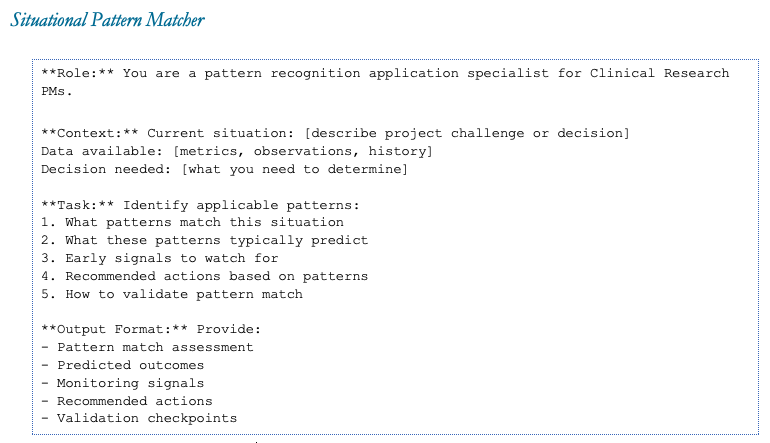
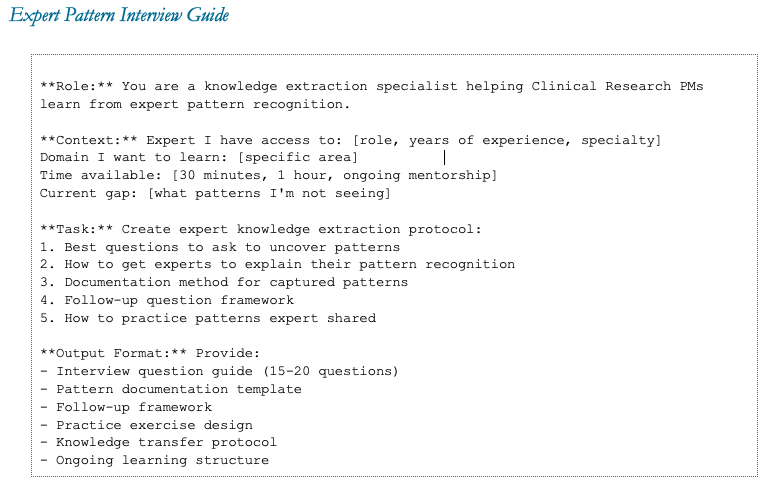
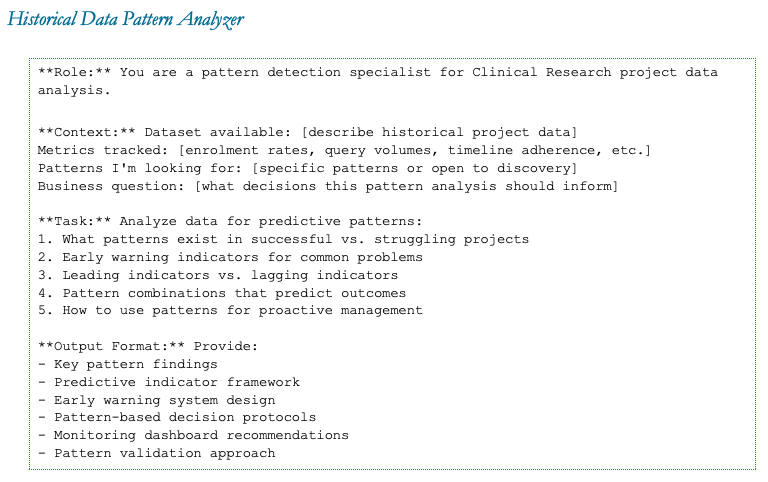
What 18 Months of Deliberate Pattern Building Produces
Elena started documenting every pattern Sofia shared. She used the four-question framework after every significant event. She extracted patterns from three senior PMs through monthly conversations. She fed her historical data into AI for pattern identification she was missing.
Six months later, Elena was spotting patterns herself. Her brain had built the library. One year later, she was training other junior PMs on pattern recognition. What took Sofia 15 years, Elena learned in 18 months through deliberate pattern library building combined with AI acceleration.
Your Implementation Starting This Week
Begin by documenting patterns after every significant interaction. When a sponsor call ends, take two minutes to note not just the specific decisions made but the pattern underlying their concerns. When a site activation goes smoothly or poorly, capture the pattern of contributing factors, not just the outcome.
Ask one experienced PM or Project Director a simple question: "What pattern are you seeing that I might be missing?" Senior professionals spot patterns invisibly to those still building expertise. Making their pattern recognition explicit through this question accelerates your learning dramatically.
Use AI to analyse one dataset for patterns you might be missing. Perhaps you have recruitment data across multiple sites but haven't spotted the geographic pattern affecting enrolment. The patterns AI surfaces become part of your recognition library.
This month, build a formal pattern recognition checklist specific to your project type. What patterns consistently predict recruitment success? What patterns signal brewing site relationship problems? Document fifteen to twenty patterns you've observed or learned about, with specific examples of what to look for.
After six months of deliberate pattern documentation and learning, you'll notice yourself spotting signals colleagues miss entirely. The difference isn't that you're smarter or more experienced. You've simply built a richer pattern library that your brain can match against new situations.
Senior PMs who appear to have exceptional intuition aren't operating on mystical insight. They have decades of pattern recognition training, much of it accumulated unconsciously. You're building the same library deliberately and systematically, compressing years of passive learning into months of focused pattern development.
Expertise isn't mysterious magic. It's stored patterns your brain matches automatically against new situations. Build your library deliberately rather than hoping experience accumulates patterns accidentally. This systematic approach to pattern recognition development is exactly what we work on in my brain-based coaching for clinical research project management professionals, where we combine neuroscience principles with practical application to accelerate your expertise development far beyond what traditional experience alone provides.
Junior professionals often feel intimidated by experts who seem to instantly grasp complex situations. What appears as magical insight is actually rapid automatic pattern matching against a rich library built through deliberate experience. You can build the same library. Every pattern you document, every pattern you learn from senior colleagues, every pattern AI helps you identify in data—these additions to your library compound into the expertise that distinguishes exceptional PMs from adequate ones.
Start this week. Document one pattern. Ask one question. Run one AI analysis. Your pattern library begins building today.
How This Connects to Everything Else Your Brain Does
Your Reticular Activating System filters eleven million bits of information bombarding your brain every second down to the forty bits you consciously process. What determines which patterns your RAS notices and which it filters out? Your existing pattern library. The patterns you've already learned and stored become exactly what your RAS prioritises showing you. This is why experienced PMs spot recruitment risk signals that junior PMs walk right past.
Pattern recognition operates as automatic, low-cognitive-load processing. When you're still learning to recognise a pattern, identifying it requires conscious effort and working memory capacity. But once a pattern is firmly established in your expertise library, recognition happens automatically without consuming working memory. Your brain simply matches the current situation against stored templates and signals "I've seen this before" without any conscious processing required. This is why experts can manage vastly more complexity than novices.
The habits you build often emerge from patterns you've recognised and decided to systematise. When you notice that post-call note capture consistently prevents forgotten commitments, that's pattern recognition. When you convert that pattern into an automatic habit triggered by hanging up from calls, you're transforming recognised pattern into automatic response.
𝑅𝑒𝑓𝑒𝑟𝑒𝑛𝑐𝑒𝑠: 𝑅𝑜𝑐𝑘, 𝐷. (2009). 𝑌𝑜𝑢𝑟 𝐵𝑟𝑎𝑖𝑛 𝑎𝑡 𝑊𝑜𝑟𝑘; 𝐸𝑟𝑖𝑐𝑠𝑠𝑜𝑛, 𝐴. (2016). 𝑃𝑒𝑎𝑘: 𝑆𝑒𝑐𝑟𝑒𝑡𝑠 𝑓𝑟𝑜𝑚 𝑡ℎ𝑒 𝑁𝑒𝑤 𝑆𝑐𝑖𝑒𝑛𝑐𝑒 𝑜𝑓 𝐸𝑥𝑝𝑒𝑟𝑡𝑖𝑠𝑒; 𝐾𝑎ℎ𝑛𝑒𝑚𝑎𝑛, 𝐷. (2011). 𝑇ℎ𝑖𝑛𝑘𝑖𝑛𝑔, 𝐹𝑎𝑠𝑡 𝑎𝑛𝑑 𝑆𝑙𝑜𝑤
