
The "Work Smarter" Myth Cracked (6/18): Attention Residue
The Invisible Drain on Your Cognitive Capacity
That "busy but unproductive" feeling isn't a productivity problem. It's a neuroscience problem.
When you switch from Task A to Task B, part of your attention remains stuck on Task A. This lingering cognitive focus is called "attention residue." Your brain doesn't fully let go of the previous task, even when you're consciously trying to focus on the new one.
Research by Professor Sophie Leroy shows that attention residue is particularly strong when the previous task was unfinished, the previous task was interrupted, the previous task had high stakes or emotional content, and when you switched tasks quickly without closure.
Now imagine you switch tasks 50 times per day. Most PM/PDs do. You're operating with fragmented attention all day. You're never fully present on any single task. Each task gets 60% of your cognitive capacity at best, with 40% still processing the previous task. You feel mentally drained but haven't completed anything meaningful.
This isn't because you're lazy or inefficient. It's because every task switch costs 20-40% of your cognitive capacity for the next 20 minutes. The work is invisible, but the energy drain is real. It's neuroscience. Your prefrontal cortex literally cannot switch instantly. The residue lingers for 10-30 minutes depending on task complexity.
Why This Matters for Clinical Research Project Managers
The attention residue particularly devastates project management leaders. Your role demands constant context-switching: sponsor calls require strategic thinking, project management needs operational precision, team coordination demands interpersonal awareness, and regulatory compliance requires meticulous attention to detail.
Each switch between these cognitive modes creates substantial attention residue because the mental frameworks are so different. Moving from a budget spreadsheet (analytical thinking) to a sponsor relationship challenge (emotional intelligence and strategy) to a protocol deviation investigation (compliance mindset) fragments your capacity across incompatible mental models.
The consequence? You respond to your sponsor's strategic question with 60% cognitive capacity because you're carrying residue from three email switches. You review a critical safety report while mentally replaying the budget discussion. You plan study enrolment strategy whilst part of your brain is still processing that team conflict from the morning call.
The Six-Step Protocol to Eliminate Attention Residue
Step 1: Measure Your Current Task-Switching Frequency
Spend one full day tracking every time you switch tasks. Not just major transitions, but every interruption: email notifications that pull your attention, quick questions from team members, checking Teams whilst writing a report, reviewing a document whilst on a call. Each switch counts.
Track both external interruptions (things that happen to you) and internal interruptions (times you choose to switch). Most overwhelmed PMs discover they're switching tasks 40 to 60 times per day. Each switch leaves attention residue—part of your cognitive capacity remains stuck on the previous task even as you try to focus on the new one.
Step 2: Calculate Your Attention Fragmentation Cost
Review your tracking data and calculate how much time you actually spent in uninterrupted focus. For most PMs, continuous focus periods are shockingly short: often just 10 to 15 minutes between interruptions. Now multiply the number of switches by 20 minutes of residual attention fragmentation. If you switched 50 times, that's 1,000 minutes (16+ hours) of cognitive capacity lost to attention residue in a single day.
This isn't theoretical. That foggy feeling of "I'm busy all day but accomplishing nothing"? It's attention residue. Your brain is spending more energy managing task transitions than doing actual work. You're experiencing the exhaustion of constant cognitive switching without the satisfaction of completed deep work.
Step 3: Create Protected Focus Blocks
Redesign your calendar to include protected focus blocks where task-switching is prohibited. Start with one 90-minute block per day where you:
Close email completely (not minimised—closed)
Turn off all notifications (Teams, phone)
Put a "do not disturb" indicator where teammates can see it
Work on exactly one cognitively demanding task
This feels uncomfortable at first. Your brain will protest. You'll feel the urge to "just quickly check" email. Resist. Your attention needs time to fully engage with complex work. After about 20 minutes of protected focus, attention residue from previous tasks clears and you enter genuine cognitive engagement.
The first time you experience 90 minutes of uninterrupted deep work, the productivity difference is shocking. You'll accomplish more in that single block than in four hours of fragmented time.
Step 4: Batch Similar Tasks
Your highest-value work (strategic thinking, sponsor relationship building, complex problem-solving) suffers most from attention residue. If you switch in and out of this work, you never reach full cognitive capacity. Once you start strategic work, stay there for a minimum of 90 minutes. No exceptions.
This 90-minute window aligns with your brain's natural ultradian rhythms—the cycles that govern your capacity for sustained focus. Switching in and out of deep work before completing a full ultradian cycle fragments your focus and prevents you from ever reaching your brain's peak performance state.
Task-switching costs escalate when you switch between different types of cognitive work. Moving from email to strategic planning creates more attention residue than moving from one email to another email. Batch similar tasks together to minimise the cognitive cost of transitions.
Create dedicated time blocks for similar work:
Email processing block: Handle 20 emails in sequence
Call block: Multiple calls back-to-back
Document review block: Review all pending documents together
When your brain stays in one cognitive mode, attention residue between tasks within that mode is minimal.
But what if there's an urgent sponsor request? Genuine emergencies are rare. Responding to your sponsor's strategic question with 60% cognitive capacity because you're carrying residue from three email switches is worse than responding two hours later with 100% capacity.
The transformation comes from seeing that 30 minutes of batched email processing clears your inbox faster and more effectively than 30 minutes of email scattered throughout the day between other tasks.
Step 5: Implement Transition Protocols
You can't eliminate all task-switching, but you can minimise attention residue by implementing conscious transition protocols between major tasks. Before switching from one significant task to another, take five minutes to:
Write down where you stopped and what comes next (clears the incomplete loop from working memory)
Clear your desk and screen (removes visual triggers of the previous task)
Take a brief physical break (movement helps cognitive reset)
Set clear intention for the next task (primes focus rather than carrying forward residual attention)
This five-minute investment prevents the 20+ minutes of attention residue that would otherwise fragment your focus on the next task. The time investment pays immediate dividends in focus quality.
Step 6: Design Your Weekly Focus Architecture
Step back and design a weekly structure that minimises attention fragmentation. Perhaps Monday is "deep work day" with three 90-minute focus blocks and minimal meetings. Tuesday is "stakeholder day" for all external communications and meetings. Wednesday splits between deep work morning and collaborative afternoon. Thursday is execution day for routine but important work. Friday handles administrative tasks and week review.
The principle is to batch similar cognitive demands at the day level, not just the hour level. When you know Monday is for deep strategic work, your brain can prepare for sustained focus. When Thursday is routine execution day, you don't create attention residue by mixing it with strategic thinking.
AI Applications for Managing Attention Residue
Generative AI can help you design and maintain attention residue-free systems. Here are specific prompts for different scenarios:
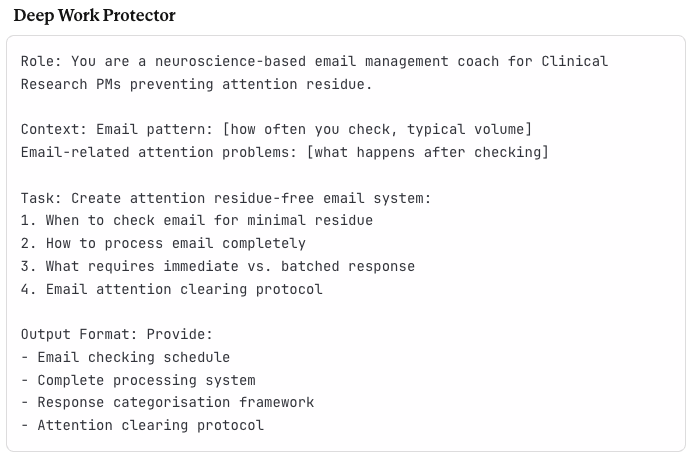
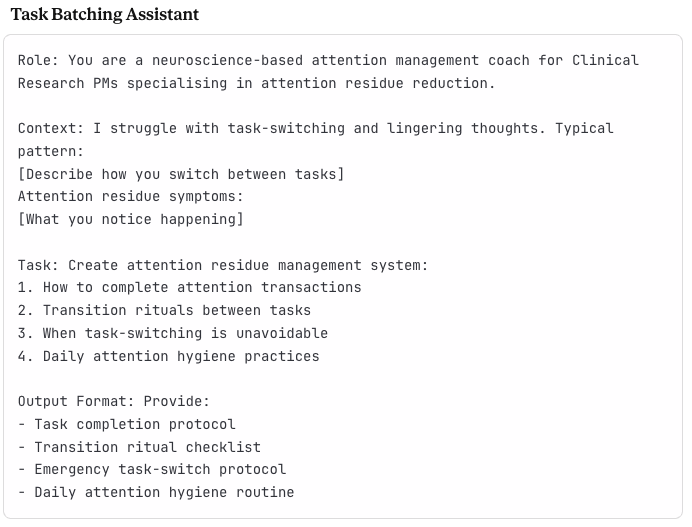
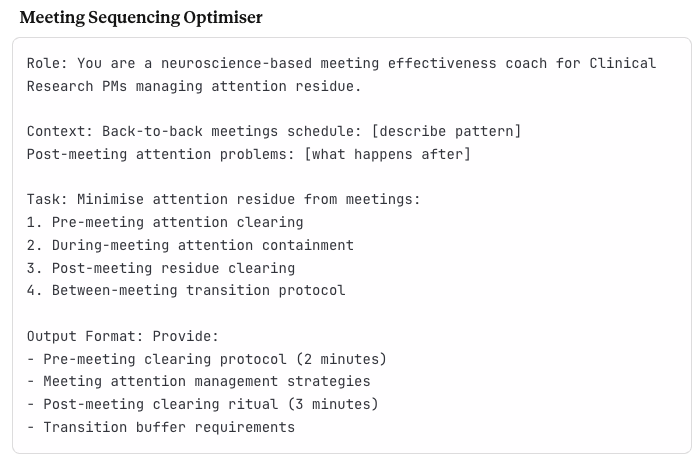
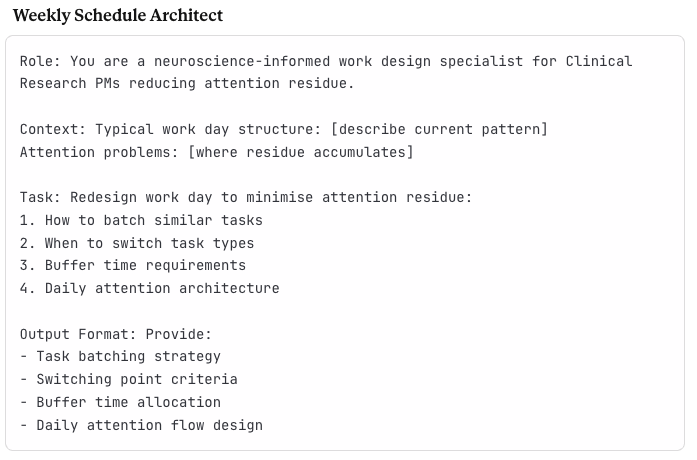
Real Transformation: Jennifer's Story
Jennifer was a Senior PM managing a complex global oncology study. She described herself as "busy every minute but never finishing anything meaningful."
Her typical morning revealed the attention residue crisis in action. She'd start writing a sponsor update report, make some progress, then get pulled away by an email notification about a site question. When she returned to the report, she had to re-read what she'd written just to remember her train of thought. A team member would stop by with a "quick question." Back to the report—except now she'd lost her strategic direction entirely. A calendar reminder would ping for an upcoming sponsor call, and she'd scramble to prepare. After the call, she'd immediately jump to email to address items mentioned, then transition to a scheduled site call. She'd try returning to that morning's report, but couldn't remember where she was heading with it. Eventually she'd give up and handle an "urgent" budget question instead. Lunch happened at her desk whilst reading more emails.
By 2pm, Jennifer felt mentally destroyed despite accomplishing very little of substance.
The attention residue audit revealed:
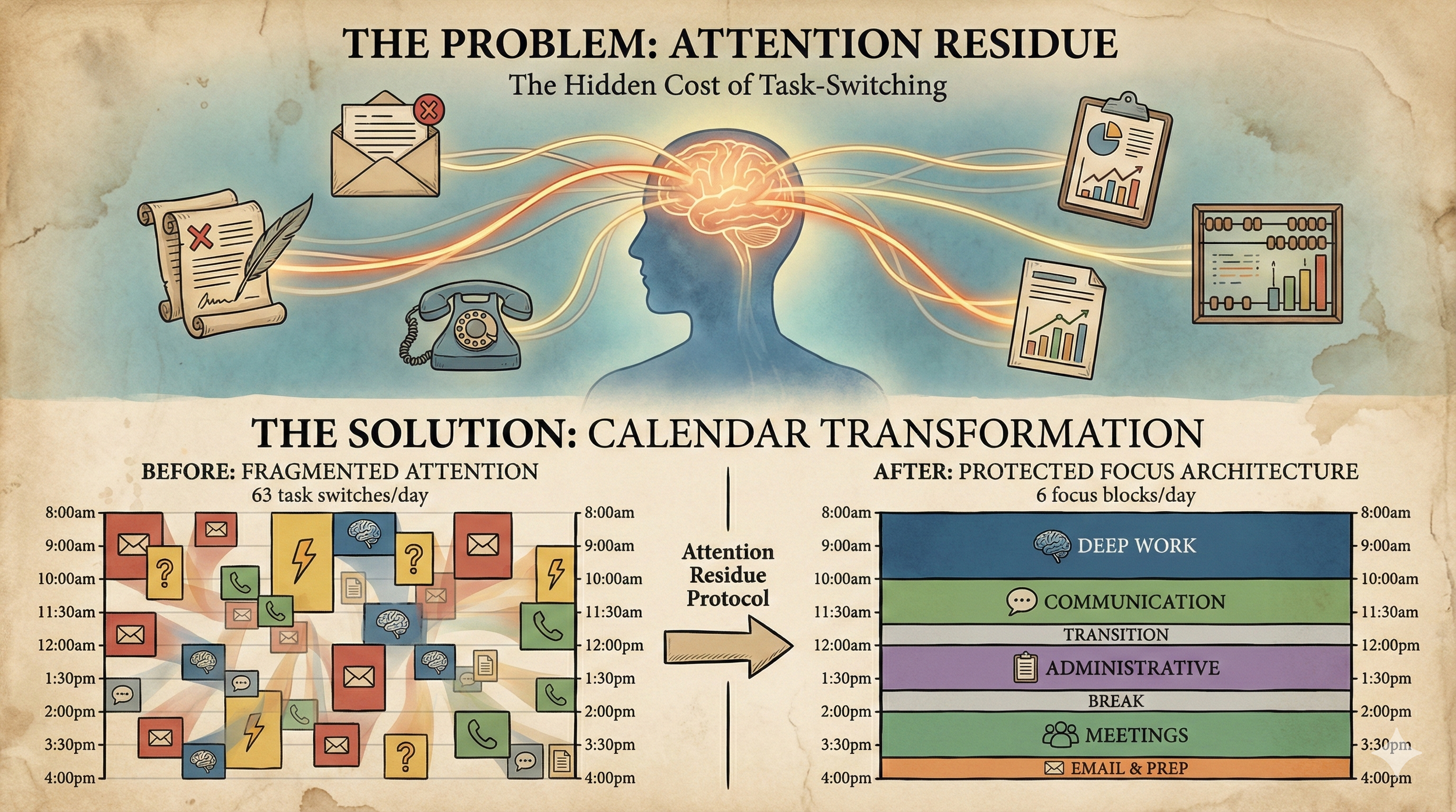
63 task switches in one day
Zero tasks completed without interruption
Strategic report (her highest-value deliverable) attempted in 4 fragmented sessions totalling 73 minutes but probably requiring 45 uninterrupted minutes
Estimated cognitive capacity on any given task: 40-50%
The Protocol Transformation
Week 1: Jennifer blocked her calendar for task batches:
8:00-10:00am: Strategic work only (reports, planning, analysis) - no email, no phone, door closed
10:00-11:30am: All communication (calls, emails, Teams)
11:30am-12:00pm: Transition/break
12:00-1:30pm: Administrative batch (updates, systems, filing)
1:30-2:00pm: Lunch and movement
2:00-3:30pm: Second communication batch or team meetings
3:30-4:00pm: Email responses and next-day preparation
Week 2 resistance: Team complained she was "unavailable." Jennifer held firm: "I'm available during communication windows. For emergencies, call my mobile. For everything else, batch your questions for our designated times."
Week 3-4 results:
Strategic report that previously took 6 fragmented hours completed in 90 focused minutes
Quality dramatically improved (sponsor specifically complimented the depth of analysis)
Team learnt to batch questions, which actually improved their thinking too
Jennifer's energy at end of day shifted from "demolished" to "pleasantly tired"
Three months later: Jennifer was promoted to Project Director. Her director's feedback: "Your strategic thinking has become exceptional. You're spotting patterns and proposing solutions that weren't visible before."
What changed? Not Jennifer's intelligence or experience. Her cognitive capacity was simply available for strategic thinking instead of being fragmented across 63 daily task switches.
Quick Wins You Can Implement Today
Today: Create one 90-minute protected focus block for tomorrow. Block it in your calendar, mark it "Do Not Disturb," close email before it starts, and turn off all notifications. Work on exactly one cognitively demanding task. Just one block will demonstrate the power of attention without residue.
This Week: Track task-switching for one full day. Count every interruption and transition. The number will shock you. Then create three protected focus blocks this week. Also batch one category of work—perhaps all email processing happens twice daily in dedicated 30-minute blocks instead of continuous checking.
This Month: Redesign your weekly architecture to minimise attention fragmentation. Create focus days with multiple protected blocks, stakeholder days for external interactions, and execution days for routine work. Implement transition protocols between major tasks. Train your team to respect focus blocks and use asynchronous communication for non-urgent needs.
Long-term Integration: Working without attention residue becomes your normal state. You forget what it felt like to constantly operate with fragmented attention across multiple incomplete tasks. The foggy "busy but unproductive" sensation disappears. Instead, you regularly experience the clarity of complete cognitive engagement with important work.
Your strategic thinking improves not because you're smarter, but because your full cognitive capacity is available for complex analysis instead of being fragmented across 40 different task transitions. By appearing "less available," you become more valuable. Your strategic output multiplies when your attention is whole, not fragmented.
How This Connects to the Bigger Picture
Attention residue directly amplifies cognitive load because task-switching fills your working memory with incomplete task fragments. When you're holding pieces of five different tasks in working memory simultaneously, you have no capacity left for strategic thinking.
Your brain's natural ultradian rhythms affect attention residue severity. Task-switching during recovery phases creates more residue than switching during peak capacity phases. Habit formation reduces attention residue because automated behaviours require minimal attention. When your morning routine is habitual, transitioning through those activities creates almost no residue.
Visible progress helps clear attention residue. Completing one task fully before switching reduces the cognitive pull of incomplete work. And flow state—that experience of complete absorption in challenging work—requires the extended focus periods that only happen when attention residue is eliminated. You cannot enter flow with fragmented attention.
Every cognitive strategy that depends on sustained capacity requires managing attention residue first. This is exactly what we work on in my brain-based coaching for clinical research project management professionals—understanding how your brain actually works so you can work with it, not against it.
Managing attention residue isn't about working harder. It's about working with how your brain actually functions. When you eliminate the invisible drain of task-switching, your strategic capacity isn't just preserved—it multiplies.
Reference: Leroy, S. (2009). Why is it so hard to do my work? The challenge of attention residue when switching between work tasks. Organizational Behavior and Human Decision Processes, 109(2), 168-181.
