
The "Work Smarter" Myth Cracked (10/18): Motivation
You wake up Monday dreading the week ahead. Not because the work is too difficult—you're technically excellent. But because your motivation feels completely dependent on external circumstances: Sponsor pressure, deadline panic, crisis management.
When external pressure is high, you perform well. When it's not, you coast. This isn't sustainable, and it's not how strategic PMs operate.
Let me start with what nobody tells you about motivation: it's not a personality trait you either possess or lack. It's a neurological state influenced by predictable brain chemistry, particularly dopamine—the neurotransmitter that drives goal-directed behaviour.
Understanding how motivation works at the neural level transforms it from something you hope to feel into something you can deliberately engineer.
The Clinical Research Motivation Challenge
Your brain's motivation system operates on two parallel tracks: the reward prediction system (driven by dopamine) and the meaning-making system (driven by intrinsic values alignment). Clinical Research Project Managers face a unique motivational challenge because the work involves:
Long timelines between meaningful milestones. Studies take years, not days. Your brain's reward system is designed for more frequent feedback loops.
Invisible successes. Your greatest achievements are preventing problems that never happen. Crisis averted isn't celebrated like crisis resolved.
Constant external pressure. Sponsor demands, regulatory requirements, site issues create a reactive environment where you're always responding rather than proactively creating.
High cognitive load that depletes motivational resources. Decision fatigue and cognitive overload literally reduce your brain's capacity to generate motivation.
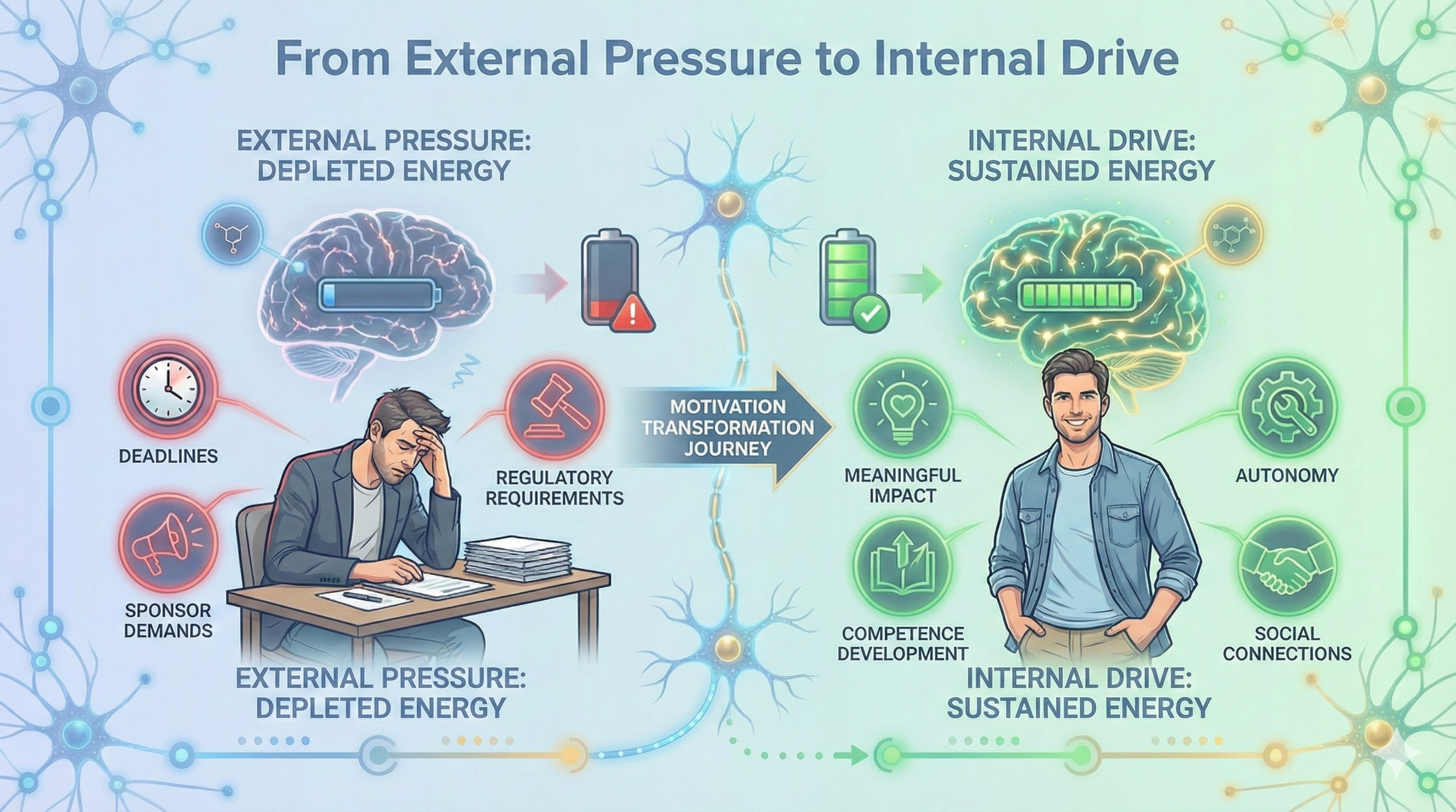
Most PMs rely entirely on external motivation: Sponsor feedback, fear of failure, deadline pressure. This creates a motivation rollercoaster—high energy when external pressure is intense, complete depletion when it's not.
Sustainable high performance requires shifting to intrinsic motivation that your brain can generate internally, independent of external circumstances.
The Neuroscience of Sustainable Motivation
Michael was burned out after fifteen years in Clinical Research. Technically excellent but dreading Mondays, feeling like "just a vendor executing tasks." Motivation came only from deadline panic.
Then he implemented the systematic motivation protocol based on decades of research by psychologists Edward Deci and Richard Ryan, who confirmed that sustainable motivation requires three psychological needs: autonomy (feeling choice and control), competence (experiencing mastery and progress), and relatedness (meaningful connections with others).
The protocol systematically activates all three, plus the fourth element research shows is crucial: meaning (connection to purpose larger than yourself).
The Motivation Engineering Protocol
Here's exactly what transformed Michael's relationship with his work:
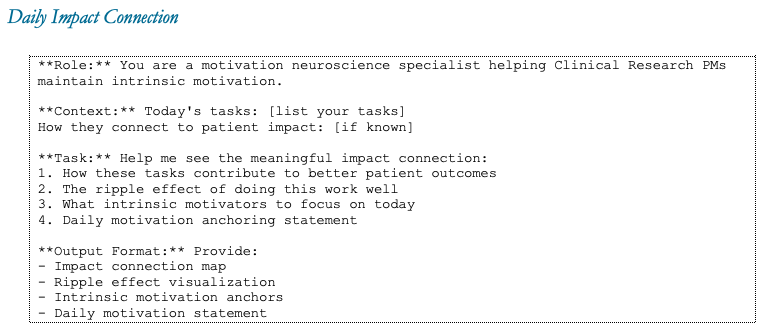
Step 1: Connect Daily Work to Meaningful Impact
Your brain's motivation system needs to see the connection between today's actions and meaningful outcomes. Without this connection, dopamine doesn't release and motivation fades.
Every week before finishing up work, complete this reflection:
This week's work contributes to: [specific patient population]
The compound in development could: [specific medical outcome]
My role specifically enables: [how your PM work accelerates this]
Example: "This week I'm managing site activation for the paediatric oncology programme. The compound targets a specific mutation affecting 300 children annually with currently no treatment options. My work getting sites activated two weeks early means we could complete enrolment before summer, potentially bringing this to market six months sooner. That's meaningful."
Not abstract purpose-speak. Concrete impact your work creates.
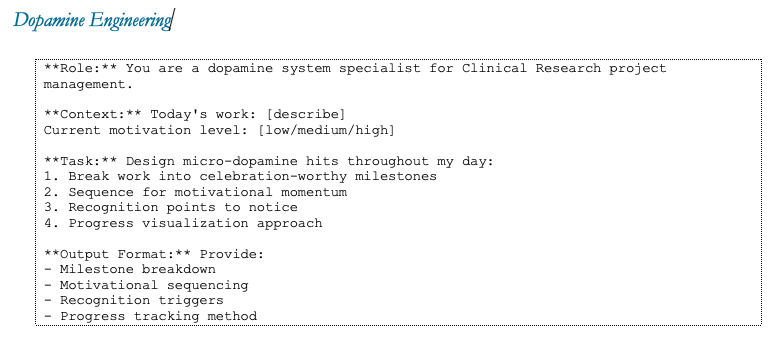
Step 2: Engineer Micro-Dopamine Hits
Waiting for study completion for dopamine release doesn't work neurologically. Your brain needs frequent, small rewards to maintain motivation.
Create a 'Wins Tracker' with three categories:
Problem Prevented: What crisis didn't happen because of your proactive work?
Strategic Value Added: What did you do that elevated the Sponsor relationship?
System Improved: What process did you make more efficient?
Every day, document one win in each category before leaving work. This deliberate attention triggers dopamine release and trains your RAS to notice future wins automatically.
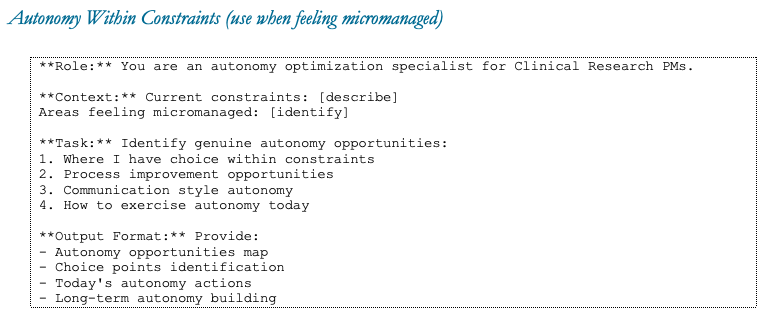
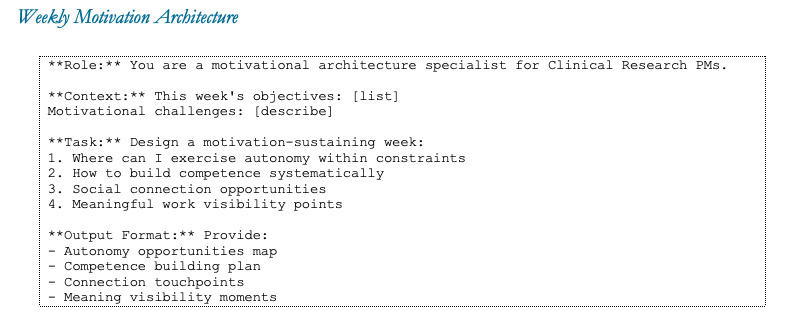
Step 3: Create Autonomy Within Constraints
Perceived autonomy is one of the strongest intrinsic motivators. Clinical Research work is heavily constrained by regulations, Sponsor requirements, and protocols, but strategic autonomy still exists.
Identify three areas where you have choice:
How you structure your day (even with fixed meetings, you control sequence and focus blocks)
How you communicate with stakeholders (templates, frequency, level of strategic insight)
Which problems you solve proactively versus reactively
Document your autonomous choices: "I decided to handle Sponsor updates this way because..." This reinforces agency and boosts intrinsic motivation.
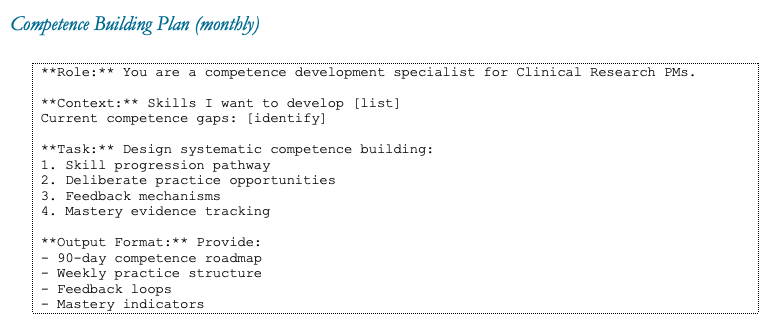
Step 4: Build Competence Systematically
Your brain releases dopamine when you're making progress on challenging but achievable goals. This is the neuroscience behind 'flow state' and explains why expertise development is inherently motivating.
Select one skill to develop each month:
Strategic Sponsor communication (practice reframing updates to highlight strategic value)
Predictive problem-solving (build your pattern library)
Efficient decision-making (implement decision trees)
Weekly, dedicate 30 minutes to deliberate practice of your current focus skill. Track improvement quantitatively: "This month I reduced Sponsor escalations from 5 to 2 by catching issues earlier."
Visible competence growth activates intrinsic motivation because your brain has concrete evidence you're becoming more expert, not just accumulating more years.
Step 5: Protect Motivational Energy Like a Resource
Motivation is finite. It depletes through the day like willpower and decision-making capacity. Strategic PMs protect it ruthlessly.
Energy allocation strategy:
Morning (high motivation): Strategic work, important decisions, proactive problem-solving
Midday (moderate motivation): Stakeholder communication, team coordination, planning
Afternoon (low motivation): Administrative tasks, email, routine updates
Never schedule strategic decisions or difficult conversations in the afternoon when motivational resources are depleted.
Step 6: Use Social Connection as Motivational Fuel
Humans are social species. Our motivational systems respond powerfully to connection, recognition, and shared purpose.
Weekly, engage in:
Peer Learning: 30-minute call with another PM to share challenges and solutions
Recognition Sharing: Acknowledge a colleague's good work (activates reward circuits in both brains)
Mentoring: Help a junior PM solve a problem (reinforces your own competence and meaning)
Social connection isn't networking. It's deliberately activating the relatedness component of intrinsic motivation.
The Transformation
Michael's transformation was measurable. Within 30 days of implementing the protocol, he connected his daily work to patient impact, realising his vendor management decisions could accelerate programme timelines by two months.
He started documenting daily wins systematically:
Week 1: "Prevented budget crisis by catching cost overrun in vendor contract review."
Week 2: "Added strategic value by providing Sponsor with competitive intelligence from vendor discussions."
Week 3: "Improved system by creating vendor evaluation template that cut assessment time from 8 hours to 3 hours."
By week 4, he identified his autonomy zones and documented his choices: "I decided to restructure weekly vendor calls to focus on strategic updates first when energy is highest, then tactical issues."
He selected 'strategic communication' as his skill development focus and practised reframing operational updates to highlight strategic value.
After 90 days, Michael wakes up Monday engaged rather than dreading the week. His Sponsor feedback shifted from "reliable executor" to "strategic partner who consistently adds value beyond requirements." He was recommended for Project Director role without increasing his working hours—simply by experiencing his current work through a motivated lens.
Why This Protocol Works: The Integration Effect
The protocol worked because it systematically activated all four intrinsic motivation factors: meaning (patient impact connection), autonomy (choice documentation), competence (skill development), and relatedness (peer engagement).
External motivation from deadlines and pressure remained the same, but Michael built internal motivation sources that sustained engagement independent of external circumstances.
Six months later, Michael's motivational resilience had become self-reinforcing. His RAS automatically noticed wins and progress. His decision-making improved because meaningful work felt less depleting. He naturally scheduled reflection work during cognitive peaks, making the practices sustainable rather than another task burden.
This motivation protocol amplifies every other strategy in this series:
RAS Programming becomes exponentially more powerful when filtering for progress, value creation, and meaningful impact rather than exclusively scanning for problems and threats.
The Progress Principle provides the neurochemical mechanism underlying motivation maintenance. Documenting micro-wins generates the frequent dopamine hits that signal your brain continued effort is worthwhile.
Decision Fatigue becomes less depleting when you're motivated by meaningful work. Research shows that work perceived as meaningful actually reduces the glucose depletion that typically accompanies decision-making.
Ultradian Rhythms interact with motivation by determining when you have energy available for the reflection work that sustains motivation. Timing your wins documentation and impact reflection during cognitive peaks ensures these practices actually happen consistently.
Pattern Recognition supports motivation by allowing you to see competence development objectively. As your pattern library grows, you notice yourself solving problems more efficiently—visible competence growth that activates intrinsic motivation.
AI-Enhanced Motivation Tracking
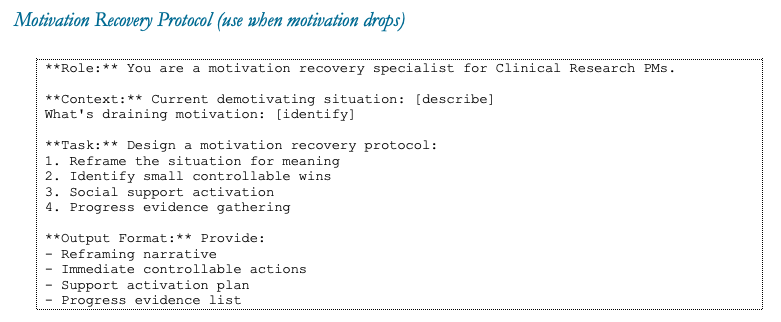
Use AI tools to systematise your motivation maintenance:
Create a motivation dashboard in NotebookLM or Claude Projects. Upload your weekly wins documentation and ask: "What patterns do you notice in my motivation triggers? What themes emerge in my most energising work?"
Build meaning connection prompts: Use Perplexity to research the patient populations and therapeutic areas you're working on. Understanding the broader medical context makes the impact connection more vivid and motivating.
Automate competence tracking: Use your project management tools to generate monthly reports showing: response times improved, issues caught proactively, Sponsor satisfaction ratings. Visible progress data feeds intrinsic motivation.
This systematic approach to motivation maintenance is exactly what we develop in brain-based coaching for Clinical research project management professionals—building sustainable drive systems that don't depend on external circumstances or deadline panic.
The Strategic Truth About Motivation
Maintaining motivation isn't about constant positivity or finding passion in everything. It's about systematically activating the neurological and psychological factors research confirms sustain human motivation: meaning, autonomy, competence, relatedness, and visible progress.
Clinical Research project management provides inherent meaningful impact, genuine autonomy domains, continuous competence development opportunities, and natural relationship building. These motivational resources exist already—the question is whether you're deliberately activating them or accidentally ignoring them while hoping external circumstances provide motivation instead.
The difference between PMs who burn out and those who thrive for decades isn't tolerance for pressure. It's whether they've built internal motivation systems that sustain engagement independent of external circumstances. Strategic PMs don't rely on Sponsor praise or deadline panic for drive. They engineer it systematically using the neuroscience of human motivation.
When motivation becomes something you create rather than something you hope to feel, every aspect of your performance improves. Not because you're working harder, but because you're working with your brain's natural reward systems rather than fighting against them.
In the next post, we'll explore Cognitive Load Theory—understanding how to manage the mental resources that enable both motivation and strategic thinking simultaneously without depleting either.
