
The "Work Smarter" Myth Cracked (9/18): Dopamine & Progress Principle
You're eight months into an eighteen-month study. Database Lock feels impossibly distant. Last Patient Last Visit is even further away. When colleagues ask "How's the project going?", you struggle to identify anything that feels like progress despite working intensively every day.
This is your brain on dopamine starvation.
Dopamine is your motivation molecule. It's released when you make progress toward goals, creating satisfaction and motivating continued effort. The key insight: progress, not completion.
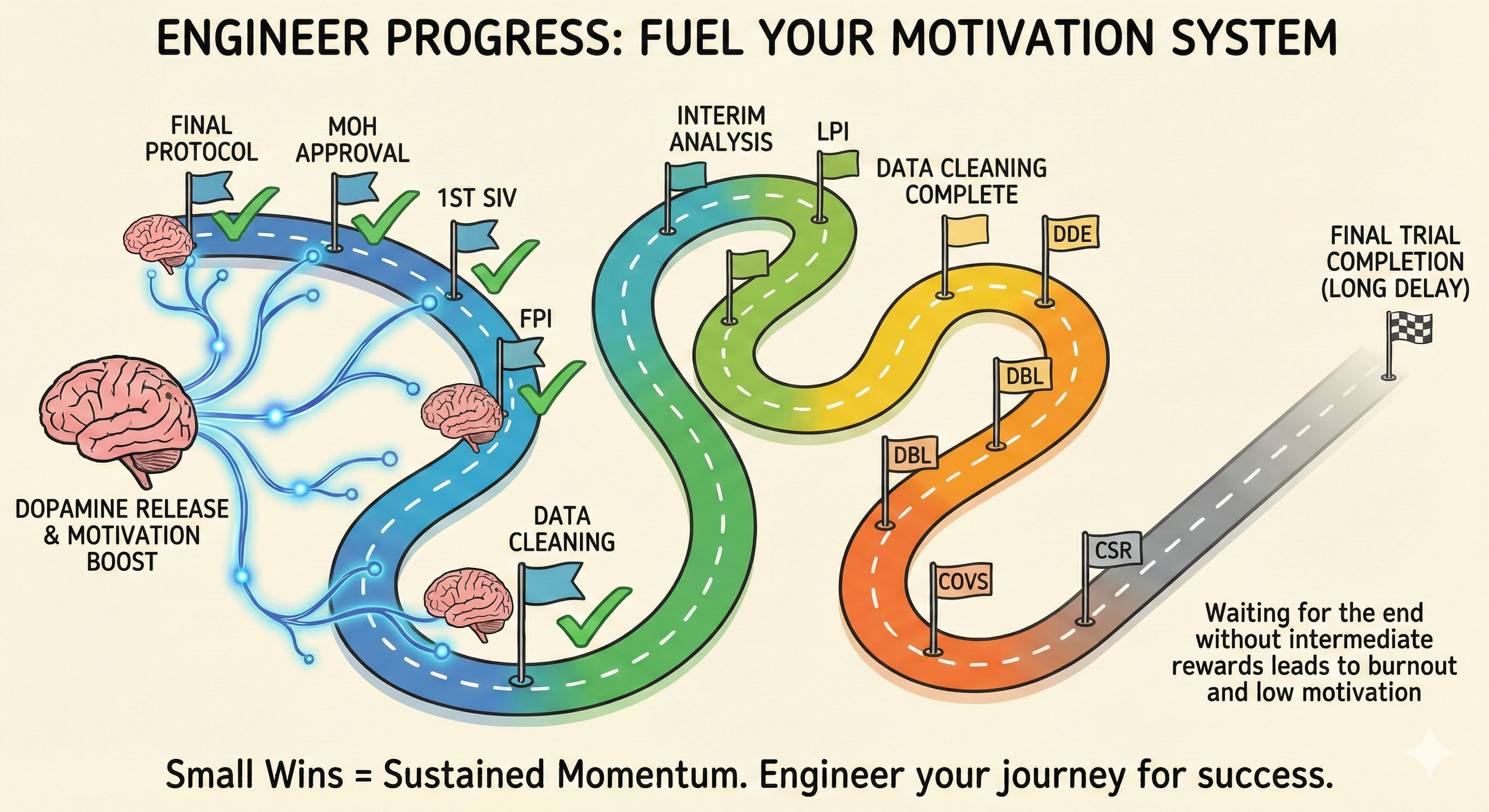
Teresa Amabile's research demonstrates that small, frequent wins trigger more sustained motivation than occasional big wins. Yet clinical research projects are structured around distant milestones that can be months apart. If you wait for "study complete" to feel accomplished, you'll burn out long before then.
The empowered PM's response isn't grinding harder through motivation deserts. It's deliberately engineering dopamine-worthy progress markers throughout your project lifecycle.
The Neuroscience of Motivation Collapse
Your dopamine system evolved to respond to progress signals. When early humans made progress toward finding food, shelter, or safety, dopamine rewarded that progress and motivated continued effort. This system still governs your modern motivation.
Clinical research projects violate every principle of healthy dopamine function. Consider the typical Phase II timeline: First Patient In to Database Lock might span eighteen months. Between these bookends, your brain receives precious few completion signals. Site activation might take four months with no clear progress markers. Patient enrolment happens gradually with daily frustrations but no distinct wins. Protocol amendments drag on for weeks without resolution.
Meanwhile, your dopamine system is scanning for progress signals and finding none. The result isn't laziness or lack of commitment. It's neurochemical reality: without progress signals, motivation depletes regardless of how important your work is intellectually.
This explains why you can feel completely exhausted despite "only" managing an ongoing project. Your brain interprets the lack of completion signals as evidence that your efforts aren't working. Dopamine drops. Energy follows. What started as an exciting study becomes an endless slog you can't wait to finish.
The Five-Step Dopamine Protocol
Step 1: Milestone Engineering
Transform massive deliverables into sequences of completable chunks that generate regular dopamine hits.
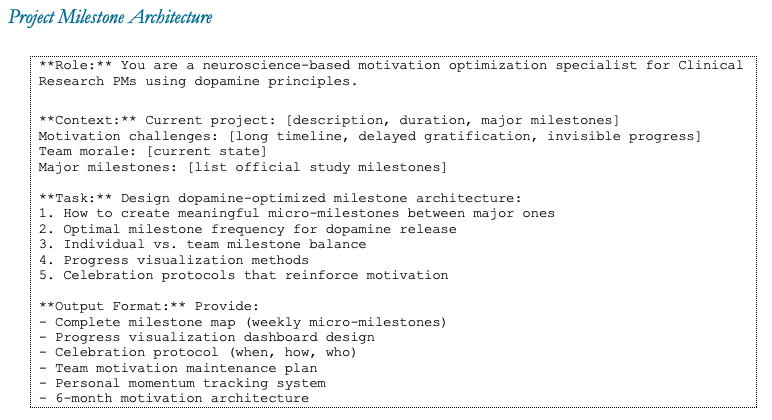
Instead of the daunting "Complete site activation" that might take months, create this milestone architecture:
Break massive deliverables into dopamine-worthy chunks
Celebrate incremental wins
Make progress visible
Use AI to generate "quick wins" that provide momentum
Take the examples below, when possible, to give you a sequence of daily wins, not just something "worked on”:
Budget planning breaks into daily chunks: day one complete vendor cost analysis, day two draft allocation model, day three review with finance, day four incorporate feedback, day five send to Sponsor.
Strategic planning becomes: day one gather intelligence, day two identify three priority opportunities, day three develop approach for first opportunity.
Step 2: Progress Visualisation
Your brain processes visual information faster and more powerfully than abstract concepts. Knowing you've completed twenty-seven of fifty site activations doesn't generate nearly the same dopamine response as seeing a progress bar that's 54% filled.
Create progress trackers you update immediately when completing something. Perhaps a simple spreadsheet with conditional formatting that turns cells green as milestones complete. Maybe a physical chart on your wall where you colour in sections. Some use project management software ( project management tools like Trello, Asana, ClickUp, or Monday.com) that generates automatic completion percentages. Or just use the good old Microsoft Project (MSP) Gantt chart.
Just know that deleting finished tasks from your list robs you of motivational fuel. When you delete completed items, they disappear, and your brain registers only what remains undone. Instead, maintain a visible archive of completed work. Move finished tasks to a "Done" column. Keep a "Wins This Week" running list that grows rather than resets.
Once a week, maybe before a Sponsor's call before leaving the office for the weekend,?, document your week's accomplishments in concrete terms. Not vague entries like "worked on sites," but specific completions: "Activated Sites 12 and 15, completed feasibility for Sites 18-22, resolved contract issues for Site 9, conducted three investigator calls."
This written record serves two purposes:
immediate dopamine hit as you acknowledge accomplishments, and
Monday morning resource to prime your brain for continued momentum.
Step 3: Use AI for Quick Wins
When motivation dips below sustainable levels, use AI to rapidly generate quick wins that restart your dopamine engine.
Spend ten minutes with AI identifying tasks you can complete today that will feel like tangible progress. AI might identify: "You mentioned needing to update the Sponsor on recruitment trajectory. You have all the data. This could be completed in 30 minutes and would constitute meaningful communication progress."
AI excels at breaking overwhelming work into manageable pieces because it's not experiencing your emotional resistance. You might avoid a complex budget analysis because it feels impossible. AI can chunk it: "Step one, gather last month's actuals, 10 minutes. Step two, compare to forecast, 15 minutes. Step three, identify top three variances, 10 minutes. Step four, draft brief explanation, 10 minutes. Total: 45 minutes, generates completed analysis."
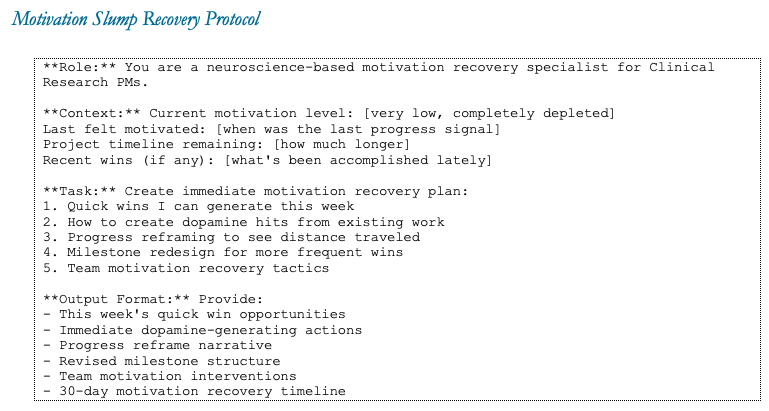
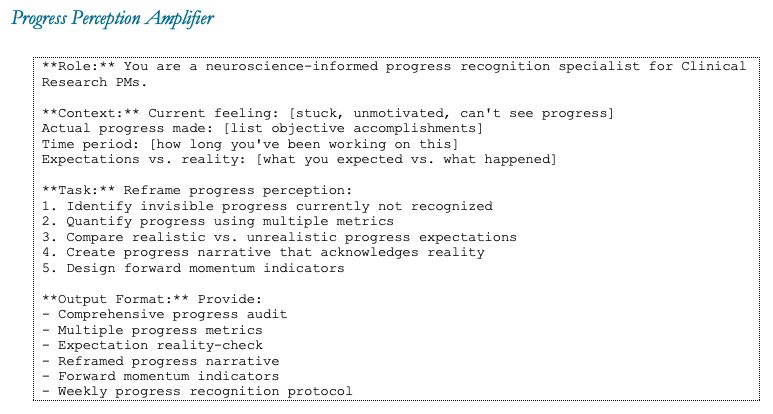
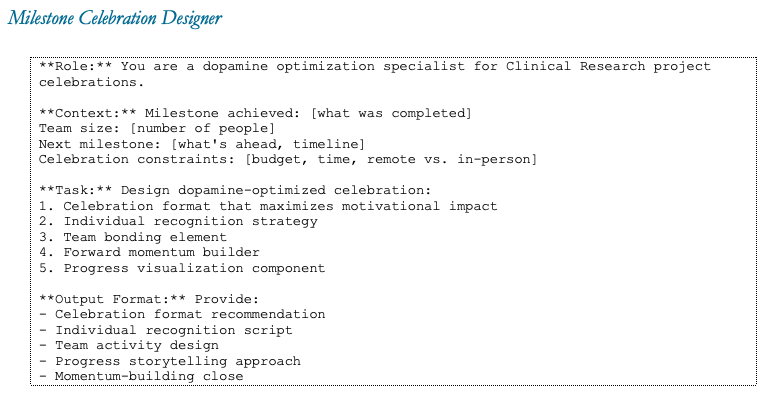
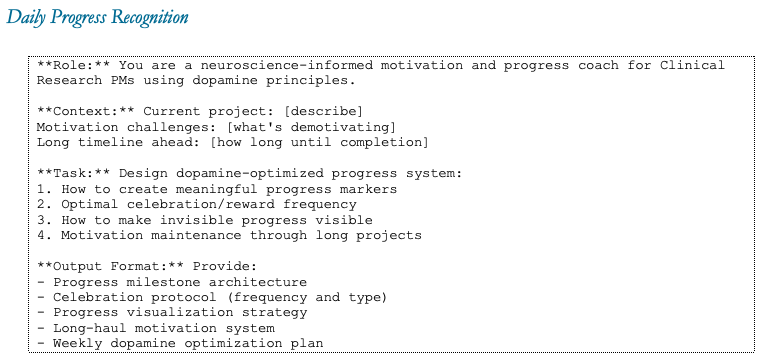
below you can see some EA prompt examples
Use AI to reframe invisible progress into visible accomplishment. You might feel like you accomplished nothing this week, but when you describe your week to AI and ask it to identify progress, it surfaces. Example cases:
For breaking down overwhelming tasks: "I'm avoiding this complex budget variance analysis because it feels overwhelming. I need to compare Q3 actuals vs forecast, identify major variances, and explain them to my Sponsor. Can you break this into 4-5 specific tasks, each taking 10-20 minutes?"
For identifying hidden progress: "I feel like I made no progress this week. Here's what I worked on: [describe your week]. Can you identify 5-6 specific accomplishments or progress markers I might be overlooking?"
For generating quick wins: "I'm feeling unmotivated and stuck. Here are the projects I'm managing: [list current work]. What are 3 tasks I could complete today in under an hour that would feel like meaningful progress?"
Step 4: Celebration Rituals
Western professional culture teaches us to immediately move to the next task after completing something. This systematically robs you of dopamine reinforcement and trains your brain that completion doesn't feel rewarding.
Implement celebration rituals that allow your brain to register wins. When you complete something meaningful, stand up from your desk. Do something different. Take two minutes to walk away from your workspace before starting the next task. These physical actions signal: "Something significant just happened." Update your visible progress tracker immediately, not later. The immediacy matters neurologically. Completing a task and seeing the progress bar fill creates direct connection between effort and reward. Tell someone about significant completions. Send your Project Director a message: "Just activated Site 23, we're now at 18 of 25 target sites." The social sharing amplifies dopamine response because humans value social recognition.
Let the dopamine register. Your brain needs this micro-pause to consolidate the win. Without it, completions blur into undifferentiated effort, and you lose the motivational benefit you just earned.
Step 5: Weekly Momentum Review
End every week with structured review designed to feed your brain's motivation system by making progress explicit and creating forward pull. Answer four specific questions:
What got completed this week? Be comprehensive and specific. Include smaller wins: problems prevented, relationships strengthened, systems improved, knowledge gained.
What moved forward measurably even if not complete? Progress isn't only finished items. Acknowledge forward movement: "Budget analysis 70% complete."
What obstacles were overcome? These count as wins: "Managed stress response during challenging Team call."
What progress continues next week? This creates forward momentum: "Site activation momentum continues with three more contracts in process."
Read this review Monday morning before checking email. You're priming your brain for progress by starting from "I'm someone who makes progress" rather than "I'm drowning in unfinished work."
AI Prompt Examples
Practical Implementation: Your Next Four Weeks
Michael re-engineered his deliverables into weekly progress markers. He started each day asking "What can I complete today that will feel like progress?" He ended each day documenting what got done, not just what remained.
One month later, Michael's energy was completely different. Same project, same distant Database Lock deadline. But his brain was getting daily dopamine hits from visible progress. Motivation restored.
You can also do it!
Identify one large task currently overwhelming you and break it into three dopamine-worthy chunks, each completable within one focused session. Complete the smallest chunk first to generate immediate dopamine.
Create a visible progress tracker for your main deliverable using whatever format works for your brain. Document three wins every Friday in a running log you'll maintain throughout the year.
Engineer a milestone structure for your entire current project phase. Break it into ten to fifteen significant checkpoints achievable within one to three weeks each.
Build a celebration ritual requiring exactly two minutes after every significant completion. Use AI to identify quick wins when motivation drops.
This systematic application of the progress principle connects powerfully with other strategies we've explored. Your decision fatigue from Strategy 4 depletes mental energy throughout the day. Progress creates energy that partially counters this depletion. When you complete chunks and experience dopamine reward, you generate motivational energy carrying you through subsequent decisions with less depletion.
Your Ultradian Rhythms create predictable ninety-minute cycles of high energy followed by low energy. Aligning wins with these cycles maximises motivational impact. Achieving dopamine-worthy completions during high-energy phases compounds positive reinforcement with natural alertness, creating strong momentum.
This is exactly the kind of strategic self-awareness we develop systematically in brain-based coaching for clinical research professionals—understanding your motivation neurobiology and building systems that work with your brain rather than against it.
Long-term, you'll become highly attuned to your dopamine state and proactive about engineering progress when motivation lags. You'll automatically structure ambiguous work into dopamine-worthy chunks. You'll recognise motivation depletion early and intervene with quick wins.
Most importantly, you'll understand that sustained motivation isn't about discipline or personality. It's about providing your dopamine system the frequent progress signals it evolved to respond to. Small, frequent wins generate the neurochemical momentum that sustains effort through long, complex projects.
In the next post, we'll explore Ultradian Rhythms—your brain's natural 90-minute energy cycles and how working with them (rather than against them) can dramatically improve both your productivity and your experience of work.
Reference: Amabile, T. M., & Kramer, S. J. (2011). The Progress Principle: Using Small Wins to Ignite Joy, Engagement, and Creativity at Work. Harvard Business Review Press.
