
The "Work Smarter" Myth Cracked (11/18): Prospect Theory & Loss Aversion
You've just finished preparing what you know is a solid proposal. The enhanced monitoring approach you're recommending would genuinely improve data quality and accelerate database lock. The numbers are sound. The logic is impeccable. You present it to your Sponsor with confidence.
Their response? A noncommittal "That sounds interesting. Let's discuss it later."
Later never comes. Your proposal joins the graveyard of good ideas that somehow never got approved.
Here's what happened: you framed your proposal as an opportunity to gain something positive. Your Sponsor's brain processed it as "nice to have" rather than "must have." You were speaking to the wrong part of their decision-making circuitry.
The Neuroscience of Why Losses Loom Larger
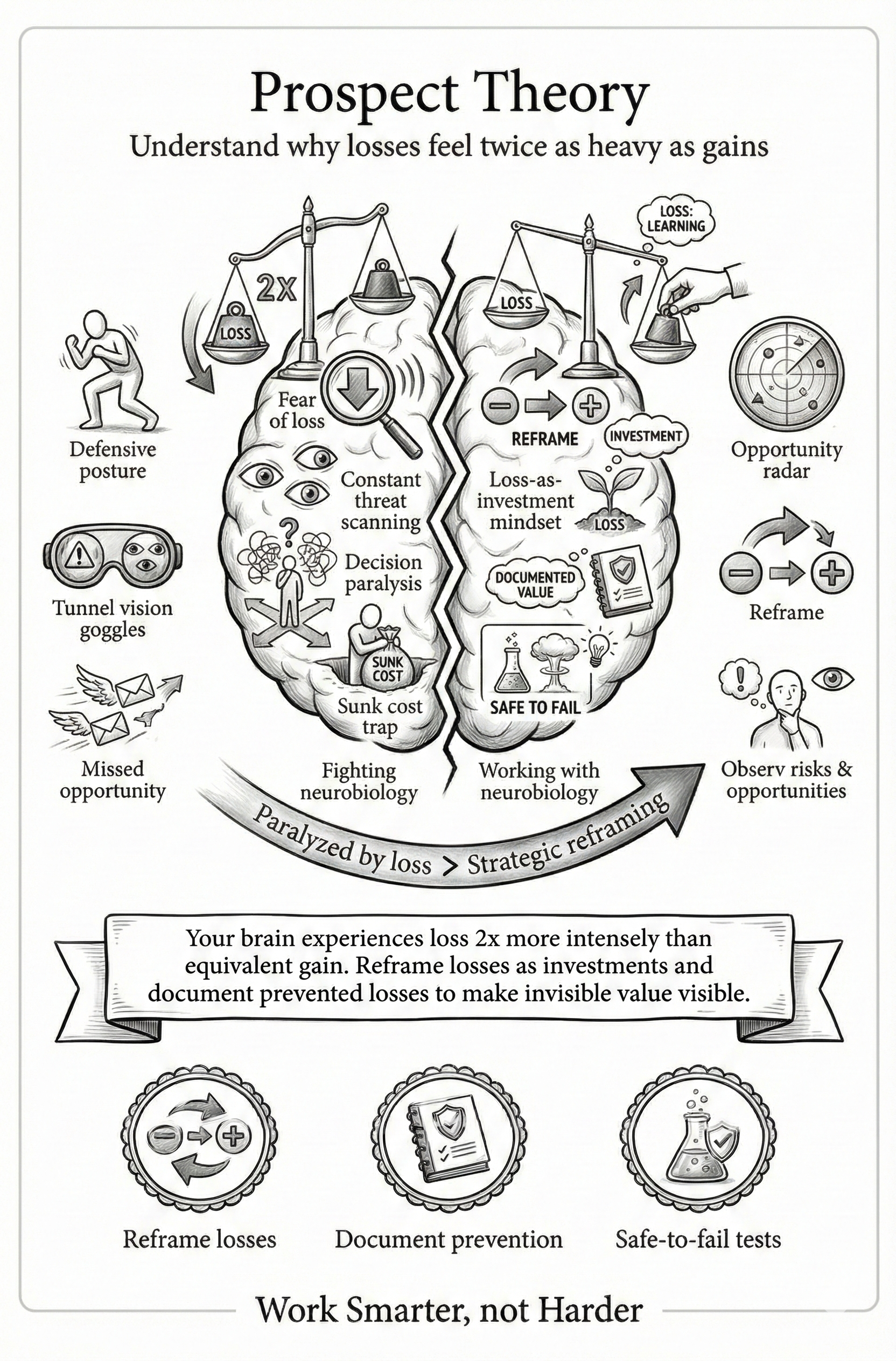
Your brain fears losses approximately 2-2.5 times more intensely than it values equivalent gains. This is loss aversion, discovered by Daniel Kahneman and Amos Tversky in their groundbreaking work on Prospect Theory—research that eventually earned Kahneman a Nobel Prize.
Losing €100 feels psychologically twice as painful as gaining €100 feels good. This asymmetry isn't irrational; it's evolutionary biology at work. In ancestral environments, losses—losing food, shelter, status within your group—could be fatal. Gains were nice but rarely survival-critical. Your ancestors who treated potential losses with heightened concern survived and reproduced. Their threat-sensitive neurology is now your inheritance.
This explains a pattern you've likely noticed: you focus more on preventing problems than creating opportunities. Your default mental mode is threat detection rather than possibility exploration. Every email might contain bad news. Every Sponsor call might reveal dissatisfaction. Every site update might show problems emerging.
This hypervigilance is exhausting. It's also preventing you from strategic thinking.
Overwhelmed PMs operate in constant threat-detection mode, their amygdala chronically activated, their prefrontal cortex partially offline. They're so busy scanning for disasters that they miss the opportunities right in front of them. And when they do identify solutions, they frame them in ways that don't resonate with how their Sponsors' brains actually make decisions.
The Communication Transformation
Consider Priya, a PM preparing for a challenging Sponsor call. Her Sponsor was concerned about slow recruitment across several sites. Priya had identified a solution: adding social media recruitment to accelerate patient screening.
Her first draft framed it as a gain: "I propose we add social media recruitment. This could increase patient screening by 20%."
The Sponsor's response was lukewarm. "Maybe. Let's discuss later."
Priya reframed using loss aversion: "Based on current trajectory, we'll miss our recruitment window by 3 months, delaying your regulatory submission. Social media recruitment prevents this delay by accelerating screening 20%. Without intervention, you're at risk of missing your fiscal year target for submission."
Same solution. Different framing. The Sponsor immediately authorised the additional budget.
Priya wasn't manipulating—she was speaking the language her Sponsor's brain naturally processes. Loss prevention (missing deadlines, delayed submission, fiscal year targets at risk) triggered significantly stronger response than opportunity language (increased screening, improved efficiency).
The Loss Aversion Protocol
Step 1: Reframe Your Daily Focus
Your brain's default mode is threat detection. This served your ancestors well when survival depended on noticing dangers before they became fatal. In modern clinical research project management, this same circuitry makes you hyperfocused on everything that could go wrong while blind to opportunities you could create.
Starting your day in threat-detection mode activates your amygdala and keeps you reactive rather than strategic. Every morning before checking email, invest five minutes deliberately reframing your mental focus from problems to opportunities.
Instead of opening your day by asking "What problems need preventing today?"—which immediately activates threat responses—ask yourself "What opportunities can I create today?"
Both questions are legitimate. Both address important aspects of project management. The difference is neurological. The threat-focused question primes your brain to filter reality for dangers, activating stress responses that impair strategic thinking. The opportunity-focused question primes your prefrontal cortex for strategic thinking, possibility recognition, and creative problem-solving.
Make this concrete with three specific opportunity questions:
"Where can I add unexpected value for my Sponsor today?" This shifts you from vendor mode to strategic partner mode. Perhaps you could provide market intelligence they haven't requested, offer timeline optimisation they haven't considered, or flag opportunities in their upcoming pipeline based on your site relationships.
"What capability can I build in my team today?" Maybe it's mentoring a junior PM through their first challenging site call, teaching your team a more efficient monitoring approach, or creating a template that makes everyone's work easier. These capability-building opportunities are invisible when you're in problem-prevention mode.
"What pattern can I capture today that will make me more effective long-term?" Perhaps you'll document a Sponsor communication pattern, refine your site selection criteria based on this study's experience, or capture lessons learned that prevent future issues.
Write down your three opportunities for the day. Now when you open email and encounter the inevitable problems and demands, your brain processes them against the backdrop of opportunity rather than threat. Same inbox, completely different cognitive context.
Step 2: Use Loss Aversion with Sponsors Strategically
Your Sponsor's brain, like yours, fears losses approximately 2.5 times more intensely than it values equivalent gains. When you understand this, you can frame your communications and proposals in ways that speak directly to their decision-making circuitry.
Whenever you're proposing a solution, resource request, or strategic change, frame it first in terms of losses prevented rather than gains created. Not because you're manipulating, but because loss framing makes the same information more cognitively accessible to their brain's decision-making system.
Compare these framings of an identical proposal:
Weak framing: "This enhanced monitoring approach will improve data quality and accelerate database lock." This gain-framed statement is factually accurate but neurologically weak. Your Sponsor's brain processes this as a nice-to-have enhancement.
Strong framing: "This enhanced monitoring approach prevents the risk of critical data gaps that could delay your regulatory filing by six months and require costly remediation visits."
You're describing the exact same monitoring approach. The activities are identical. The difference is that loss framing—prevented delay, regulatory risk, costly remediation—triggers significantly stronger response in your Sponsor's decision-making circuitry than gain framing. Their brain weighs "prevent six-month delay" roughly 2.5 times more heavily than "accelerate timeline."
Practice converting your standard communications into loss-prevention framing:
When requesting additional resources: Instead of "Adding a CRA would improve site support," frame as "Current CRA coverage creates risk of monitoring gaps that could trigger audit findings and remediation requirements."
When proposing timeline adjustments: Instead of "Earlier activation would optimise enrolment," frame as "Delayed activation risks missing your Q3 enrolment target and pushes DBL into next fiscal year."
This doesn't mean only using loss framing. After establishing the loss being prevented, absolutely include the positive outcomes: "This prevents six-month delay and positions you for Q3 regulatory submission, beating your competitor's anticipated timeline." You've led with loss prevention because that's what their brain weighs most heavily, then reinforced with gain framing.
The transformation in Sponsor responsiveness is often immediate. Proposals that previously got "We'll think about it" suddenly get "Approved, proceed." You haven't changed the substance; you've aligned your communication with how their brain naturally evaluates decisions.
Step 3: Engineer "Safe to Fail" Experiments
Your own loss aversion prevents innovation. Trying new approaches means risking failure, and your brain experiences potential failure as a significant threat. This keeps you locked in established patterns even when better approaches exist.
The solution isn't overriding your loss aversion through willpower; it's engineering experiments where failure is contained and survivable.
Every month, identify one aspect of your project management approach you want to innovate. Perhaps it's recruitment strategy, Sponsor communication, monitoring efficiency, or team coordination. Instead of attempting complete redesign—which creates high loss risk if it fails—design a small-scale experiment with clearly bounded failure potential.
Rather than "Let's completely redesign our recruitment strategy across all sites," which puts your entire timeline at risk if the new approach fails, frame as "Let's test this social media recruitment approach at three sites for four weeks. If it doesn't increase screening by 15%, we revert to standard approach, and we've lost only twelve site-weeks of effort."
The experiment becomes safe to fail.
Define the experiment parameters explicitly: Which sites will test the new approach? For how long? What success metric determines whether you scale or abandon? What's the maximum resource investment? What's the fallback plan if results are negative?
This containment structure lets you try genuinely novel approaches without triggering your brain's loss aversion alarm.
Document both successes and failures. When an experiment succeeds, you've discovered an improvement you can scale across your entire programme. When an experiment fails, you've gained knowledge at minimal cost—it tells you what doesn't work in your specific context, preventing you from making the same mistake at larger scale later.
Over twelve months of monthly safe-to-fail experiments, you'll have tested twelve innovations. If half fail and half succeed, you've still improved six aspects of your project management approach, and you've built a culture of continuous improvement rather than rigid adherence to established patterns.
Step 4: Document Prevented Losses
The most valuable work you do as a PM is often invisible. You prevented a crisis through early intervention, but because the crisis never happened, nobody—including you—registers this as achievement. Your brain doesn't naturally give you credit for bad things that didn't occur.
This creates a motivation problem where your most important contributions go unrecognised and unrewarded.
Every Friday afternoon, invest 15 minutes systematically documenting problems you prevented this week. Make the invisible visible. Create a "Prevented Losses" log separate from your standard accomplishments tracking.
Work backwards through your week and identify situations where your proactive action prevented problems from materialising:
Protocol deviation prevention: "Identified Site 8's confusion about inclusion criterion 3 through proactive monitoring call. Provided clarification and verified understanding on next three patients before enrolment. Prevented systematic protocol deviation that would have affected estimated 12 patients and required extensive remediation."
Budget overrun prevention: "Projected Q3 expenditure trajectory in July showing 15% variance to plan by September. Alerted Sponsor in July rather than September, providing three months lead time for budget modification discussions rather than crisis management. Prevented surprise budget overrun and preserved Sponsor confidence."
Timeline delay prevention: "Noticed Sites 4, 7, and 12 trending below target in Week Six, implemented recruitment strategy enhancement in Week Eight. Prevented three-month timeline delay that would have pushed DBL into next year."
Quantify the prevented losses where possible. Six months of delay prevented. Twelve protocol deviations avoided. €75,000 budget crisis prevented. Three months of lead time created for Sponsor planning. These numbers make prevention concrete rather than abstract.
After three months of systematic documentation, you'll have a comprehensive record of value delivered through loss prevention. This becomes powerful in performance reviews, Sponsor relationship discussions, and your own motivation maintenance.
More importantly, this documentation trains your Reticular Activating System to notice prevention opportunities. What you pay attention to becomes what you see. Once you start systematically recognising and documenting prevented losses, you'll spot prevention opportunities earlier and more frequently.
How Loss Aversion Connects to Your Other Cognitive Systems
Loss aversion fundamentally shapes what your Reticular Activating System prioritises for conscious attention. Because your brain weights losses more heavily than gains, your RAS naturally filters for threats, problems, and potential disasters rather than opportunities, possibilities, and potential wins.
This creates a self-reinforcing cycle: loss aversion programmes threat-focused RAS filtering, which surfaces primarily negative information, which reinforces your sense that threats dominate, which intensifies loss aversion. Breaking this cycle requires conscious RAS reprogramming to balance threat awareness with deliberate opportunity identification.
Constant loss focus keeps your stress response system chronically activated because your HPA axis cannot distinguish between actual threats and mentally constructed potential losses your loss-averse brain magnifies. When you spend your day mentally simulating everything that could go wrong—imagining Sponsor dissatisfaction, anticipating site failures, catastrophising timeline risks—you're triggering genuine stress response to imagined threats.
Your cortisol levels rise, your prefrontal cortex goes partially offline, and your strategic thinking capacity diminishes—all because your loss-averse brain treated potential future losses as present dangers.
Decision fatigue intensifies when every decision feels like potential loss rather than potential gain. Your loss-averse brain treats decisions as threat-laden because every choice contains risk of loss, and this perception depletes decision-making energy faster than if you framed choices as opportunity selection.
Quick Implementation Plan
Today: Notice how you frame your next three communications. Are you leading with gains or loss prevention? Reframe at least one proposal using loss-aversion language.
This week: Implement the morning opportunity reframe. Before checking email, identify three opportunities you can create today. Track how this changes your cognitive state throughout the day.
This month: Design one safe-to-fail experiment for an innovation you've been avoiding. Define explicit parameters that make failure survivable. Run the experiment.
Ongoing: Create your Prevented Losses log. Every Friday, document problems you prevented through proactive management. After three months, review what patterns emerge about where you add the most value.
Loss aversion is hardwired evolutionary neuroscience that served survival well but serves complex modern work poorly when left unmanaged. You cannot eliminate it through willpower or positive thinking, but you can absolutely develop conscious practices that prevent loss aversion from dominating every perception and decision.
Balancing appropriate caution about genuine risks with deliberate opportunity focus, using loss framing strategically in communication, and creating safe-to-fail innovation structures all allow you to work with loss aversion rather than being unconsciously controlled by it.
This kind of strategic self-awareness—understanding how your brain's threat-detection circuitry affects your communication and decision-making, then building practices to channel it productively—is fundamental to the work we do in brain-based coaching for clinical research professionals. When you can speak to your Sponsor's loss-averse brain while managing your own, you transform from reactive problem-solver to strategic partner.
In the next post, we'll explore the Default Mode Network—your brain's "wandering" system that activates when you're not focused on external tasks, and how to harness it for strategic insight rather than letting it spiral into unproductive worry.
