
The "Work Smarter" Myth Cracked (12/18): Memory Consolidation
You've experienced this frustration before. You attended mandatory training—ICH-GCP refresher, new protocol procedures, updated regulatory guidance, complex system training. You paid attention. You took comprehensive notes. You felt confident walking out of that session.
Then, one week later, you need to apply that knowledge. You're preparing for an audit, or a Sponsor is asking specific questions, or you're training a team member. You sit down to recall what you learned, and significant portions have simply vanished. The details are fuzzy. The sequence is unclear. You're forced to re-study material you already invested hours learning.
You blame your memory. Perhaps you should have taken better notes. Perhaps you should have paid closer attention. Perhaps you're simply not good at retaining information.
None of these explanations is correct. The problem isn't your memory capacity. It's that you never gave your brain the specific rest intervals it requires to transfer learning from temporary to permanent storage.
The Counterintuitive Truth About Learning
Learning doesn't happen during the training itself. It happens during rest.
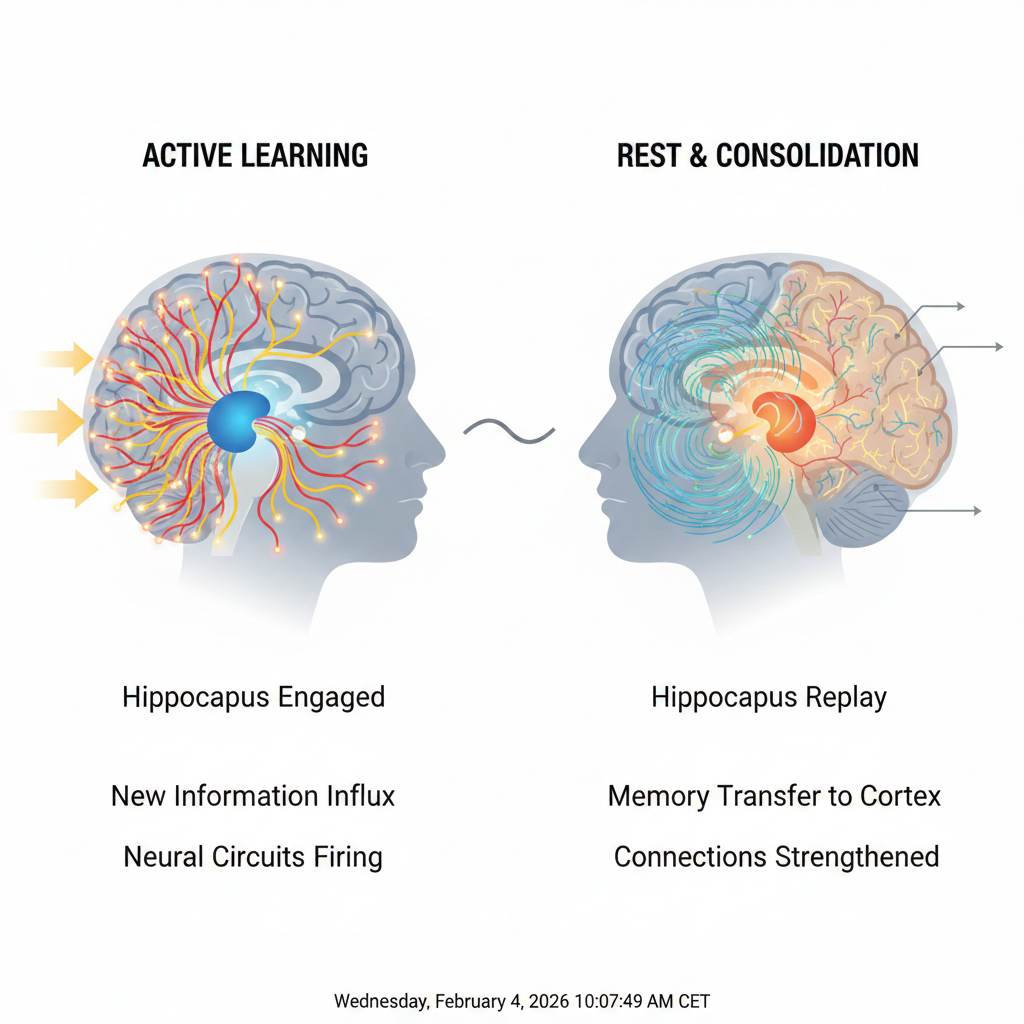
When you're actively engaged in learning—whether it's sitting in a four-hour protocol training, reviewing regulatory documents, or participating in a complex Sponsor discussion—your brain is taking in massive amounts of new information through your hippocampus, which functions as temporary storage for new memories.
Your hippocampus can't hold information permanently. It's too small and processes too much incoming data. Information needs to transfer from your hippocampus to long-term storage in your cortex. This transfer process, called consolidation, happens primarily during rest, not during continued activity.
If you attend intensive training, then immediately shift to email, then to site calls, then to report writing, your hippocampus never gets the opportunity to consolidate. The training material stays in temporary storage, where it degrades rapidly. Within hours, significant portions become inaccessible. Within days, most of it is effectively forgotten.
The issue isn't that you didn't learn the material initially. You did. The issue is that you never allowed the neurological process that makes learning permanent.
What Happens in Your Brain During Consolidation
Understanding the mechanism helps explain why this matters so much. During consolidation breaks and sleep, your hippocampus replays the experience at high speed—typically seven to 20 times faster than the original experience occurred. This replay is measurable on EEG. It's not metaphorical. It's actual neurological activity.
During this replay, your brain is essentially reviewing the recording, deciding what's important enough to transfer to permanent cortical storage and what can be discarded. Important information gets encoded into long-term memory networks. Less critical details fade away.
If you interrupt this consolidation window by taking in new information—checking email, attending another meeting, jumping into a different cognitively demanding task—your hippocampus must process that new input instead of consolidating what you just learned. The training material stays in temporary storage, where it degrades rapidly.
This is why the 20-minute investment after intensive learning isn't optional luxury. It's the difference between temporary familiarity and permanent knowledge.
The Four-Step Consolidation Protocol
This protocol works with your brain's natural consolidation mechanisms rather than against them. Each step serves a specific neurological purpose.
Step 1: The 20-Minute Consolidation Break
Immediately after any intensive learning session—whether it's protocol training, regulatory guidance review, new system instruction, or complex Sponsor discussion—take a mandatory twenty-minute consolidation break. This isn't "taking a break to relax." This is active consolidation time. Your brain is working harder during this break than it was during the training itself. Your hippocampus is replaying the experience, transferring information to permanent storage, and building the neural pathways that make future recall automatic. How does this look like in practice?:
Block 20 minutes in your calendar immediately following any scheduled training. If you're in back-to-back meetings, that itself is a problem—you're preventing consolidation of all that information. Build 20-minute buffers between intensive information sessions.
During the consolidation break, don’t add any new information. No email checking, no document reading, no phone calls. Light physical activity like walking works perfectly. Quiet rest without stimulation also works. The key is zero new cognitive demands. Light physical activity actually enhances consolidation because the increased blood flow supports the metabolic demands of memory encoding. The rhythmic movement may help organise neural replay. But the walk must be simple—no podcast listening, no phone checking, no complex navigation of new environments.
Iitially, this feels forced and artificial. You're "wasting" 20 minutes when you're behind on everything else. Push through this discomfort. By the third or fourth time you implement this protocol, you'll start noticing the dramatic difference in retention. The information feels more solid. Recall becomes easier. The 20-minute investment pays for itself many times over by eliminating the need to re-learn the same material repeatedly.
Rest isn't luxury. It's when learning becomes permanent.
Step 2: Spaced Learning Structure
Single intensive learning sessions, even with consolidation breaks, aren't as effective as distributed learning across multiple days. Your brain consolidates information multiple times, strengthening memories with each consolidation cycle.
Rather than cramming all protocol training into 1 x 4h marathon, structure it as 4 x 1h sessions distributed across four days, each with a 20-minute consolidation break. The total learning time is identical (4h), but the retention difference is profound. Each night between learning sessions, your brain consolidates the previous day's learning during sleep. When you return to the material the next day, you're building on consolidated foundations rather than adding to an already-overloaded temporary storage system.
For team training you're designing, replace traditional full-day training sessions with shorter sessions distributed across multiple weeks. Yes, this requires more calendar coordination. Yes, it feels less efficient from a logistics perspective. But the learning outcomes are dramatically better, which means less time spent re-training, fewer errors from forgotten procedures, and more confident execution under pressure.
For self-directed learning, when you're learning new therapeutic area knowledge, regulatory requirements, or complex operational procedures, resist the temptation to consume everything in one intensive session. Break it into segments. Study one segment, take your consolidation break, then move to completely different work. Return to the next segment tomorrow. The spacing creates additional consolidation opportunities.
This spacing principle is exactly what Strategy 15: Spacing Effect explores in depth—the neuroscience of why distributed learning dramatically outperforms massed learning for long-term retention.
Step 3: Sleep Protection
Your brain consolidates during sleep more powerfully than during any wakeful activity. The hippocampal replay that happens during wakeful rest accelerates dramatically during deep sleep. Additionally, during REM sleep, your brain integrates new information with existing knowledge, creating the connections that transform isolated facts into applicable understanding.
If you learned something important today, protecting tonight's sleep is protecting that investment. Shortening sleep by even 1 to 2 hours significantly impairs consolidation. The learning stays fragmented. Connections form weakly. Retrieval becomes difficult. You might remember isolated facts but struggle to apply them because the integrated understanding never developed properly.
Important learning days are often stressful days that make you want to stay up late processing email or working on urgent deliverables. This is exactly backwards. The important learning you acquired during the day requires seven to 8h of sleep to consolidate properly. Cutting sleep short partially wastes the learning investment.
Adjust evening habits on training days. If you attended intensive protocol training today, protect tonight's sleep even if it means some emails wait until tomorrow. The protocol knowledge consolidating during sleep is more valuable than marginal evening productivity.
For ongoing learning that extends across weeks—like developing expertise in a new therapeutic area or mastering complex operational systems—establish a baseline sleep requirement of seven hours minimum. Research on learning and memory is unambiguous: regular sleep restriction below seven hours creates cumulative consolidation deficits. You might feel like you're functioning fine, but memory formation and creative problem-solving are measurably impaired.
If sleep is difficult, implement a pre-sleep protocol specifically designed to signal safety to your nervous system. This might include 20 minutes of light reading unrelated to work, gentle stretching, or listening to calming music. Review the day's key learnings briefly (as described in Step 4), but then release them rather than continuing to problem-solve.
The return on sleep investment is enormous. You cannot think your way out of inadequate consolidation time.
Step 4: Pre-Sleep Review
Your brain consolidates during sleep whatever neural pathways were most active immediately before sleep. This is why ruminating about work problems before bed both impairs sleep quality and reinforces stress pathways rather than productive learning. You can leverage this same mechanism positively by deliberately reviewing key learnings in the five minutes before sleep, then releasing them to consolidate overnight:
Create a simple pre-sleep review routine focused on activating the neural pathways you want strengthened. Spend 5 minutes mentally reviewing the most important information from today's learning or work.
If you studied protocol procedures today, mentally walk through the key steps. If you learned new regulatory requirements, briefly recall the core principles. If you had an important strategic insight during a Sponsor meeting, revisit that insight. The review should be recall-based, not re-reading. Close your notes and actively remember what you learned. What were the 3 main points? What was the critical sequence? What insight emerged? This active retrieval strengthens the memory trace more than passive re-reading would. The slight difficulty of recalling without notes is precisely what makes this effective.
Five minutes is sufficient to reactivate the relevant neural pathways. Longer review risks transitioning into problem-solving or worry, which defeats the purpose. You're simply cueing your brain about what information to prioritise during tonight's consolidation processing, then trusting your neurobiology to do its work while you sleep.
After the 5-minute review, tell yourself explicitly: "My brain will process this overnight. I can let it go now." This prevents the review from becoming rumination. You've activated the pathways, signalled priority to your consolidation system, and now you're allowing sleep to do what sleep does.
Information reviewed briefly before sleep demonstrates significantly better retention than information reviewed at other times of day, even when the review duration is identical. You're working with your brain's natural overnight consolidation process rather than hoping learning sticks despite poor timing.
For particularly important learning that you want to consolidate optimally combine all four steps:
Take the 20-minute consolidation break immediately after the intensive learning session
Structure the learning with spacing across multiple days rather than one marathon session
Protect 7-8h of sleep on nights following learning sessions
Do the five-minute pre-sleep review to activate consolidation during overnight processing
This comprehensive approach means you learn material once and retain it permanently, rather than the typical pattern of learning, forgetting, and repeatedly re-learning the same information.
After four weeks of consistent consolidation protocol implementation, you'll notice several profound shifts:
Immediate retention: Information feels more solid immediately after learning. The usual fogginess that appears when you try to recall something you just learned isn't there anymore.
Long-term accessibility: Material learned weeks ago remains readily accessible. You're not constantly re-learning the same information.
Confidence under pressure: When a Sponsor asks a specific question about protocol procedures during an audit preparation call, you can access the information instantly rather than fumbling through notes or promising to "get back to them."
Reduced cognitive load: You're no longer carrying the mental burden of knowing you should remember something but can't quite access it. The information is either properly stored and retrievable, or you know you need to learn it—no more frustrating in-between state.
Efficient re-learning: When you do need to refresh information, consolidation happens more rapidly. Your brain is re-activating existing neural pathways rather than building them from scratch.
This consolidation protocol challenges a fundamental misconception embedded in professional culture: the belief that productivity happens during active work and rest is time stolen from productivity. The neuroscience demonstrates the opposite. For cognitive work involving learning, problem-solving, and expertise development, rest is when the most critical work happens. Your hippocampus isn't idle during consolidation breaks. It's working harder than during the training itself, just in a way that isn't visible to external observers.
Professionals who protect consolidation time don't learn less. They learn more effectively. They retain information longer. They can apply knowledge more flexibly under pressure. They spend less time re-learning. They make fewer errors caused by forgotten procedures.
The empowered PM/PD isn't the one who crams more learning into less time. It's the one who understands that rest isn't lazy—it's when learning becomes permanent. This is exactly what we develop systematically in brain-based coaching for clinical research project management professionals: building the habits and systems that transform temporary learning into permanent expertise you can access instantly when it matters most.
Why This Connects to Everything Else You're Learning
Your consolidation protocol works in perfect harmony with other strategies we've explored in this series.
Ultradian Rhythms (Strategy 5): Your consolidation breaks align naturally with your brain's 90-minute cycles where energy naturally ebbs. Taking a 20-minute consolidation break isn't fighting against your natural rhythm—it's working with it. When you return from the break, you're entering a fresh ultradian cycle with renewed cognitive resources.
Pattern Recognition (Strategy 8): Every time you step away and let your mind wander during a consolidation break, you're building your pattern recognition library. Those seemingly random moments when you're walking or resting? Your brain is busy filing away what you just learned, creating stronger neural pathways that help you spot similar situations faster next time.
Spacing Effect (Strategy 15): Because you're spacing out your learning sessions rather than cramming everything into one marathon meeting, you're tapping into the spacing effect, which makes information stick far more effectively than any amount of continuous studying ever could.
These strategies aren't isolated techniques. They're interconnected elements of how your brain actually works. Consolidation is the mechanism that makes all other learning strategies effective. Without proper consolidation, even the best learning techniques produce only temporary results.
In the next post, we'll explore Strategy 13: Cognitive Offloading—the systematic approach to externalising information so your working memory can focus on strategic thinking rather than trying to remember everything. You'll discover why the most effective PMs maintain detailed external systems not because they have bad memories, but because they understand cognitive capacity limits.
