
The "Work Smarter" Myth Cracked (14/18): Chunking
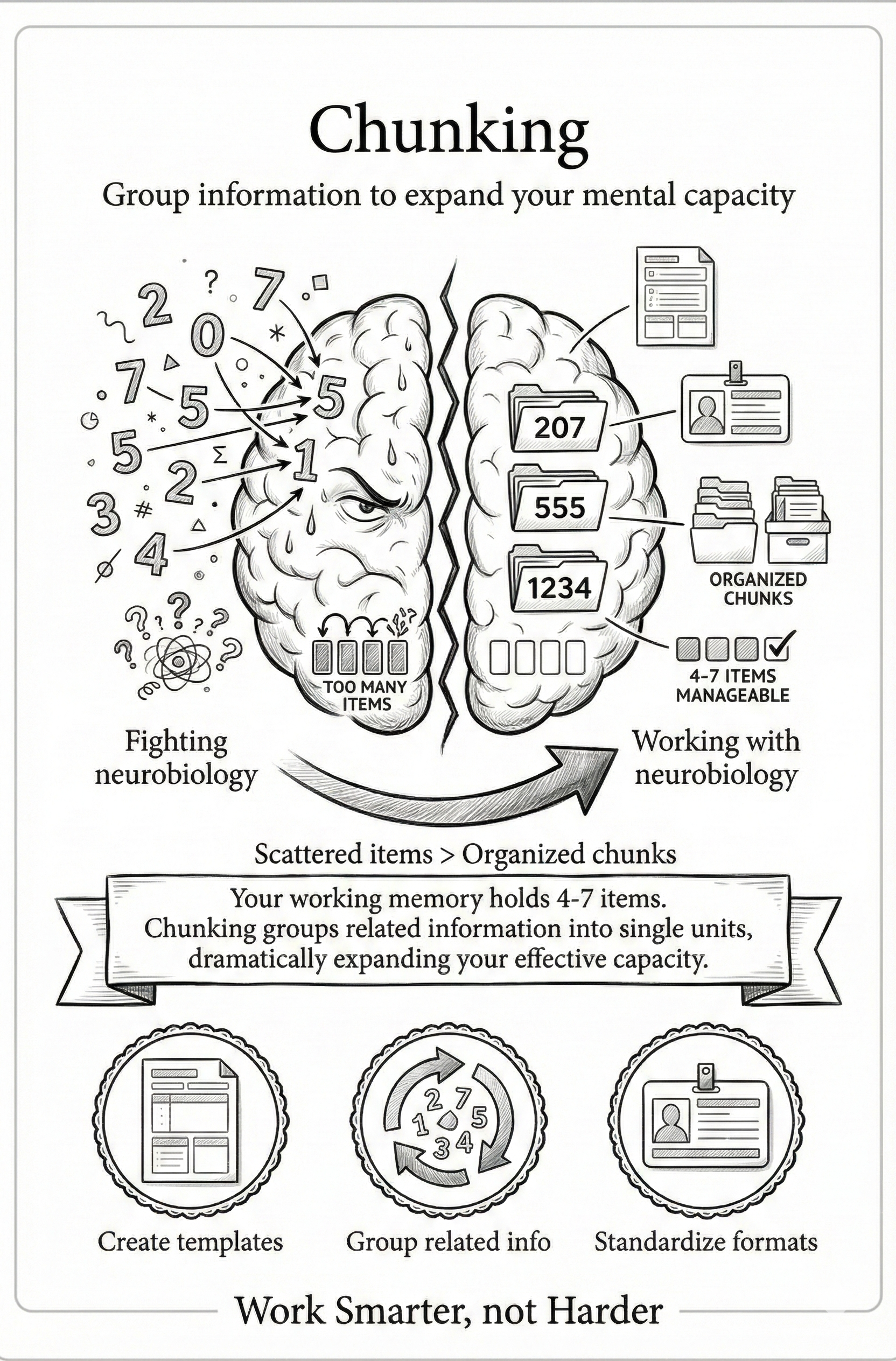
Let me start with what nobody tells you about why everything feels overwhelming. Your working memory can hold approximately 4 to 7 items simultaneously. That's it. Not 40. Not 70. Four to 7.
Cognitive psychologist George Miller's (1956) classic research identified working memory capacity at 7±2 items, later refined by Nelson Cowan (2001) to a more precise 4±1 items through rigorous experimental controls. This isn't about intelligence or capability. It's a fundamental constraint of human neural architecture. This is a hard neurological limit.
When you try to hold more than this, items start dropping out or interfering with each other. You've experienced this dozens of times today already: you're discussing site activation with a Sponsor whilst mentally tracking the three sites awaiting IRB approval, the two contracts stuck in legal review, the PI who hasn't responded about protocol amendments, the coordinator asking about drug shipment timing, and suddenly you've completely lost what the Sponsor just asked you.
That wasn't poor attention. That was working memory capacity exceeded.
But here's what transforms everything: you can dramatically expand your effective capacity through chunking, which means grouping related items into single units that your brain processes as one thing.
The Neurological Reality You're Working Against
Consider a phone number. If you try to remember 2-0-7-5-5-5-1-2-3-4, you're asking your working memory to hold ten separate items. That exceeds capacity and causes overload. Your brain starts dropping digits or mixing up the sequence.
But when you chunk it as 207-555-1234, you're holding only three items: the area code, the prefix, and the line number. Your brain can easily handle three chunks.
The same principle applies to everything you manage as a Project Management leader.
Site information includes name, address, Principal Investigator, coordinator, Institutional Review Board status, contract status, activation date, recruitment target, payment terms, and communication history. That's ten-plus items for every single site. If you're managing fifteen sites, you're asking your working memory to track 150+ individual facts.
This is why site discussions feel cognitively exhausting. You're not managing sites; you're managing hundreds of disconnected data points that keep spilling out of working memory capacity.
But when you create a standardised "Site 23 profile," your brain retrieves this as a single chunk—a complete package that contains all this information organised in a familiar structure. Suddenly, fifteen sites require fifteen chunks, well within your working memory capacity of four to seven items when you're focusing on a subset.
The Protocol: Building Information Chunks That Match Neural Capacity
Step 1: Create Information Chunks
Build standardised formats for the complex information you manage regularly.
Site profiles should follow the same structure every time, allowing your brain to process "site profile" as a single chunk rather than processing each element individually. When every site profile contains sections in identical order—contact information, regulatory status, enrolment data, communications log, open issues—your brain stops processing structure and focuses entirely on content.
Sponsor profiles should contain all your Sponsor intelligence organised in one consistent template. Decision-making patterns, escalation preferences, communication style, historical timeline flexibility, budget sensitivity, therapeutic area expertise, previous protocol amendments they've accepted or rejected. This intelligence currently exists as scattered observations you try to reconstruct during calls. Chunked into a standardised profile, it becomes one retrievable unit.
Project snapshots should present all project health metrics in one standardised dashboard layout. Instead of separately tracking enrolment status, timeline variance, budget consumption, site performance, and quality metrics as five different things, you create one project health chunk that your brain retrieves as a complete picture.
These standardised formats serve as external cognitive structures that dramatically reduce the mental load of managing complex information. Your brain doesn't have to reconstruct the organisation each time; it simply plugs new content into familiar chunks.
Step 2: Use Templates for Chunking
Every communication template functions as a chunk for your brain.
When you use a standard format for site update emails, you're not processing fifteen individual elements each time you write one. Your brain processes "site update email" as a single unit and fills in the content without having to consciously decide on structure, sequence, or elements to include.
Opening acknowledgement → current status summary → specific action items → timeline expectations → next communication point. Five sections, but your brain treats this entire structure as one chunk. The template handles the routine cognitive work, and your working memory remains available for the complex judgement calls that only you can make.
The same applies to Sponsor update templates, amendment notification templates, site activation checklists, and close-out report formats. Each template transforms a cognitively demanding task requiring multiple sequential decisions into a single chunk requiring only content population.
This automatic processing frees up cognitive capacity for the strategic thinking that requires your attention—recognising the pattern that three sites are struggling with the same protocol procedure, noticing the Sponsor's questions suggest concerns they haven't explicitly stated, identifying the recruitment trajectory that indicates you'll miss targets without intervention.
Enhance your efforts with AI:
For example you can use the prompts below:
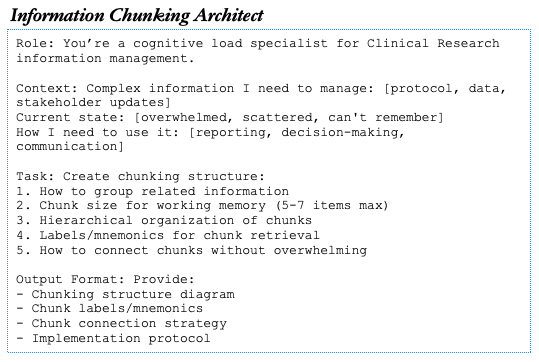
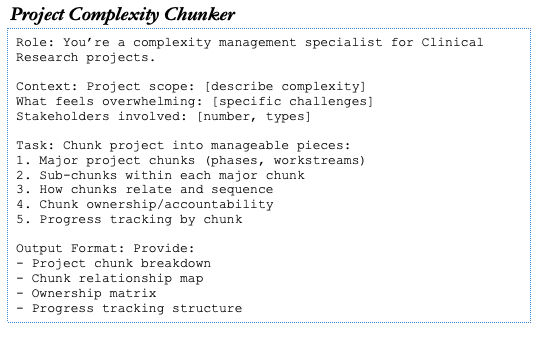
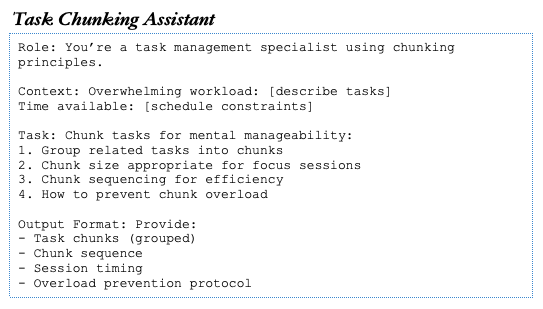
Your Quick Win: Create One Proof-of-Concept Chunk
If you want a quick win, identify one category of complex information you manage repeatedly that's currently stored as disconnected facts consuming working memory. Maybe it's site information, Sponsor intelligence, amendment tracking, or budget variance monitoring. Choose the category that feels most overwhelming when you try to hold it all in your head.
Create a standardised template organising all relevant information for one instance of this category. If it's site information, create a site profile template with sections for contact details, regulatory status, enrolment data, communications history, and open issues. Keep it to five to seven main sections to match working memory capacity.
Fill in this template for just one site to test whether the structure captures everything you need. This single chunk becomes your proof of concept.
Notice what happens the next time you need to discuss this site with your Sponsor. Instead of mentally assembling facts from your inbox, your project tracker, and your memory, you retrieve one complete chunk. The cognitive difference is immediately apparent.
This Week: Build Your Top Three Information Chunks
This week, create templates for your top three information chunks—the categories of complex data you access most frequently.
Build these templates to match your working memory capacity, organising information hierarchically with five to seven main sections, each containing sub-details you can expand when needed. Your brain comfortably holds the main structure (five to seven sections) whilst accessing detailed content within relevant sections as needed.
Test each template with real data from current projects. Adjust the structure if you find yourself needing information the template doesn't accommodate or if sections feel redundant. The goal is creating chunk structures that match how your brain naturally wants to organise and retrieve this information.
Site profile template → fill in for your three most active sites Sponsor intelligence template → populate for your primary Sponsor contact Meeting preparation template → create for your recurring Sponsor calls
After one week using these three chunks, you'll notice the cognitive difference. Discussions flow more smoothly because you're retrieving organised chunks rather than reconstructing scattered information. Preparation takes less time because you're filling in established structures rather than deciding what to include from scratch each time.
Long-term Integration: Systematic Chunk Conversion
Systematically convert all your complex recurring information into standardised chunks.
Every site gets a profile following your template. Every Sponsor gets an intelligence chunk. Every recurring meeting type gets a preparation chunk. Every project gets a health dashboard chunk.
Train your brain to retrieve these chunks as single units rather than assembling information from scattered sources. The first few times you use a new chunk structure, retrieval feels deliberate and conscious. After ten to fifteen uses, the chunk becomes automatic. Your brain stops processing the structure and focuses entirely on content.
Notice how much easier it becomes to discuss sites during Sponsor calls when you're retrieving complete site profile chunks rather than trying to remember disconnected facts. You can speak confidently about Site 23's status because your brain loads the entire profile chunk, not because you're frantically searching email for the last coordinator update.
Pay attention to how much faster meeting preparation becomes when you're filling in a preparation chunk template rather than reconstructing what you need from scratch each time. Tuesday's Sponsor call preparation drops from forty-five minutes of gathering scattered information to fifteen minutes of updating your standardised preparation chunk with this week's developments.
The Transformation: From Cognitive Struggle to Cognitive Ease
After three to six months of systematic chunk usage, your brain will refuse to work with disconnected information anymore. This isn't discipline; it's neural efficiency.
When someone mentions a site, your brain automatically retrieves the complete site profile chunk. When you think about a Sponsor, the full intelligence chunk activates. When you prepare for a meeting, the appropriate preparation chunk template loads automatically.
This transformation happens because your brain recognises that chunked information requires dramatically less cognitive effort to process than scattered facts. Once it experiences the efficiency of retrieving organised chunks, it actively resists going back to the cognitive strain of managing disconnected items.
Your working memory can comfortably hold four to seven chunks, but those chunks can each contain extensive organised information. The difference between trying to remember forty disconnected facts versus retrieving five chunks containing those same facts organised structurally is the difference between constant cognitive overload and working memory operating at optimal efficiency.
How Chunking Amplifies Everything Else
Chunking directly reduces the cognitive load we explored earlier in this series by transforming multiple individual items competing for limited working memory into single organised units. When you chunk site information into standardised profiles, you're no longer asking your working memory to hold eight separate facts about each site. You're holding one chunk per site, and working memory capacity that was maxed out at five sites can now comfortably handle dozens.
The habits you build through automaticity principles often function as behavioural chunks. Your morning project review habit is a sequence of multiple actions—checking dashboard, reviewing completions, identifying priorities, noting blockers—chunked into a single automatic routine that initiates with one decision rather than requiring four separate decisions to execute four separate actions.
Pattern recognition relies fundamentally on chunking. When you recognise a pattern like "sites in this region delay during holiday periods," you're not processing "this region" plus "holiday periods" plus "delays" as separate observations. You're retrieving a complete pattern chunk that integrates all these elements into one recognisable whole your brain matches automatically against new situations.
Decision frameworks work through chunking principles. Your escalation matrix chunks multiple decision criteria into one lookup structure. Instead of separately considering impact level, probability level, Sponsor sensitivity, timeline implications, and urgency, you've chunked all these factors into a single decision framework that yields clear action with minimal cognitive load.
The external memory systems that support multiple strategies function as chunk repositories. Your project management platform holds task chunks rather than scattered action items. Your documentation system stores decision chunks rather than disconnected notes. Your communication templates are message chunks rather than individually composed responses.
Every external chunk repository you build frees working memory that was previously consumed holding or reconstructing that information internally.
The Strategic Advantage of Organised Information
Chunking isn't just one isolated strategy; it's a fundamental organising principle that amplifies every other brain-friendly approach in this toolkit.
Your working memory capacity is fixed at approximately four to seven items. Chunking lets those items be information-rich organised structures rather than isolated facts, exponentially expanding your effective cognitive capacity without changing your actual neurobiology.
This is exactly what we work on in my brain-based coaching for clinical research project management professionals—identifying where cognitive overload stems from information organisation rather than workload, then building chunk structures that transform mental strain into mental efficiency.
Chunking transforms cognitive struggle into cognitive ease, not through harder work but through better organisation aligned with how your working memory functions. When your information architecture matches your neural architecture, complexity becomes manageable without requiring superhuman memory or endless mental effort.
Your brain's working memory limitation isn't a weakness to overcome. It's a design specification to work with. Chunking is how you work with it.
References:
Cowan, N. (2001). The magical number 4 in short-term memory: A reconsideration of mental storage capacity. Behavioral and Brain Sciences, 24(1), 87-114.
Miller, G. A. (1956). The magical number seven, plus or minus two: Some limits on our capacity for processing information. Psychological Review, 63(2), 81-97.
