
The "Work Smarter" Myth Cracked (13/18): Priming Effects
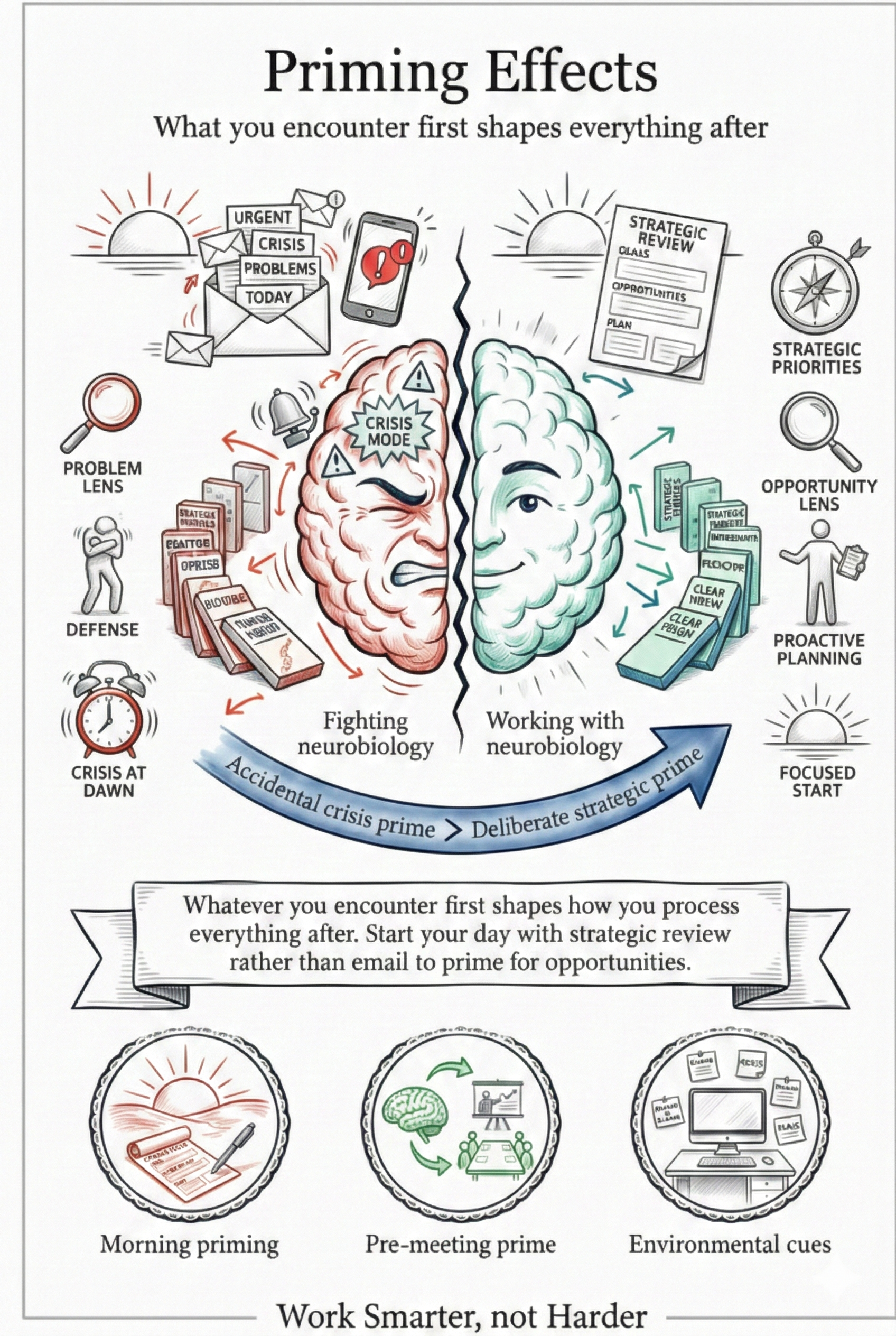
You take pride in responsiveness. Each morning, you open your laptop and immediately tackle email, handling whatever appears most urgent first. This feels productive and responsible. You're staying on top of stakeholder needs, preventing problems from escalating, demonstrating dedication.
What you don't realize is that this habit is programming your entire day for reactive firefighting.
Email naturally contains problems requiring attention. Sites reporting delays. Sponsors raising concerns. Team members escalating issues. Budget variances. Timeline pressure. Risk notifications. By processing this problem-focused information first thing every morning, you're priming your brain to spend the entire day in threat-detection mode.
By 10 a.m., before you've accomplished anything strategic, your brain has been primed for crisis response. Your Reticular Activating System (RAS) has been programmed to filter for problems (see previous blog on RAS for more details). Your stress response is activated by accumulated urgency. Your prefrontal cortex is operating in reactive rather than strategic mode. You feel behind before you've even started productive work.
This isn't about attitude or mindset. It's neurology.
The Neuroscience of Priming
Priming is the phenomenon where recent exposure to information influences how your brain processes subsequent information. In other words, your brain processes everything through the lens of what it encountered first. When you read about problems first thing in the morning, you prime your brain to spot problems all day. When you read about opportunities, you prime your brain to spot opportunities. The same environment exists either way, but what you notice and how you interpret it depends heavily on your neural priming.
A comprehensive meta-analysis of 352 priming experiments demonstrated that incidentally presented words measurably influence subsequent behaviour. The effects are strongest when the primed concept relates to valued goals. For Project Management professionals, this means morning priming with strategic priorities is particularly effective because career advancement and project success are genuinely valued outcomes.
You're not trying to trick your brain into caring about random concepts; you're deliberately directing attention toward what actually matters to you.
Your RAS gets programmed by whatever information hits it first. If urgent email floods it before you've oriented strategically, your RAS spends the entire day filtering your environment for threats and problems. If strategic priorities reach it first, it filters your environment for opportunities and progress. The same meetings, conversations, and challenges happen either way, but what surfaces to your conscious attention depends on the morning prime.
The mechanism works through activation of neural networks. When you read about budget concerns, neural networks associated with financial threat, risk management, and defensive explanation activate. Those networks remain more easily re-activated throughout the day, making you more likely to notice and focus on similar information. When you read about relationship-building opportunities, neural networks associated with collaboration, value creation, and strategic partnership activate, priming you to notice and focus on those patterns instead.
This explains why two Project Managers working on identical studies can have completely different daily experiences based solely on their morning information sequence. One PM starts with strategic review and encounters a day full of opportunity. The other starts with urgent email and encounters a day full of crisis. The external environment is identical. The internal neural priming creates divergent experiences.
Ana's Accidental Crisis Programming
Ana discovered this pattern when her manager asked why her quarterly strategic planning consistently happened late. Ana insisted she simply didn't have time for strategic work when so many urgent matters demanded attention. Her manager probed deeper: what made these matters urgent? Were they genuinely time-critical, or did they just feel urgent because Ana encountered them first thing each morning?
That question shifted Ana's perspective. She conducted an experiment.
For 2 weeks, Ana maintained her usual routine of checking email immediately upon starting work, tackle the most urgent messages first, then move to planned tasks. She tracked how much time she spent on strategic work versus reactive firefighting. The results surprised her. Less than 15% of her time went to strategic activities. The remaining 85% was reactive problem-solving, even though many of the "problems" weren't genuinely urgent when examined objectively.
For the next 2 weeks, Ana implemented a different approach. Before touching email, she spent five minutes with a strategic review. Then she tracked the same metrics. Strategic work increased to 40% of her time. Reactive firefighting decreased to 60%. The same projects, same stakeholders, same challenges existed. The only variable that changed was her morning priming sequence.
The difference wasn't that problems disappeared. The difference was that Ana's brain stopped treating everything as a problem requiring immediate defensive response. Strategic priming allowed her prefrontal cortex to evaluate situations with more nuance, distinguishing genuine urgency from manufactured urgency created by the order she encountered information.
The Morning Priming 5’ Protocol
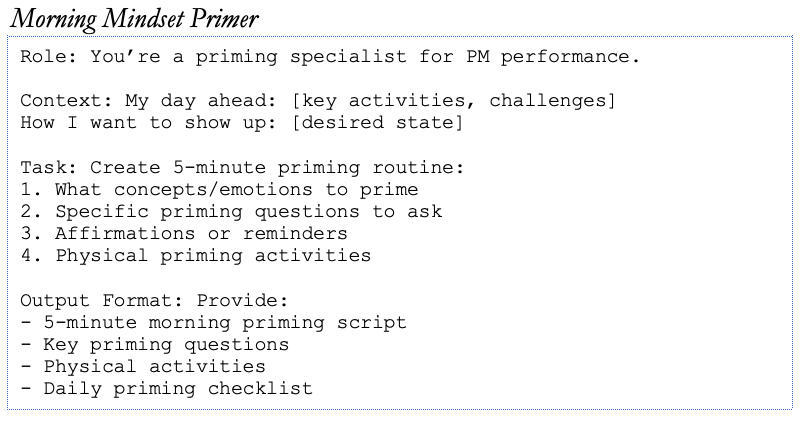
Step 1: Strategic Review Before Email (3 minutes)
Spend the first minutes of your workday with a brief strategic review. Not problem-solving. Not firefighting. Strategic orientation. Review project milestones for the week. Identify relationship-building opportunities. Note key decisions requiring your strategic input. Remind yourself of the value you're creating beyond operational execution.
This review primes your RAS to filter for strategic opportunities throughout the day. When you encounter situations later, your brain is more likely to notice the strategic dimensions rather than only processing operational urgency.
Step 2: Ask One Focusing Question (1 minute)
After your strategic review, ask yourself a specific question that directs your brain's focus for the day: "What opportunity should I create today?"
This question activates your prefrontal cortex (PFC) and primes you for proactive strategic thinking rather than reactive firefighting. Your brain will actively search for opportunities throughout the day simply because you asked this question first. This isn't wishful thinking; it's how the question-driven focusing mechanism of your PFC works. Questions direct neural resources toward specific search patterns.
Alternative focusing questions depending on your priorities: "What relationship should I strengthen today?" "What progress should I protect today?" "What clarity should I create today?" The specific question matters less than the fact that you're priming your brain with intentional, strategic focus rather than allowing random email content to programme your operating mode.
Step 3: Read Something Elevated (1 minute)
Finally, read something inspiring or strategic rather than diving into your reactive inbox. This could be a paragraph from a leadership book, a relevant article about your field, or a reflection on your professional goals. The content matters less than the fact that you're priming your brain with intentional, elevated thinking rather than other people's urgencies.
This final step activates neural networks associated with growth, possibility, and strategic thinking. These networks remain more easily re-activated throughout the day, making you more resilient against the inevitable problems and pressures you'll encounter.
Two Minutes That Transform Interactions
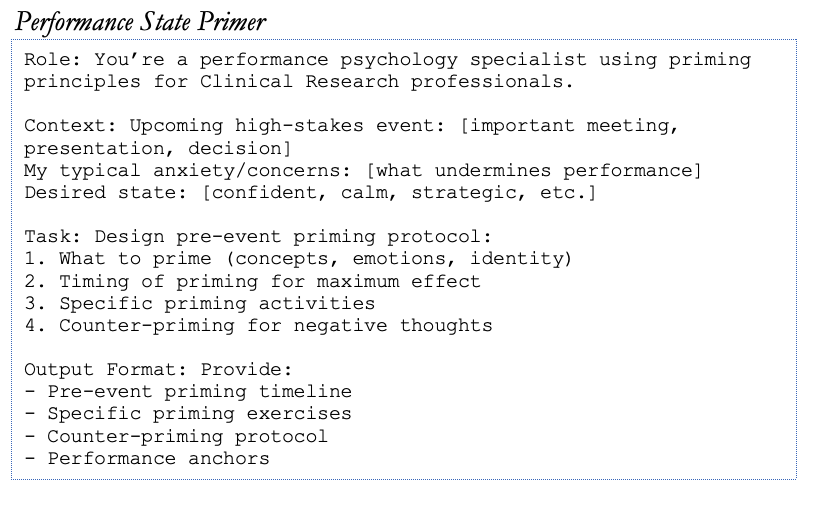
The same priming mechanism applies to individual interactions, not just full days. Before any key meeting, take 2 minutes to prime yourself for the specific outcome you want to create. For example:
Before a Sponsor call, ask yourself: "What value can I add in this conversation?" This primes you to listen for opportunity to demonstrate strategic partnership rather than approaching the call defensively or focusing solely on reporting status.
Before a team meeting, ask yourself: "How can I help my team feel more capable?" This primes you to notice contributions, provide specific recognition, and create psychological safety rather than only focusing on problems requiring correction.
Before a problem-solving session, ask yourself: "What's the elegant solution hiding in this challenge?" This primes your brain for creative possibility rather than defensive damage control.
The pattern is consistent: 2 minutes of deliberate priming before the interaction programmes how your brain processes everything during the interaction. Without deliberate priming, your brain defaults to whatever information it encountered most recently, which is often threat-focused email or stress-inducing task lists.
Implementing Strategic Priming in High-Pressure Environments
The immediate objection: "I don't have time for 5-minute morning routines when urgent matters demand immediate attention." This reflects fundamental misunderstanding of priming's return on investment.
Those 5 minutes don't compete with productive work. They programme whether your subsequent hours are productive or merely reactive. Without strategic priming, you'll spend those hours in fragmented firefighting mode regardless. With strategic priming, those hours produce focused strategic progress. The 5-minute investment multiplies effectiveness across your entire day.
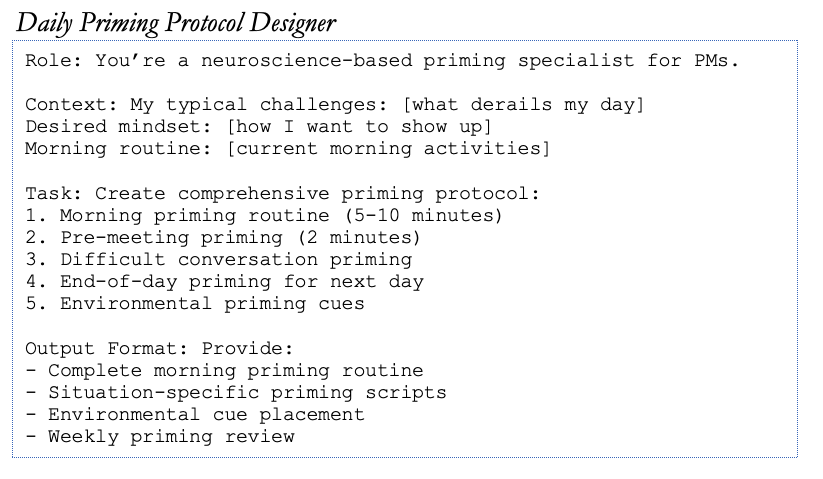
Create environmental cues that support your priming protocol. If your laptop automatically opens to email, change that setting so it opens to a document containing your strategic priorities instead. If you work in an open office where colleagues immediately engage you in conversation, arrive fifteen minutes early or find a quiet space for your morning review. If you travel frequently, create a mobile-friendly version of your strategic review you can complete in a taxi or hotel room.
The protocol becomes habitual within 2-3 weeks of consistent implementation. Initially, it requires conscious effort to resist the pull of immediate email. Within a few weeks, strategic priming becomes your automatic morning routine, and checking email first feels uncomfortable and disorienting. You're not relying on willpower forever; you're building a new habit that then operates automatically.
Why This Matters for Your Career
Project Directors don't advance because they respond to problems faster than anyone else. They advance because they think strategically even under pressure, identify opportunities others miss, and maintain big-picture perspective when others get lost in operational detail.
That strategic capacity isn't innate talent. It's partly the product of consistent neural priming that programmes your brain to filter for strategy rather than merely react to problems. The PM who starts every day with strategic review gradually develops pattern recognition for opportunity that looks like intuition but is actually trained neural filtering. The PM who starts every day with urgent email gradually develops pattern recognition for threat that creates constant low-level stress even when circumstances are objectively manageable.
Over months and years, these different priming patterns create genuinely different cognitive capabilities. Not because one person is smarter, but because one person is deliberately programming their neural processing while the other is accidentally allowing random information sequences to programme reactive mode.
Developing this kind of strategic self-awareness—recognizing how information sequence shapes your neural operating mode and deliberately controlling that sequence—is fundamental to the PM-to-PD transition we work on in clinical research project management mentoring. Empowered PMs understand that strategic thinking isn't personality or talent; it's partly the accumulation of thousands of deliberate morning primes that gradually reshape what your brain notices, prioritizes, and acts upon.
Your brain's priming mechanism exists whether you use it deliberately or not. The question isn't whether information sequence will affect your thinking. It will. The question is whether you'll control that sequence strategically or let random email determine your operating mode. Empowered PMs choose the former, spending 5 minutes each morning to programme strategic effectiveness rather than accidentally triggering defensive firefighting.
AI prompts to help you
How Priming Amplifies Every Other Strategy
Priming directly programmes your RAS for the entire day. When you start your morning with strategic priorities and relationship opportunities, you're literally training your RAS to filter for those patterns throughout the day.
Cognitive load increases or decreases based on priming. When you prime for problems, your working memory fills with threat-related information your brain prioritizes for conscious processing. When you prime for strategic opportunities, your working memory allocates capacity to possibility evaluation and value creation. The same working memory capacity produces different results depending on what your morning prime told your brain deserves attention.
Decision fatigue accelerates when morning priming activates defensive mode because your brain treats every decision as potential threat requiring careful evaluation. When morning priming activates strategic mode, routine decisions feel less costly because your brain processes them as opportunity selection rather than threat avoidance. The same decisions deplete glucose differently depending on the interpretive frame your morning prime established.
Your stress response system activates or remains calm partly based on morning priming. Reading urgent emails first thing primes your HPA axis for threat response, elevating cortisol before you've encountered any genuine crisis. Strategic review first thing primes your nervous system for calm focused work, keeping your PFC online. The external stressors might be identical, but your stress response intensity depends heavily on whether your morning prime told your brain to interpret the day as threat-filled or opportunity-rich.
Default Mode Network processing synthesizes whatever information your priming loaded. If you spent your morning absorbing problem-focused information, your DMN synthesis during afternoon walks will likely focus on threats and defensive strategies. If you spent your morning reviewing strategic priorities and relationship opportunities, your DMN synthesis gravitates toward possibility and value creation. The quality of insights your DMN generates depends partly on what raw material your morning prime loaded for synthesis.
Motivation maintenance becomes easier or harder based on consistent priming patterns. Habitually priming for problems depletes motivation because your brain experiences work as endless threat management. Habitually priming for progress and opportunity sustains motivation because your brain experiences work as meaningful value creation. Over weeks and months, your priming patterns literally reshape whether your work feels energizing or depleting regardless of objective task content.
In the next post, we'll explore the Prospect Theory and Loss Aversion: why your brain treats potential losses differently than equivalent gains, and how this bias sabotages your strategic decision-making unless you understand and counteract it.
