
The "Work Smarter" Myth Cracked (15/18): Spacing Effect
Rachel, a new PM at a mid-sized CRO, was assigned to her first Phase III oncology project. The Sponsor sent 72 pages of protocol documentation requiring mastery within 2 weeks before the kick-off meeting. Rachel panicked.
She blocked an entire Saturday for marathon studying. Eight hours straight reading protocol procedures, assessment schedules, safety monitoring requirements, and data collection specifications. By evening, her head was spinning. She felt she'd absorbed everything. She took comprehensive notes, highlighted key sections, and felt confident.
The kick-off meeting 2 weeks later was a disaster. The Sponsor asked about a specific safety reporting timeline. Rachel knew she'd studied it but couldn't recall the details. She fumbled through her notes whilst everyone waited. The Sponsor asked about patient visit windows. Again, Rachel had read this, but the specifics escaped her. The Sponsor's confidence in Rachel visibly dropped with each uncertain response.
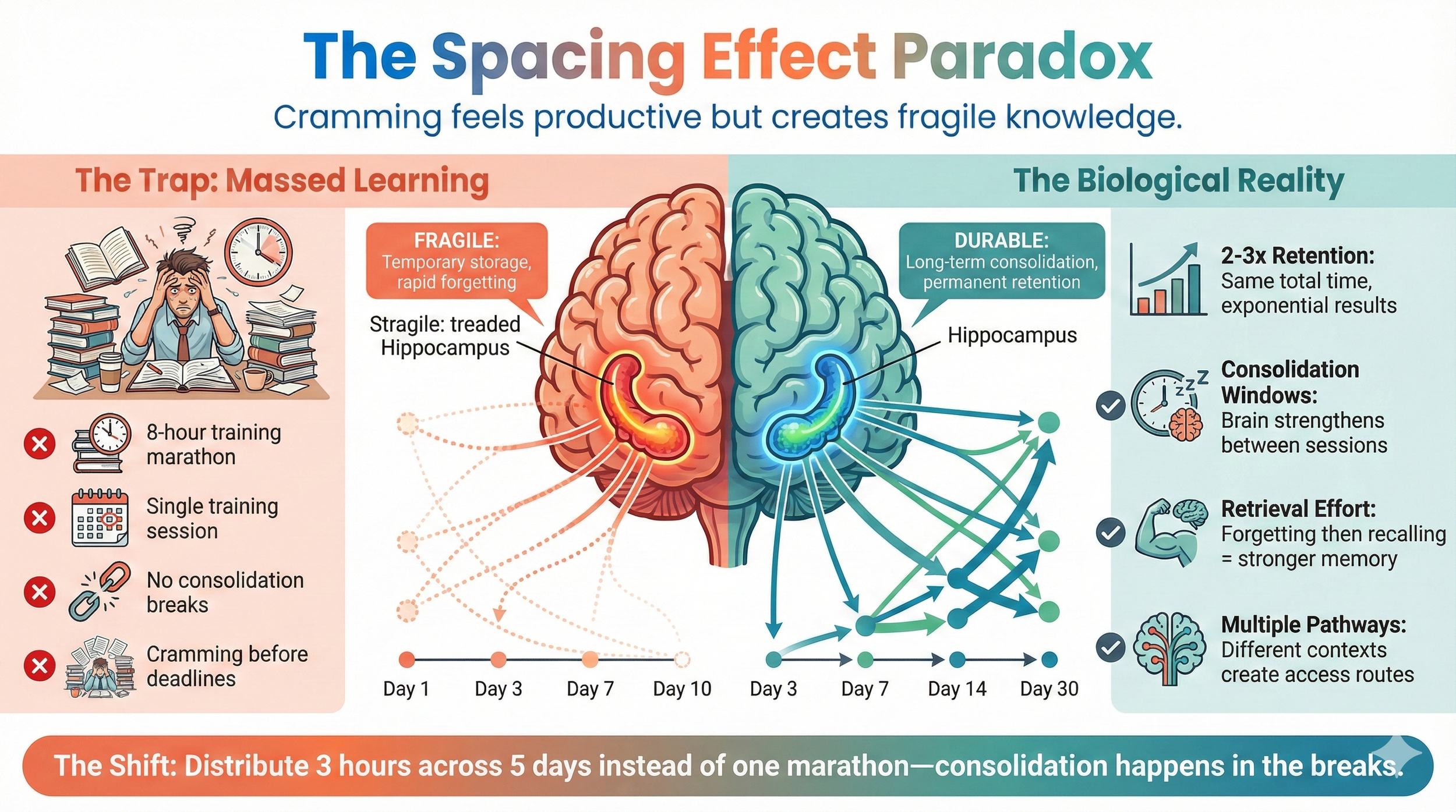
Rachel's 8h cramming session forced massive amounts of information into her hippocampus with no spacing for consolidation. The information stayed in temporary storage, degraded rapidly, and became inaccessible when she needed it under pressure.
Why Cramming Doesn't Work
Cramming doesn't work. Your brain cannot consolidate substantial learning from a single massed exposure, regardless of duration or intensity. This is the spacing effect, one of the most robust findings in all of learning science. Information distributed across multiple sessions separated by time intervals produces dramatically stronger memory and understanding than the same information presented in a single session.
The research is unambiguous. A meta-analysis of 317 experiments confirmed that distributed practice consistently produces superior long-term retention compared to massed practice across diverse materials and retention intervals. Educational psychologists identify spacing as one of the two most effective evidence-based learning techniques available, alongside retrieval practice.
Study for 1h daily across 5 days and you'll retain more than if you studied for 5 hours straight. Learn protocol procedures across 4 sessions spanning 2 weeks and you'll demonstrate better procedural mastery than from an 8h training marathon. This isn't marginal improvement—it's often double or triple the retention for identical total learning time.
Your brain needs time intervals between exposures for information to consolidate properly and transfer to long-term memory. Studying for 1h daily for 5 days produces better retention and deeper understanding than studying for 5 hours in a single session. The total time investment is the same, but the spacing allows your brain to consolidate between sessions, making each subsequent exposure more effective.
The Clinical Research Training Problem
Yet Clinical Research training consistently violates spacing principles. Protocol training happens in marathon sessions. Regulatory updates get delivered in multi-hour webinars. New systems training crams everything into intensive bursts. Then organisations wonder why teams can't remember procedures three months later and why the same questions get asked repeatedly despite comprehensive training having occurred.
The problem isn't that people aren't paying attention or taking notes. The problem is neurological. Your hippocampus consolidates information during intervals between learning sessions. Without spacing, consolidation can't happen. The information stays fragile, poorly integrated with existing knowledge, and rapidly forgotten.
Understanding this transforms both how you learn and how you structure learning for your teams. You're no longer fighting your neurobiology with brute force exposure. You're working with your brain's natural consolidation mechanisms.
Structure Your Own Learning with Optimal Spacing
When you need to master new information—whether it's a complex protocol, new regulatory guidance, or a different project management system—resist the urge to learn it all immediately. That urgency comes from deadline pressure, not from neuroscience. Cramming might make you feel prepared temporarily, but it won't produce durable mastery.
Instead, map out a spaced learning schedule. For substantial new material, use this proven structure:
Day One: Initial exposure of 60 minutes covering core concepts and framework. Don't try to master everything, just establish the foundation. Your goal is comprehension, not memorisation.
Day Three: First review session of 20 minutes. You're not re-learning from scratch; you're retrieving what you learnt on day one and filling gaps. The retrieval effort itself strengthens memory traces.
Day Seven: Second review session of 15 minutes. By now, some forgetting has occurred. That's intentional. The forgetting and subsequent retrieval creates stronger learning than if you'd reviewed too soon when everything was still fresh.
Day Fourteen: Third review session of 10 minutes. You're testing whether information has truly consolidated into long-term memory.
Day Thirty: Final review session of 5 minutes. This long interval tests and reinforces durable learning.
Total learning time in this spaced structure is 110 minutes. Compare that to a 3h cramming session. The spaced approach takes less total time yet produces dramatically better retention and application capability. The difference is pure neuroscience, allowing your hippocampus to do what it evolved to do: consolidate information during rest intervals.
For particularly complex material, extend the spacing: initial exposure on day one, reviews on days four, eight, fifteen, thirty, and sixty. For simpler content, compress slightly but maintain the spacing principle: day one, day two, day five, day ten, day twenty. The specific intervals matter less than ensuring that intervals exist at all.
Design Spaced Learning for Your Teams
When you control how learning is structured—whether you're designing team training or planning your own knowledge development—always use spaced intervals rather than massed cramming. The neuroscience is unambiguous: distributed practice produces stronger, more durable learning than concentrated practice, even when total learning time is significantly less.
Instead of a four-hour protocol training session delivered straight through, structure it as four 45-minute sessions distributed across four days, with fifteen-minute consolidation breaks built in, plus a final twenty-minute consolidation at the end. Total learning time: three hours and 40 minutes including breaks. Total retention: dramatically higher than the four-hour single session.
Here's why spacing works. Each learning session creates a memory trace—a neural pathway representing the new information. Immediately after initial learning, this trace is fragile. Spacing allows consolidation between sessions, during which the trace strengthens through the replay process. When you return to the material days later, your brain must work slightly harder to retrieve it because some forgetting has occurred. This retrieval effort, called active recall, strengthens the memory trace far more than re-exposure without retrieval effort would.
Additionally, each spaced session provides opportunity for different contexts and connections. Day one you might be well-rested and focused, connecting new protocol information to existing project knowledge. Day two you might be slightly stressed, but this creates different neural activation patterns that provide alternative retrieval pathways. Day three you might encounter real project situations that connect to the training material. These varied contexts create multiple pathways to the same information, making it more accessible under different circumstances.
When planning significant learning events, map out the spacing structure in advance. For complex protocol training that traditionally takes eight hours in two consecutive half-days, propose instead:
Week One:
Monday: 90 minutes covering background and objectives
Thursday: 90 minutes covering methodology and assessments
Week Two:
Monday: 90 minutes covering safety monitoring and reporting
Thursday: 90 minutes covering data management and closeout
Each session includes built-in consolidation breaks. Total training time: six hours. Learning durability: far superior to eight hours massed.
This spacing principle applies to your own learning as well. When you need to master new regulatory guidance, resist the urge to read all sixty pages in one sitting. Structure it as twenty pages per day across three days, with consolidation breaks after each session and review questions the following morning to activate retrieval. The total reading time might be slightly longer, but the retention and application capability will be substantially higher.
Admittedly, spacing is less convenient than massing. It requires more calendar coordination, extends the timeline, and demands discipline to follow the structure rather than cramming. The convenience of massed learning is exactly why it's so common despite being neurologically inefficient. The question is whether you want convenient learning that fades quickly, or slightly less convenient learning that creates permanent expertise.
Use Active Retrieval Between Spaced Sessions
Spacing works best when combined with active retrieval practice. Passive re-reading or re-watching training materials provides minimal benefit. Your brain doesn't have to work, so the memory traces don't strengthen. Active retrieval—forcing yourself to recall information without looking at notes—creates the cognitive effort that produces durable learning.
At each spaced review session, begin with retrieval attempt before reviewing materials. Close your notes and ask yourself: what were the main concepts from the last session? What procedures or steps do I remember? What examples illustrated key points? Attempt to recall and write down or speak out loud what you remember. This will feel harder than re-reading. That difficulty is the mechanism of improvement.
Only after you've attempted retrieval should you review the original materials to check accuracy and fill gaps. This two-step process—retrieve then verify—produces substantially better learning than simply reviewing. The retrieval attempt creates struggle, which signals to your brain that this information is important enough to strengthen. The verification corrects errors and reinforces accurate knowledge.
For team training, build retrieval practice into each spaced session. Don't start session two by re-teaching session one's content. Start by asking people to recall what they learnt previously. Use quick quizzes, group discussion, or practical application exercises that require retrieval. Only after retrieval should you build on that foundation with new content.
This retrieval practice has an additional benefit beyond learning: it reveals what hasn't stuck. If your team can't retrieve basic protocol procedures from the previous session, you know consolidation failed and need to adjust your approach. If retrieval is strong, you can confidently build more complex content on that foundation.
Protect the Spacing Structure Against Organisational Pressure
Organisations constantly pressure for compressed timelines. Training needs to happen faster, knowledge transfer needs to be completed immediately, everyone needs to be up to speed right now. This pressure directly conflicts with neuroscience, and yielding to it produces worse outcomes despite seeming more efficient.
When stakeholders push for cramming, explain the spacing effect clearly. Demonstrate with research: distributed learning produces two to three times better retention than massed learning for identical content and total time. The timeline extension isn't delaying productivity; it's preventing the need to repeatedly retrain the same material because it didn't consolidate the first time.
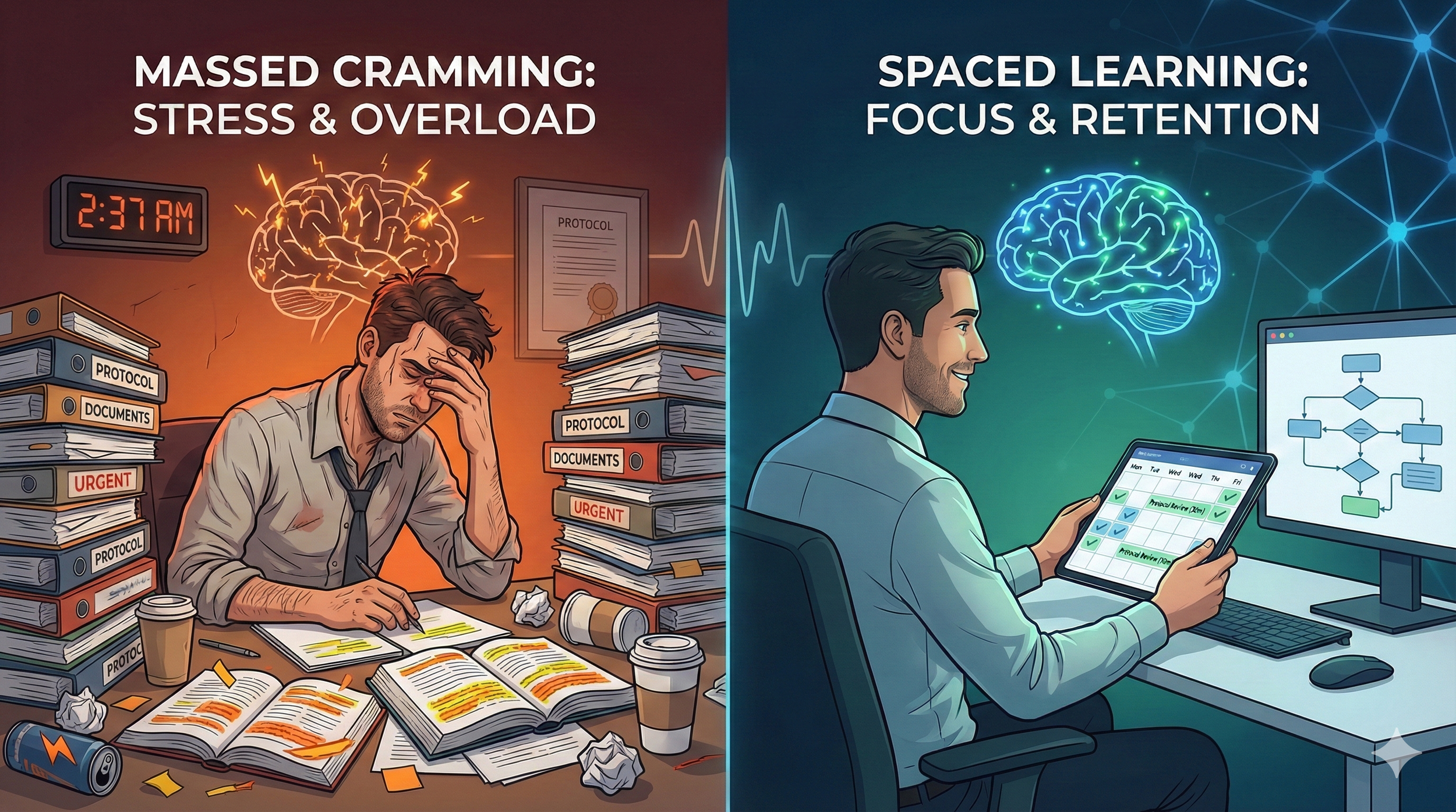
Frame spacing as efficiency, not delay. "We can train this protocol in one eight-hour session, but we'll need to retrain it again in three months when people have forgotten. Or we can structure six hours across two weeks, and the team will retain and apply it permanently. Which creates less disruption long-term?" Most organisations value avoiding repeated training enough to accept modest timeline extension.
For urgent situations where spacing truly isn't possible, build intensive review intervals post-training. If protocol training must happen in a single day due to regulatory timelines, schedule mandatory review sessions at day three, day seven, and day fourteen post-training. This post-training spacing partially mitigates the consolidation disadvantage of initial massed learning.
Similarly, when you're personally facing learning deadlines that force cramming, protect post-learning review intervals. You might have to cram 40 pages of guidance tonight before tomorrow's deadline, but schedule review sessions over the following 2 weeks to transition that fragile cramming knowledge into durable understanding.
The spacing effect isn't optional neuroscience you can work around through determination. Your brain consolidates during intervals between exposures, or learning stays fragile. Work with this reality rather than against it. Structure learning with spacing, and permanent expertise follows naturally.
The Transformation
Rachel's next major protocol learning opportunity came three months later with a cardiovascular project. This time, she approached it differently. Instead of one marathon session, she structured spaced learning across the two weeks before kick-off:
Week One:
Monday (60 minutes): Initial read of protocol overview, background, and objectives. She focused only on comprehension, not memorisation. No note-taking beyond key framework concepts.
Thursday (20 minutes): Without looking at the protocol, Rachel attempted to recall the main objectives and framework. She wrote down what she remembered, then reviewed the protocol to check accuracy and fill gaps. The retrieval effort was harder than re-reading would have been. That difficulty was exactly what strengthened the memory traces.
Week Two:
Monday (60 minutes): Second learning session covering methodology, assessments, and visit schedules. Again, comprehension first, not cramming.
Wednesday (15 minutes): Retrieval practice from Monday's session, then verification against protocol.
Friday (45 minutes): Final session on safety monitoring, reporting requirements, and data management.
Weekend before kick-off (10 minutes): Final retrieval practice across all sections.
Total learning time: three hours and 30 minutes. Forty minutes less than her previous Saturday marathon.
The kick-off meeting transformed Rachel's credibility. When the Sponsor asked about safety timelines, Rachel answered confidently from memory. Patient visit windows? She knew them without notes. Assessment sequences? Clear recall. The Sponsor complimented her protocol mastery and asked if she'd worked on similar projects before.
Six months later, Rachel was assigned two additional Phase III projects based on her demonstrated protocol mastery. Her secret wasn't working longer hours or having better memory than other PMs. She simply understood the spacing effect and structured her learning accordingly.
AI support
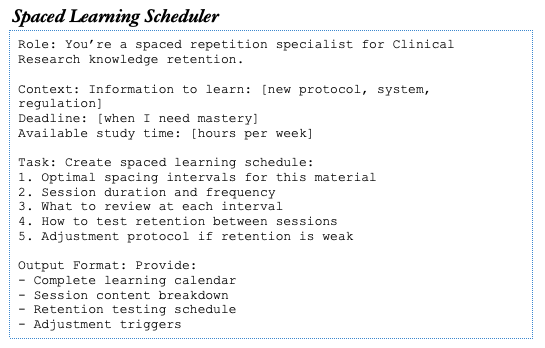
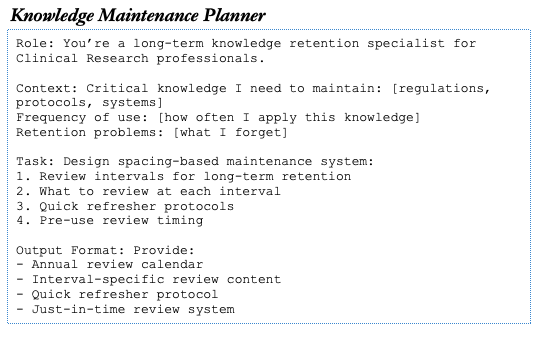
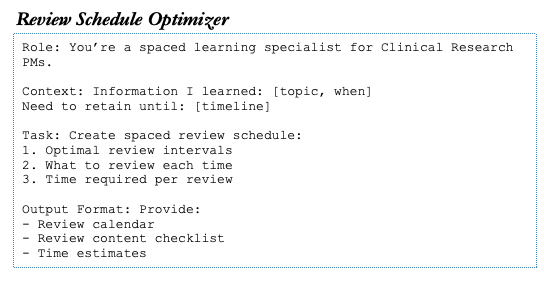
Before you go ahead and review all the training materials in order to create the optimal spacing intervals and reviewing scheduling, think about using AI to help you with that. Here are a couple of prompts that can support you with this:
How the Spacing Effect Connects to Other Brain-Based Strategies
The Spacing Effect works in concert with Memory Consolidation because spacing provides the intervals consolidation requires to function. Your hippocampus cannot consolidate learning from a single massed exposure, regardless of how intensely you study. The breaks between spaced sessions are when consolidation actually happens. Without spacing, there's nothing for your brain to consolidate during sleep or rest periods. These two strategies are essentially two perspectives on the same underlying neuroscience: consolidation describes what your brain does during intervals, whilst spacing describes how to structure learning to create those intervals.
Your Reticular Activating System benefits from spaced reviews because repeated exposure across time keeps knowledge accessible through sustained RAS activation. When you review protocol procedures on day one, day four, and day fourteen, each review signals to your RAS that this information matters. Single exposure followed by forgetting tells your RAS the opposite. Spaced learning essentially trains your RAS to prioritise retrieval pathways for the information you're learning.
Cognitive Load decreases dramatically when you distribute learning across manageable sessions rather than attempting to absorb everything at once. A four-hour protocol training marathon floods your working memory, forcing information to compete for limited processing capacity. Four 45-minute sessions spread across days allow each session to process fully before the next begins. Your working memory handles each chunk comfortably, and consolidation between sessions means you're building on solid foundations rather than unstable temporary storage.
Ultradian Rhythms align naturally with spaced learning because your 90-minute energy cycles determine optimal session length. Massed cramming sessions inevitably push through multiple ultradian troughs, forcing learning during periods when your brain lacks the glucose and focus for effective encoding. Spaced sessions can each be scheduled during peak energy windows, meaning every minute of learning time operates at maximum neurological efficiency. You're not just distributing learning across days; you're ensuring each session happens when your brain is primed to learn.
The compound effect of combining these strategies transforms learning efficiency fundamentally. When you structure protocol mastery using optimal spacing intervals, schedule each session during your ultradian peaks, protect consolidation breaks between sessions, and prime your RAS through repeated review, you're working with every relevant aspect of your neurobiology simultaneously. The result isn't incremental improvement; it's a fundamentally different relationship with knowledge acquisition where learning actually sticks.
Try it yourself by identifying one upcoming learning requirement. It's about experiencing neuroscience-aligned learning that works.
This is exactly what we work on in my brain-based coaching for Clinical Research project management professionals—transforming how you learn and how you lead your teams to learn, using evidence-based strategies that work with your neurobiology rather than against it.
