
The "Work Smarter" Myth Cracked (16/18): Default Mode Network (DMN)
Michael was stuck on a protocol deviation problem that had consumed 3 full days of intensive analysis. A site had enrolled patients outside the approved eligibility window, affecting data integrity for the entire cohort. The Sponsor was understandably concerned. Michael needed to propose a mitigation strategy that protected data integrity without derailing the entire study timeline.
He'd analysed the problem from every angle. He'd consulted the protocol, reviewed regulatory guidance, modelled different statistical approaches and even drafted 4 different mitigation proposals. None felt quite right. Each had trade-offs that didn't adequately address all stakeholder concerns.
Michael was exhausted, frustrated, and increasingly convinced he was missing something obvious but couldn't identify what.
Thursday afternoon, his brain absolutely saturated with protocol deviation analysis, Michael forced himself to stop working. Not because he'd solved the problem, but because continuing to stare at the same information was clearly producing diminishing returns.
When Your Brain Appears to Be Doing Nothing
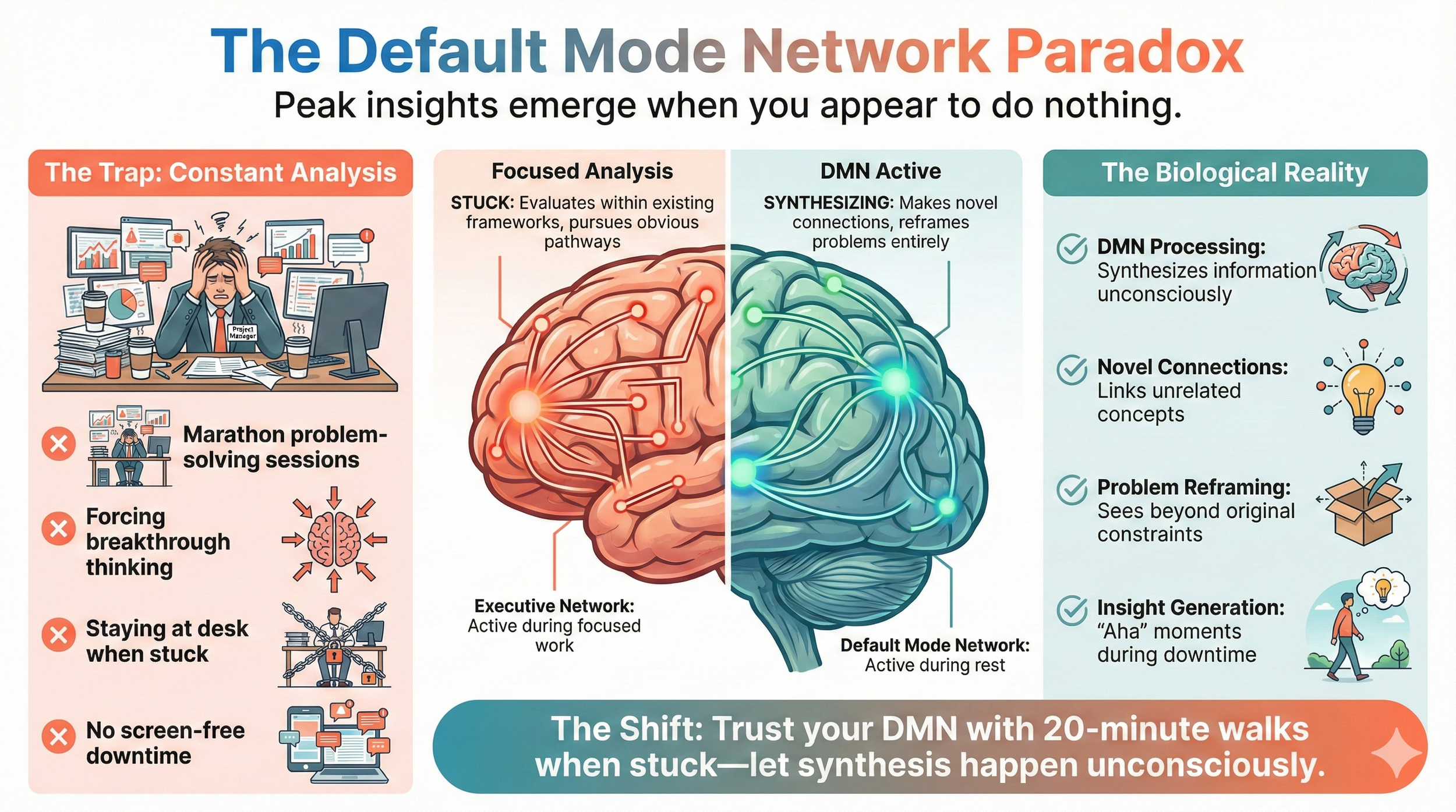
When your brain appears to be "doing nothing" during a walk, a shower, or the moments just before sleep, it's highly active. Your Default Mode Network (DMN) is processing experiences, making unexpected connections, and solving problems unconsciously. Many breakthrough insights happen during apparent downtime, but only if you give your DMN the space to work without constant information input.
Neuroscientist Marcus Raichle and his colleagues identified the Default Mode Network as a specific brain system active during wakeful rest, distinct from task-focused networks. Subsequent research by Dr Beaty demonstrates that DMN activation is essential for creative problem-solving, autobiographical memory, and insight generation. The "aha" moments that surface during walks or showers aren't random; they reflect DMN synthesis of information your focused attention couldn't integrate.
The toughest problems often solve themselves during walks or sleep, not because of magic but because your DMN integrates information differently than your conscious, focused thinking does. When you're actively working on a problem, you tend to pursue obvious pathways. When your DMN is active, it makes non-obvious connections that lead to creative solutions.
The Protocol
Structured Downtime
Build deliberate DMN activation periods into your daily routine.
Take a 15-minute morning walk with no phone and no podcast. Just walk. Let your DMN process the insights that emerged during overnight sleep. This quiet processing time often produces clarity about problems that seemed intractable the evening before.
At lunch, take an actual break away from your desk. Your DMN needs this midday window to consolidate the morning's work and prepare for the afternoon. When you eat at your desk whilst continuing to work, you deny your brain this essential processing time.
Between major tasks in the afternoon, take a 10-minute walk. This allows your DMN to integrate what you just completed before you move to the next significant piece of work. The integration happens unconsciously, but it makes your next task more effective.
In the evening, create 30 minutes of screen-free wind-down time before bed. This gives your DMN space to prepare for overnight processing. When you scroll through your phone until the moment you try to sleep, you're filling your brain with random inputs rather than allowing it to process the day's meaningful work.
Problem Incubation
For complex problems that resist direct analysis, deliberately give them to your DMN:
Start by defining the problem clearly.
Then gather all relevant information so your brain has the raw material it needs.
Think about the problem consciously for 20 minutes, exploring obvious approaches and considering various angles.
Then stop.
Go for a walk or engage in another activity that allows mind wandering. Don't try to solve the problem during this time. Instead, trust your DMN to work on it unconsciously. Insights often surface within hours, sometimes fully formed solutions that your conscious mind never would have generated through direct analysis.
The Breakthrough
For the first ten minutes of his walk, Michael's conscious mind kept circling back to the protocol deviation. He mentally reviewed the proposals again, finding the same flaws he'd identified at his desk.
But gradually, his conscious focus drifted. He noticed the weather changing. He thought briefly about a conversation with his daughter that morning. He observed how the park's winter landscaping worked. His mind wandered without particular direction or purpose.
Twenty-five minutes into the walk, completely unbidden, a solution emerged. Not from active problem-solving, but from what felt like nowhere.
Michael suddenly saw that he'd been framing the problem wrong. He was trying to choose between protecting data integrity and protecting timeline. But the solution wasn't choosing between them—it was restructuring the analysis to separate the affected cohort whilst maintaining both datasets.
The affected patients could be analysed as a distinct subgroup. The properly enrolled patients would provide the primary efficacy data. Both objectives preserved.
Michael immediately recognised this was the right approach. It addressed the Sponsor's data integrity concerns, maintained statistical power, avoided catastrophic timeline impact, and provided richer analysis by comparing the two cohorts.
He practically ran back to his office, drafted the proposal in thirty minutes, and sent it to the Sponsor. They approved it within hours, thanking Michael for his creative problem-solving.
What Michael didn't fully appreciate until later was that his walk hadn't been a break from work. His DMN had been actively processing the problem whilst his conscious mind wandered.
During focused analysis at his desk, his brain had been pursuing obvious pathways, trying to optimise within the constraints as he'd framed them. Those three days of intensive work had loaded all the relevant information into his brain: protocol requirements, regulatory constraints, statistical considerations, Sponsor priorities. But his executive network kept forcing evaluation within the same mental framework.
When he stopped actively working and let his mind wander during the walk, his DMN activated. This network operates differently than focused, executive thinking. Instead of evaluating solutions within existing frameworks, the DMN makes unexpected connections between seemingly unrelated information. It synthesises rather than analyses. It generates possibilities rather than evaluating feasibility.
The insight about restructuring analysis to create two cohorts didn't come from harder thinking. It came from his DMN connecting his protocol knowledge with statistical approaches he'd encountered in different contexts, synthesising them into a novel solution his focused analysis had never considered because it was stuck evaluating options within the original problem frame.
Building DMN Time Into Your Work Rhythm
Michael started deliberately incorporating DMN time into his work rhythm, especially when facing complex problems. Not as "taking a break," but as a different mode of cognitive processing equally valuable to focused analysis.
Morning walks before diving into challenging problems allowed his DMN to warm up creative thinking. Afternoon walks when stuck allowed his DMN to process information his focused analysis had loaded. Evening walks after intensive work let his DMN synthesise learning and identify patterns he hadn't consciously noticed.
The pattern became clear over months. Michael's best strategic insights, most creative solutions, and clearest pattern recognition emerged during apparent downtime when his DMN was active rather than during focused desk work. Focused analysis remained essential for implementation, but his DMN provided the breakthrough thinking that focused analysis alone never accessed.
His reflection: "I used to feel guilty taking walks when I'd urgent problems to solve. Now I understand those walks aren't breaks from problem-solving—they're a different type of problem-solving. My DMN makes connections my focused thinking can't access. The hardest problems don't solve themselves through harder focused thinking. They solve themselves when I trust my DMN to work unconsciously whilst my conscious mind rests. That walk that solved my protocol deviation crisis wasn't procrastination. It was exactly the cognitive process needed."
Practical Implementation
Today: Identify your hardest current problem, the challenge you've been consciously working on without breakthrough. After your next focused work session on this problem, immediately take a twenty-minute walk without your phone, without podcasts, without any information input. Just walk. Let your mind wander naturally. Don't force yourself to think about the problem, but don't force yourself not to think about it either. Your DMN works best when your conscious mind relaxes its executive control. Many professionals report insights emerging around the fifteen-minute mark when their DMN has had enough idle time to make novel connections.
This Week: Build DMN activation time into your daily rhythm with three specific practices. Take a ten-minute walk before beginning complex strategic work to activate your DMN's synthesis capability before your focused analysis begins. When you hit a wall on difficult problems and notice yourself reviewing the same information repeatedly without new insights, immediately shift to DMN time rather than pushing harder with focused thinking. Build a deliberate end-of-day DMN window, perhaps a fifteen-minute walk or quiet time with no information input, letting your DMN process and synthesise everything from the day.
This Month: Track when your best insights emerge. Most professionals discover their strategic breakthroughs, creative solutions, and pattern recognitions happen during DMN time rather than focused desk work. Document this pattern explicitly: shower insights, walk revelations, just-before-sleep clarity, morning-commute synthesis. This evidence base helps you trust DMN processing as legitimate cognitive work rather than viewing it as unproductive downtime. Adjust your schedule to protect more DMN time, especially before and after intensive focused work sessions.
After experiencing repeatedly that your DMN solves problems your focused thinking cannot, you'll stop equating productivity solely with active desk work. You'll recognise that the hardest challenges require two complementary cognitive modes: focused analysis to load information and evaluate solutions within frameworks, plus DMN synthesis to make novel connections and reframe problems entirely. You'll schedule both deliberately.
Complex strategic planning might include ninety minutes of focused analysis, forty minutes of DMN walk time, then thirty minutes of focused work capturing insights the DMN generated.
Your most valuable thinking often happens when you appear to be doing nothing.
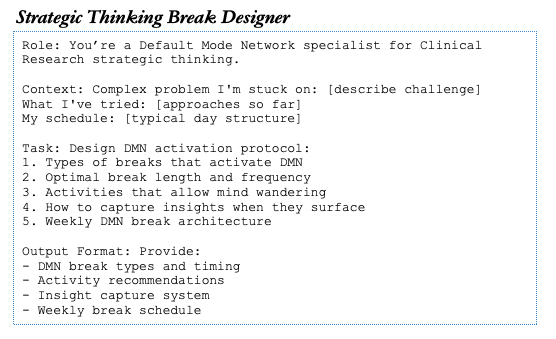
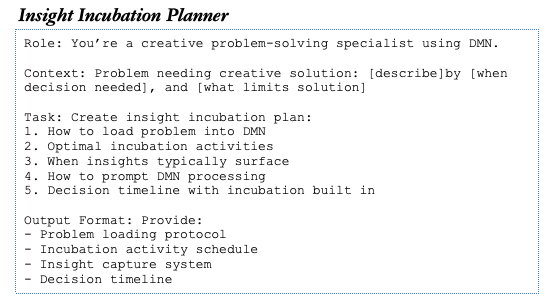
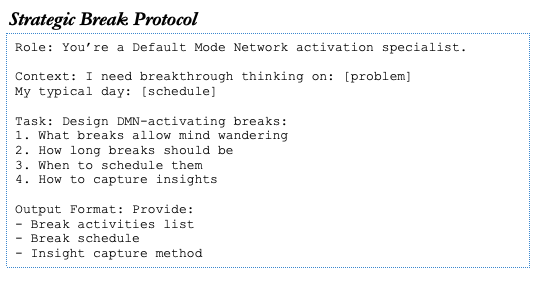
AI prompts to help you
The Bigger Picture
Your DMN provides the cognitive processing that enables pattern recognition. When you're actively focused on work, your brain evaluates information within existing frameworks. During DMN time, your brain synthesises information across different contexts, making the unexpected connections that reveal patterns you hadn't consciously noticed. Senior PMs with exceptional pattern recognition often have DMN-rich work rhythms, with regular walks and downtime that allow synthesis to occur.
Memory Consolidation happens partially during DMN activation. When you take that twenty-minute walk after intensive learning, your DMN isn't idle. It's actively integrating new information with existing knowledge, creating the connections that transform isolated facts into applicable understanding. Sleep provides the most powerful consolidation, but DMN time during wakefulness contributes significantly to learning integration.
The Ultradian Rhythms naturally include DMN activation periods if you work with them rather than against them. Every ninety-minute focused work cycle should be followed by a rest interval where your DMN can activate. Most professionals override this natural rhythm, forcing continuous focused work that never allows DMN synthesis. This creates cognitive exhaustion without the creative problem-solving benefits DMN provides.
Flow State and DMN activation are complementary rather than competitive. Flow requires sustained focused attention on challenging work within your capability. DMN activation requires relaxed unfocused attention allowing synthesis and creative connection. Complex strategic work often benefits from alternating between these states: focused flow sessions loading information and executing solutions, DMN time generating novel insights and reframing problems, then returning to focused flow to implement those insights. Neither state alone optimises strategic thinking, but alternating between them creates cognitive conditions for both deep analysis and creative synthesis.
Priming effects influence what your DMN synthesises during downtime. If you've loaded your brain with problem-focused information through morning email processing, your DMN synthesis during afternoon walks will likely focus on problems and threats. If you've loaded strategic priorities and relationship-building opportunities, your DMN synthesis gravitates towards those domains. What you expose your brain to during focused time influences what your DMN integrates during downtime, making the sequence of information exposure throughout your day surprisingly important for optimising DMN processing.
Your DMN isn't optional processing you can skip when busy. It's essential cognitive work your brain needs to perform regularly for strategic thinking, creative problem-solving, and pattern synthesis. Eliminating DMN time by filling every moment with focused work or information consumption doesn't make you more productive. It eliminates the cognitive processing that generates insights focused thinking cannot access.
Protecting DMN time is protecting your brain's capacity for synthesis, creativity, and strategic breakthrough thinking.
This is exactly what we work on in my brain-based coaching for Clinical Research project management professionals—understanding how different cognitive systems work and structuring your days to leverage each system optimally, creating conditions for both focused execution and creative breakthrough thinking.
