
The "Work Smarter" Myth Cracked (17/18): Flow State
Flow is the optimal performance state where you're fully immersed in challenging work, time seems to disappear, and difficult tasks feel effortless despite their complexity. During flow, your brain operates in a unique neurological state characterised by heightened focus, reduced self-consciousness, and seamless integration of thought and action that enables extraordinary performance with surprisingly little perceived effort.
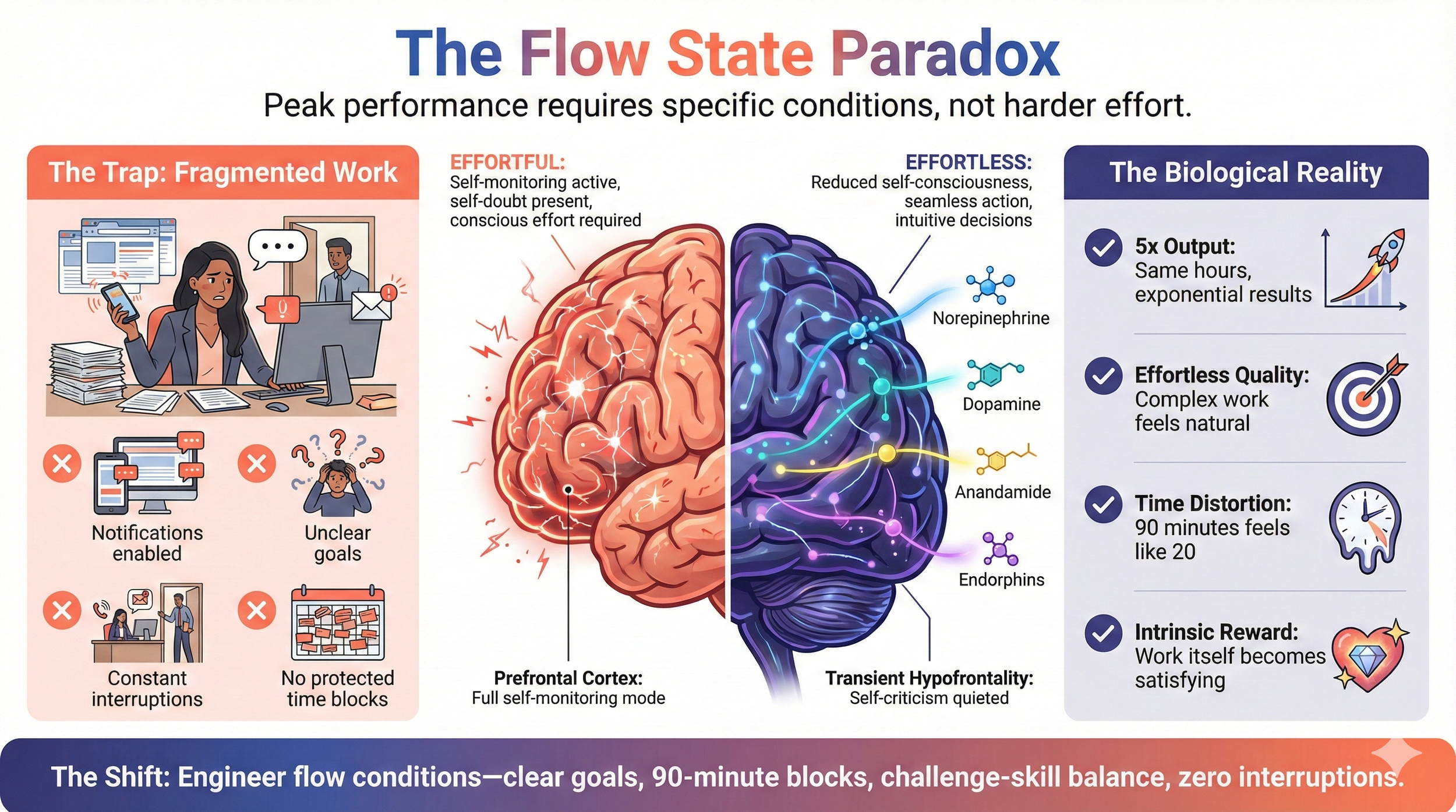
Research from Dr Mihaly Csikszentmihalyi demonstrates that flow states occur when specific conditions are met: clear goals, immediate feedback, balanced challenge-to-skill ratio, and complete absorption in the activity. Neuroscience research from Dr Dietrich reveals that during flow, the prefrontal cortex enters a state called "transient hypofrontality" where self-critical inner dialogue decreases whilst focus and creativity increase.
In flow state, when your best strategic work happens, you produce approximately 5 times your normal output at higher quality with less perceived effort.
But flow is extraordinarily fragile. A single interruption can destroy it completely, requiring 20-30 minutes to re-enter even under ideal conditions.
The Protocol
Engineer Flow Conditions
Create the specific conditions that allow flow to emerge.
Start with an absolutely clear goal. "Complete Sponsor strategy brief" works. "Work on Sponsor stuff" doesn't. Your brain needs concrete direction to enter flow.
Timebox your flow session for 90 minutes and protect this time ruthlessly. This duration aligns with your ultradian rhythms and is long enough to achieve deep work but short enough to sustain peak focus.
Choose work where the challenge level stretches you without overwhelming you. Too easy and you become bored, which prevents flow. Too difficult and you become anxious, which also prevents flow. The sweet spot is work that requires your full capability but remains achievable.
Create an interruption-proof environment. Turn off all notifications. Close your door if you have one. Inform your team that you're unavailable except for genuine emergencies. Put your phone in another room. Every potential interruption is a threat to flow state.
Prepare all your tools and information before you begin. If you need to break flow to search for a document or find a reference, those minutes spent searching will cost you 20 to 3 additional minutes to re-enter flow. Have everything ready at hand before you start.
Flow-Friendly Scheduling
Schedule work with flow potential—strategic analysis, complex writing, difficult problem-solving—during your peak cognitive hours. Flow is difficult to achieve when your brain is already depleted. Protect these peak hours for the work that benefits most from flow state.
Build buffer time after flow sessions. Don't schedule a meeting immediately after a 90-minute flow block. Allow time for completion and transition. When you know a hard stop is approaching, the anticipation prevents you from fully entering flow.
Batch similar complexity work together when possible. It's easier to maintain flow state across related tasks than to constantly shift between different types of work that require different cognitive modes.
The Neuroscience of Flow
During flow, your PFC—the brain region responsible for self-monitoring, self-criticism, and conscious decision-making—temporarily down-regulates in a state called transient hypofrontality. This isn't a malfunction; it's a feature that enables peak performance.
When your inner critic quiets and self-consciousness fades, your brain can access intuitive pattern recognition and creative problem-solving that analytical overthinking actually inhibits. Complex decisions that would normally require careful deliberation become automatic and intuitive. Actions flow seamlessly without the friction of self-doubt or second-guessing.
This neurological state explains why flow feels effortless despite tackling genuinely difficult work. Your brain isn't working less hard—it's working more efficiently by reducing the cognitive overhead of self-monitoring and conscious deliberation.
Why Flow Matters for Clinical Research PM/PDs
The research is clear and your experience will confirm it: you produce approximately five times your normal output during flow state, at higher quality, with less perceived effort.
Flow isn't about working harder; it's about engineering the specific conditions your brain needs for peak strategic performance. Those conditions aren't luxuries or nice-to-haves. They're requirements. Protect them as rigorously as you protect your most important Sponsor commitments, because your strategic thinking capacity depends entirely on your ability to enter and maintain flow.
Research from Dr Steven Kotler's Flow Research Collective demonstrates that flow states can improve performance by up to 500% across cognitive, creative, and physical domains. The key neurochemicals associated with flow—norepinephrine, dopamine, anandamide, and endorphins—create the optimal brain state for learning, creativity, and performance whilst providing intrinsic reward that sustains motivation.
The profound insight from flow research is that peak performance doesn't require constant effort or willpower. It emerges naturally when conditions are appropriately structured.
Clinical Research PMs who learn to cultivate flow states systematically can maintain exceptional performance levels whilst feeling energised rather than depleted, creating sustainable excellence rather than burnout-prone overwork.
Practical Implementation: Building Your Flow Practice
This Week: Identify one ninety-minute block during your peak cognitive window. Choose a single complex strategic task: developing a Sponsor strategy brief, analysing a protocol deviation pattern, designing a team development framework. Engineer all the flow conditions: clear goal, tools prepared, notifications off, phone away, door closed, team informed you're unavailable. Track your output. Most professionals are genuinely surprised by how much high-quality work emerges from a single protected flow session compared to an entire day of fragmented attention.
This Month: Build flow sessions into your regular schedule. Two to three ninety-minute flow blocks per week, scheduled during peak hours, protected as rigorously as client meetings. After each session, document what worked and what interfered. Common flow disruptors: unclear goals at the start, missing tools or information requiring mid-session searches, anticipation of upcoming hard stops, insufficient challenge creating boredom, or excessive challenge creating anxiety. Adjust your engineering based on what you learn.
This Quarter: Track when your best strategic work happens. Most professionals discover their highest-quality thinking, most creative solutions, and clearest strategic frameworks emerge during flow states rather than fragmented work time. This evidence base transforms how you structure your calendar. Instead of filling every hour with meetings and reactive work, you protect flow time as your primary value-creation activity. Meetings, email processing, and routine tasks get scheduled around flow blocks rather than flow blocks getting squeezed into whatever time remains.
After experiencing repeatedly that two hours of flow produces more strategic value than eight hours of fragmented attention, you'll fundamentally restructure how you work. You'll stop equating productivity with hours worked or tasks checked off lists. You'll recognise that your role's strategic value comes almost entirely from work produced during flow states, making flow cultivation your highest-leverage professional activity.
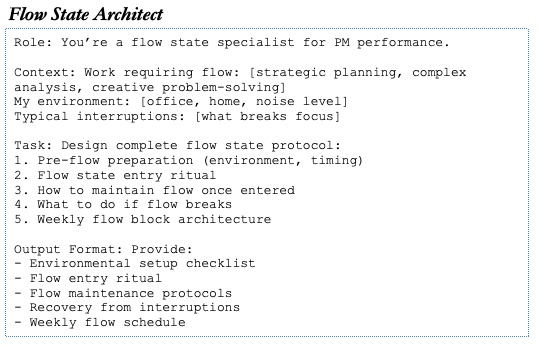
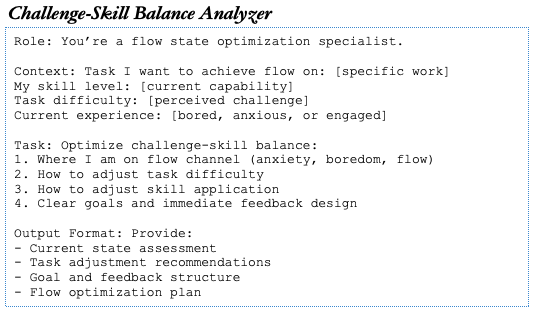
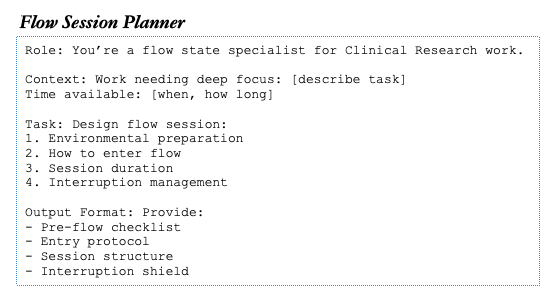
AI prompts to help you
How Flow State Connects to Other Brain-Based Strategies
Flow States represent the optimal integration of all previous strategies.:
Neurointelligence provides the foundation for understanding how flow operates neurologically through transient hypofrontality and network synchronisation in the brain.
RAS programming determines what your brain notices during flow. Programming for opportunities and solutions enhances flow experiences.
Cognitive Load Theory explains why flow feels effortless: the brain operates more efficiently when working memory isn't overwhelmed by competing demands.
Decision Fatigue is minimised during flow because decisions feel automatic and intuitive rather than effortful.
Ultradian Rhythms determine when flow states are most accessible, typically during biological peak performance periods. Flow is extraordinarily difficult to achieve when your brain is already depleted from hours of continuous work.
Attention Residue Management creates the focused conditions necessary for flow emergence. When your attention isn't fragmented across multiple incomplete tasks, your brain can achieve the complete absorption that flow requires.
Habit Formation creates the foundation that makes flow possible. When your morning review, communication processing, and documentation all run automatically, you eliminate the constant low-level decisions that fragment attention. Flow requires sustained attention without decision friction. Habits handle the routine cognitive work automatically, preserving your decision-making capacity and attention for the challenging strategic work where flow creates exceptional value.
Pattern Recognition accelerates during flow states because you can access and apply complex patterns more readily when self-doubt and analytical interference are reduced. Flow creates the optimal conditions for rapid, intuitive pattern matching.
Memory Consolidation benefits from flow sessions because the intense focus and engagement during flow strengthens encoding. Information processed during flow states transfers to long-term memory more effectively than information processed during fragmented attention.
The Spacing Effect combines powerfully with flow when you structure spaced learning sessions as flow blocks. Instead of cramming protocol information in one marathon session, create multiple flow sessions distributed across days. Each flow session enables deeper processing than fragmented study, whilst spacing between sessions allows consolidation.
The Default Mode Network complements flow states rather than competing with them. Flow sessions load your brain with relevant information and challenge your analytical capabilities. DMN time between flow sessions allows synthesis and creative connection. Complex strategic work often benefits from alternating between these states: focused flow sessions for deep analysis and execution, DMN walks for insight generation and problem reframing.
The Dopamine and Progress Principle naturally reinforces flow because flow experiences provide immediate intrinsic reward. Progress during flow feels satisfying in ways that fragmented task completion cannot match. This creates a virtuous cycle where flow experiences increase motivation for future flow sessions.
Priming effects influence what problems you solve during flow. If you've primed your RAS with strategic priorities and creative opportunities before entering flow, your flow session gravitates towards those domains. If you've primed with problems and threats, your flow focuses on firefighting. What you expose your brain to immediately before flow sessions significantly shapes what emerges during flow.
Every strategy in this toolkit ultimately supports creating flow conditions more reliably. The compound effect of combining these strategies isn't just better individual performance—it's the systematic cultivation of peak performance states where extraordinary work feels natural rather than forced.
This is exactly what we work on in my brain-based coaching for Clinical Research project management professionals—engineering the conditions for reliable flow states and building the supporting habits, schedules, and cognitive practices that make sustainable peak performance possible rather than burnout-inducing.
