
Insights




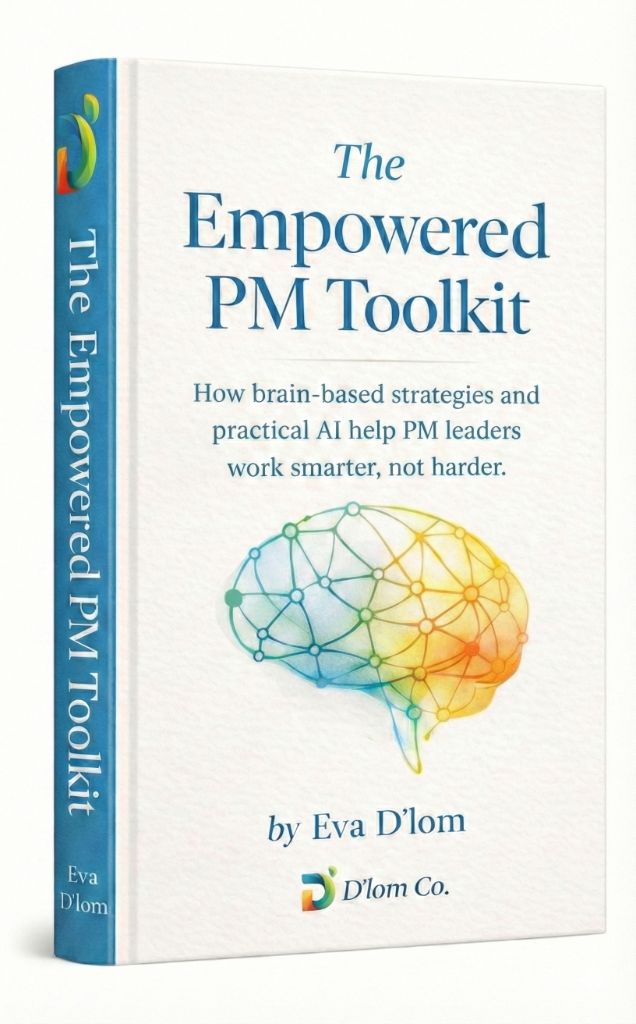
The Book I Wish I Had Had
"Work smarter, not harder." You have heard it. Probably at the worst possible moment, when you were already at capacity, managing Sponsor expectations across time zones, trying to hold a global team together, and wondering how much longer you could sustain the pace. The advice landed like an accusation. As if you just hadn't thought of that.
I wrote The Empowered PM Toolkit because that phrase deserves a real answer. After 25 years in Clinical Research, two burnouts, a redundancy that shook me to my core, and a certification in Brain-Based Coaching from the NeuroLeadership Institute, I finally understood what was missing. The how. This book contains 18 strategies grounded in peer-reviewed neuroscience, with practical AI prompts you can use immediately, designed specifically for Project Managers and Project Directors who are tired of generic advice that ignores the reality of this industry. This is the book I needed, and never had, at my most difficult moments.
The "Work Smarter" Myth Cracked (18/18): Stress Response / HPA Axis
Every email notification triggers tension in your shoulders. Every Sponsor request activates anxiety in your chest. Every site delay feels like impending disaster.
Your sleep deteriorates. Your decision-making quality drops. Small frustrations trigger disproportionate reactions.
During a routine Sponsor call, they ask a straightforward question and your mind goes completely blank. You know this information intimately, reviewed it that morning, yet can't access it under pressure.
This isn't a failure of competence or preparation—it's your Hypothalamic-Pituitary-Adrenal (HPA) axis stuck in chronic activation, treating every challenge as a survival threat.
When you perceive threat, cortisol floods your system. Blood flow shifts away from strategic thinking toward threat response. Chronic stress creates measurable changes in brain structure and function.
But evidence-based neuroscience interventions can break this cycle. Discover how to train your nervous system.
The "Work Smarter" Myth Cracked (17/18): Flow State
You're fully immersed in complex strategic work. Time seems to disappear. A task that should feel difficult flows effortlessly despite its complexity. Two hours pass in what feels like 20 minutes, and you've produced work that would normally take you an entire day.
This isn't magic or a lucky accident—it's flow state, the optimal performance state where your brain operates in a unique neurological configuration that enables extraordinary performance with surprisingly little perceived effort.
In flow, you produce approximately 5 times your normal output at higher quality. But flow is extraordinarily fragile. A single interruption can destroy it completely, requiring 20-30 minutes to re-enter even under ideal conditions.
Discover how to engineer the specific conditions that allow flow to emerge reliably.
The "Work Smarter" Myth Cracked (16/18): Default Mode Network (DMN)
Three days of intensive analysis. Four different mitigation proposals. None felt right.
You're exhausted, frustrated, and increasingly convinced you're missing something obvious but can't identify what. So you force yourself to stop working—not because you've solved the problem, but because staring at the same information is producing diminishing returns.
Twenty-five minutes into a walk, completely unbidden, the solution emerges. Not from active problem-solving, but from what feels like nowhere.
This isn't magic. Your Default Mode Network was processing experiences, making unexpected connections, and solving problems unconsciously.
The toughest problems often solve themselves during walks or sleep because your DMN integrates information differently than your conscious, focused thinking does. Discover how to activate this hidden cognitive system.
The "Work Smarter" Myth Cracked (14/18): Chunking
Your working memory holds just four to seven items simultaneously—a hard neurological limit, not a personal failing.
When you're managing sites, Sponsors, timelines, and budgets, you're constantly exceeding this capacity, causing the mental overload that makes everything feel harder than it should.
Chunking transforms multiple competing items into single organised units your brain processes effortlessly. This isn't about remembering more; it's about organising information to match how your working memory actually functions.
Discover how standardised templates and information chunks can exponentially expand your effective cognitive capacity without changing your neurobiology.
The "Work Smarter" Myth Cracked (12/18): Memory Consolidation
You attended a four-hour protocol training session. You took detailed notes. You felt confident you understood everything. Three weeks later, preparing for a Sponsor call, you can barely remember half the material.
This isn't a memory problem. It's a consolidation problem.
Learning doesn't happen during the training itself. It happens during rest—when your hippocampus replays experiences at high speed, transferring information from temporary storage into permanent memory. Without proper consolidation intervals, even the most intensive training becomes temporary familiarity that evaporates under pressure.
The solution isn't studying harder or taking better notes. It's understanding that your brain needs specific rest intervals to make learning permanent. Here's the protocol that transforms fragile short-term learning into expertise you can access instantly when it matters most.
The "Work Smarter" Myth Cracked (10/18): Motivation
You've been relying on external pressure for motivation: Sponsor deadlines, fear of failure, last-minute panic. It works short-term but creates a exhausting rollercoaster: high energy when pressure is intense, complete depletion when it's not.
This isn't a personality flaw. Motivation isn't a trait you either have or lack. It's a neurological state influenced by predictable brain chemistry, particularly dopamine, the neurotransmitter that drives goal-directed behaviour.
Clinical Research PMs face unique motivational challenges: years between meaningful milestones, invisible successes (preventing problems that never happen), constant external pressure, and high cognitive load that depletes motivational resources.
Here's the systematic protocol that transforms motivation from something you hope to feel into something you can deliberately engineer—using the same neuroscience principles that sustained Michael through fifteen years of burnout to strategic PM success.
The "Work Smarter" Myth Cracked (9/18): Dopamine & Progress Principle
Michael was 8 months into an 18-month study. Database Lock was 10 months away. First Patient Enrolled had been 7 months ago. Everything between felt like endless grind with no wins.
He was exhausted, unmotivated, questioning his career choice.
Michael's brain hadn't received a significant progress signal in 7 months. Neurologically, he was in a motivation desert.
This isn't about discipline or work ethic. It's about dopamine: your brain's motivation molecule. Research shows that small, frequent wins trigger more sustained motivation than occasional big wins. Your brain craves the dopamine hit of progress, not completion.
The overwhelmed PM problem: Big deliverables might be months away. No progress signal equals no dopamine equals motivation collapse equals burnout.
Here's the neuroscience-backed protocol to engineer dopamine-worthy milestones that sustain motivation through even the longest clinical research marathons.
The "Work Smarter" Myth Cracked (8/18): Pattern Recognition & Expertise
Ever watched a senior PM glance at a recruitment graph and immediately spot problems you completely missed?
They’re not psychic, and they’re not working harder than you. They’ve built a pattern library in their hippocampus through 10,000 hours of experience.
Here’s what nobody tells you: you don’t need a decade to build that library. With deliberate pattern recognition training and AI amplification, you can compress 15 years of expertise development into 18 months.
This isn’t about working harder; it’s about systematically training your brain to see what experts see, using neuroscience principles that accelerate pattern storage and AI tools that expose you to thousands of data points instantly. T
ransform from reactive problem-solving to predictive expert recognition.

The "Work Smarter" Myth Cracked (7/18): Habit Formation & Automaticity
You're competent and experienced, yet you spend ten minutes every morning deciding where to start. You compose identical responses to recurring questions from scratch every single time. You capture meeting notes randomly across scattered documents, then waste time reconstructing conversations later.
This isn't a discipline problem. It's a neuroscience problem.
Your prefrontal cortex controls every new behaviour with massive energy cost. But with deliberate repetition, control shifts to the basal ganglia—an efficient system running behaviours automatically at just 5% of the original cognitive cost. This is habit formation: the brain's capacity to convert conscious, effortful behaviours into automatic routines requiring almost zero mental energy.
Most overwhelmed PMs waste 90+ minutes daily on routine decisions about tasks they've done hundreds of times. Every repeated decision depletes cognitive capacity that should be reserved for strategic thinking. The solution isn't working harder. It's systematically converting routine behaviours into automatic habits, freeing your prefrontal cortex for work that genuinely requires expertise.
Here's the neuroscience-backed protocol that transforms decision-heavy routine work into effortless automatic execution.
The "Work Smarter" Myth Cracked (6/18): Attention Residue
You switch tasks 50 times per day—checking email between writing reports, answering quick questions during strategic planning, reviewing documents while on calls. You're busy every minute, yet at day's end you've completed nothing meaningful. This isn't because you're inefficient. It's attention residue: every task switch costs 20-40% of your cognitive capacity for the next 20 minutes. Your brain literally cannot switch instantly. The residue lingers, fragmenting your focus across dozens of incomplete tasks. The exhaustion is real, but invisible. This post reveals the neuroscience behind why you feel mentally destroyed despite being "productive" all day, and provides a six-step protocol to reclaim your cognitive capacity for the strategic work that actually matters.
The "Work Smarter" Myth Cracked (5/18): Ultradian Rhythms
You pride yourself on powering through. Eight-hour focus marathons. Working through lunch. Never taking breaks because there's too much to do. You measure productivity by hours at your desk, not quality of output.
Here's the brutal truth: after 90 minutes of focused work without recovery, your brain's cognitive capacity drops 40-60%. That strategic analysis you're doing at hour three? It's half the quality it would be if you'd taken two 15-minute breaks.
This isn't about working harder. It's about working with your brain's natural ultradian rhythms: 90-120 minute cycles of peak focus followed by necessary recovery.
Empowered PM/PDs produce more high-quality output in five focused hours with recovery breaks than overwhelmed PMs produce in ten straight hours fighting their biology.
Here's the protocol to transform hours worked into value delivered.
The "Work Smarter" Myth Cracked (4/18): Decision Fatigue
You're facing a critical decision at 4pm. You've already answered 50 emails, attended three meetings, made dozens of task prioritisation calls, and navigated multiple stakeholder requests. Your brain feels foggy. The decision seems harder than it should be.
This isn't burnout. It's decision fatigue: a biological reality where your prefrontal cortex (PFC) literally runs out of glucose after making too many decisions. Research shows that by late afternoon, decision quality deteriorates dramatically, leading to impulsive choices, decision avoidance, or defaulting to the easiest option regardless of quality.
The solution isn't working harder. It's eliminating 80% of routine decisions through systems and templates, protecting your decision-making capacity for the strategic choices where your expertise actually adds value.
Here the how explained.

The "Work Smarter" Myth Cracked (3/18): Cognitive Load Theory
You're working constantly but accomplishing nothing. You re-read emails because you don't remember the details. You interrupt one task to handle another, then forget where you were. You know you have information "somewhere" but can't find it. You think "I need to remember to..." dozens of times a day.
This isn't a productivity problem. It's a cognitive load problem.
Your brain's working memory can only hold 4-7 pieces of information simultaneously. When you're trying to remember 15 open actions, 40 site contacts, budget calculations, timeline dependencies, and three draft emails—all at once—your system crashes. Understanding cognitive load theory explains why you feel overwhelmed even when you're highly capable. More importantly, it reveals exactly what to do about it.
Important Considerations When Using AI (4/4)
AI tools can transform your proposal development process, but only if you use them strategically and safely.
This post covers 5 critical practices for responsible AI implementation. These aren't optional nice-to-haves. They're essential safeguards that separate effective AI use from costly mistakes. You'll find specific prompt templates, data sanitisation guidelines, and a fact-checking buddy system approach that ensures AI accelerates your work without compromising quality or compliance.
Generative AI Tools to Enhance Your RFP Response Process (3/4)
GenAI doesn't replace your strategic thinking. It amplifies it by handling time-consuming tasks and providing rapid iteration capabilities.
This comprehensive guide walks through the most effective AI tools for each stage of proposal development
Each section includes specific use cases, practical prompts you can adapt, and tips for maintaining quality while dramatically reducing development time. Whether you're analyzing past wins, researching sponsors, or preparing for bid defense, you'll find tools that solve actual problems.
Brain-Based Strategies to Manage the Chaos (2/4)
Juggling active projects while waiting on proposal responses isn't just stressful, it's cognitively expensive. Your brain's working memory can only handle 4-7 items at once, and context-switching costs you up to 23 minutes of productive focus each time.
This post shares 5 strategies to manage this reality.
These aren't just organisation tips. They're cognitive offloading techniques that free up your mental bandwidth for what matters most.
Mastering RFI/RFP Responses. A PML Survival Guide 1/4
Understanding the RFI/RFP response phase isn't just about learning a process. It's about preparing yourself for one of the most demanding, uncertain, and high-stakes periods in clinical research project management. By combining brain-based strategies with strategic use of AI tools, you can navigate this phase more effectively, reduce cognitive overload, and deliver stronger proposals without burning out in the process.
Whether you're a PM looking to grow into a PD role or already navigating these waters, recognizing these challenges and implementing practical solutions is what separates good PMLs from great ones.
The future of proposal development isn't about AI replacing your expertise. It's about AI amplifying your capabilities so you can focus on what you do best: strategic thinking, relationship building, and crafting winning narratives that convince sponsors you're the right partner for their critical research programs.
Being stuck and being lost are not the same experience.
Here is the neurological reason why high-achieving leaders stay in place despite knowing exactly what they want, and the four-layer model that shows you where to look instead.