
The "Work Smarter" Myth Cracked (5/18): Ultradian Rhythms
You're a competent PM/PD. You've delivered dozens of successful projects. Yet somehow, by 3pm on busy days, simple tasks feel impossibly difficult. That email you could write in five minutes at 9am takes twenty minutes at 4pm. Strategic thinking that comes naturally in the morning feels foggy and elusive in the afternoon.
You've probably blamed this on stress, or told yourself you need more coffee, or questioned whether you're burning out.
Here's what's actually happening: you're violating your brain's fundamental operating system.
Your brain doesn't work at constant capacity throughout the day. It operates in 90-120 minute cycles called ultradian rhythms, alternating between periods of high focus and necessary recovery. During peak phases, your prefrontal cortex fires optimally, neurotransmitters flow freely, and you can sustain deep concentration. Then your brain needs 15-20 minutes of recovery—whether you acknowledge it or not.
These rhythms are controlled by your brain's Basic Rest-Activity Cycle, the same system that governs your sleep cycles. During peak phases, your brain releases dopamine, norepinephrine, and acetylcholine: neurochemicals that enable focus. During recovery phases, these deplete and need replenishment.
The recovery phase isn't optional. Your brain is biologically incapable of sustaining high-level focus for four-plus hours straight. You can force yourself to sit at your desk, but cognitive output drops dramatically after 90 minutes without recovery. That strategic Sponsor communication you're drafting at hour three without breaks? It's probably 50% the quality it would be if you'd honoured your brain's natural cycles.
Why Clinical Research PM/PDs Are Particularly Vulnerable
The typical PM approach to productivity is to power through. Eight-hour focus marathons. Working through lunch at your desk. "Productivity" measured by hours present, not quality of output delivered.
Your role compounds the violation of natural rhythms in ways most professionals don't experience. You're simultaneously managing multiple active projects at different phases, continuous stakeholder demands requiring rapid context-switching, high-stakes decisions where errors have serious consequences, and constant interruptions fragmenting your attention throughout the day.
Here's the brutal reality: after 90 minutes of focused work without recovery, you're producing mediocre output at best. That budget analysis you're grinding through at hour three? That risk assessment you're forcing yourself to complete at hour five? The strategic thinking isn't there. Your brain simply doesn't have the neurochemical resources to sustain peak performance.
Empowered PM/PDs align their work with their brain's natural rhythms. They produce more high-quality output in five focused hours with proper recovery than overwhelmed PMs produce in ten straight hours fighting their biology.
This isn't laziness. It's neuroscience. Your brain needs recovery the same way your muscles need rest between workouts. Push through without recovery, and you're training yourself to produce consistently mediocre work whilst feeling perpetually exhausted.
Understanding Your Personal Rhythm Pattern
Before forcing new patterns, you need to understand your current energy cycles. Most people have never tracked their cognitive capacity systematically. They just know they're "tired" by afternoon but can't pinpoint why or when the decline begins.
For three to five days, rate yourself every 30 minutes on three metrics: focus capacity (Can I think deeply right now?), energy level (Physical and mental energy combined), and decision quality (Confidence in my judgment at this moment). Use a simple 1-10 scale for each.
You'll discover patterns most people never see. A typical pattern might show morning peak from 8:00-10:30am, mid-morning dip around 10:30-11:00am, second peak from 11:00am-12:30pm, post-lunch low from 1:00-2:30pm (this is biological and predictable), afternoon recovery from 2:30-4:00pm, and late afternoon fade from 4:00pm onwards.
Your specific pattern will vary based on your chronotype (whether you're naturally a morning or evening person), but you'll see clear 90-120 minute cycles with dips in between. This tracking isn't busy work. It's revealing your brain's operating manual that you've been ignoring for years.
Matching Work Type to Brain State
Once you know your peaks, strategic work allocation becomes simple. During peak phases when your brain is firing optimally, tackle strategic planning and analysis, complex problem-solving, critical Sponsor communications, risk assessment requiring judgment, budget modelling and scenario planning, creative solution development, and learning new complex information.
During recovery phases when your brain needs restoration, engage in physical movement like walking or stretching, routine administrative tasks, light email processing, casual team conversations without cognitive demand, actual lunch away from your desk, filing and organisation, and meeting preparation that doesn't require analysis.
Recovery doesn't mean scrolling social media or checking email. True cognitive recovery requires either physical movement, complete mental disengagement, light physical tasks like tidying your workspace or getting water, or social connection without cognitive demand. The key is giving your prefrontal cortex a genuine break from executive function demands.
The Ideal Daily Structure
Here's what working with your brain's natural rhythms looks like in practice. Block one from 8:00-9:30am (all the first 1.5 hours of your day) represents 90 minutes of peak focus for your most cognitively demanding work: strategic thinking, complex analysis, or important writing. Follow this with recovery from 9:30-9:45am: walk outside, get coffee or water, have a casual chat with a colleague, or stretch.
Block two from 9:45-11:15am is another 90 minutes of peak focus for your second-most demanding work: Sponsor calls, team problem-solving, or important communications. Recovery from 11:15-11:30am follows the same pattern.
Block three from 11:30am-1:00pm handles 90 minutes of moderate focus work—routine meetings, site calls, email batch processing, or standard updates. Then comes extended recovery from 1:00-1:30pm: actual lunch away from your desk, a light walk, or complete mental break.
Block four from 1:30-3:00pm recognises the biological post-lunch dip with 90 minutes of lower-focus work: administrative tasks, system updates, template-based communications, or routine documentation. Recovery from 3:00-3:15pm provides another reset before block five from 3:15-4:30pm, your final 75-minute push for meeting wrap-up, next-day planning, email closure, and task list management.
Hard stop at 4:30pm. Your brain is done producing quality work. Staying later produces quantity, not quality. The hours from 4:30pm onwards generate the errors you'll spend tomorrow morning fixing.
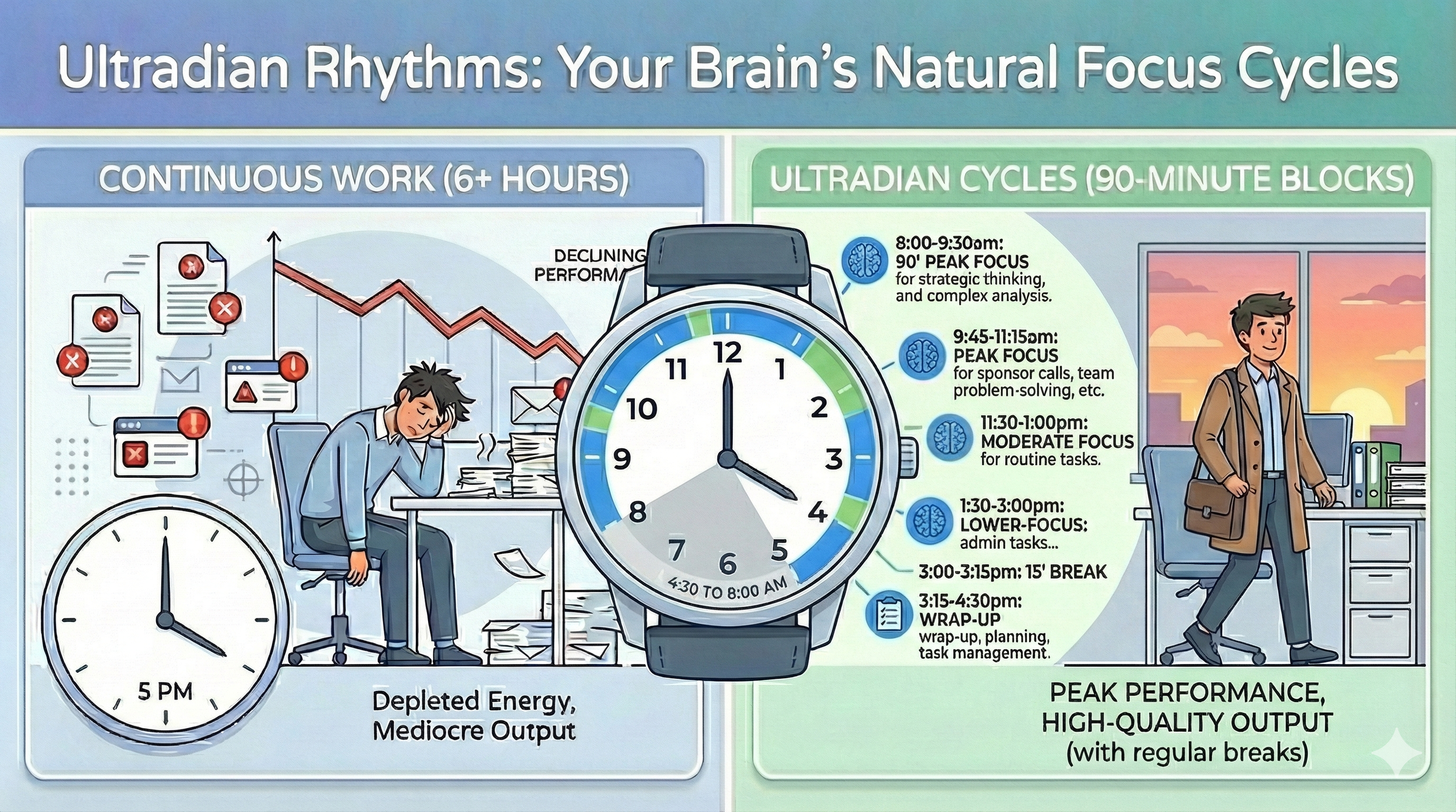
This is the difference before and after taking into consideration your brain's natural focus cycles
Protecting Recovery Time From Cultural Pressure
Your biggest challenge won't be the focus phases. It's protecting recovery time from the constant demands that threaten to consume it. "Quick" questions from team members during your break time. The urge to check email "just for a minute." Meetings that overrun into your recovery window. Guilt about "not working" when everyone else seems to be grinding through.
Set clear expectations with your team and stakeholders. "I take a 15-minute break every 90 minutes. Research shows this increases my output quality significantly. I'm available before and after these windows, but protecting them is non-negotiable for maintaining peak performance." This positions breaks as professional discipline, not personal indulgence.
Use environmental signals to mark context boundaries. Leave your desk during recovery. Close your laptop. Put your phone in your pocket rather than checking it. Take headphones off. These physical cues help your brain recognise the shift from work mode to recovery mode.
Schedule recovery blocks in your calendar with the same importance as meetings. When someone tries to schedule over a recovery window, respond exactly as you would if they tried to book you during an existing meeting: "I have a commitment during that time."
The most powerful protection is measuring the difference. Track your output quality in block one (after full overnight recovery) versus block five (after hours without adequate breaks). The difference becomes your evidence that recovery isn't lazy, it's strategic capacity protection.
Adapting for Meetings and Collaborative Work
Ultradian rhythms don't pause because you're in a meeting. Long meetings without breaks produce progressively worse decisions and declining engagement regardless of how important the topic.
For 90-minute meetings, schedule a 10-minute break at the 45-minute mark. This isn't optional. Require movement. Not sitting in the same seat checking phones, but actually getting up and moving. For multi-hour sessions, maintain 90-minute maximum blocks between breaks with 15-minute minimum break duration. Change environment between blocks if possible.
All-day workshops, Kick-Off meeting or Investigator Meetings, require particular attention: 90-minute blocks maximum, 15-minute recovery breaks at minimum, 60-minute lunch minimum, and afternoon sessions that start with movement or an energy activity to counteract the post-lunch biological dip.
The resistance is predictable: "We don't have time for breaks." The reality is that a six-hour meeting with proper breaks produces better decisions than an eight-hour meeting without them. You're not saving time by skipping breaks. You're producing worse outcomes whilst exhausting everyone involved.
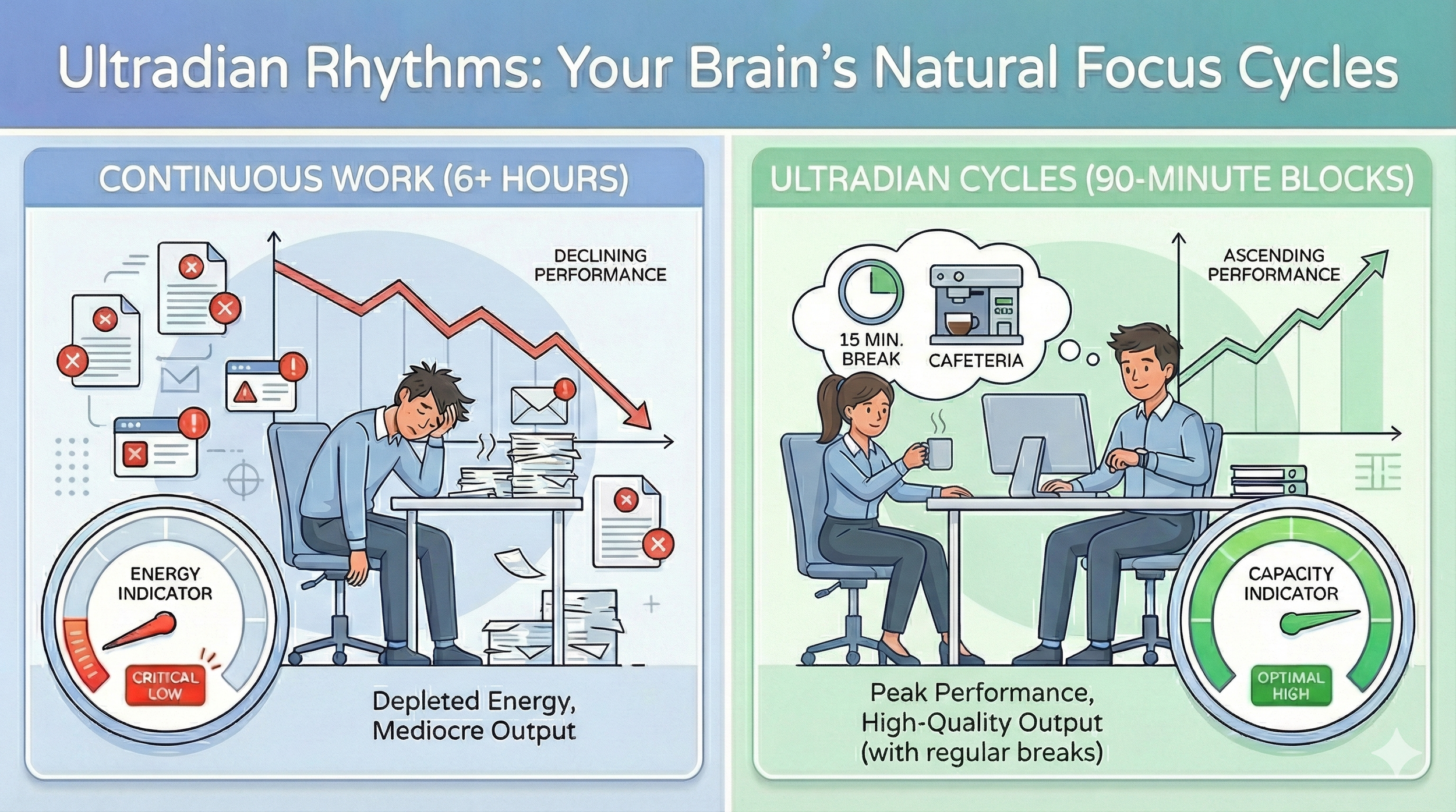
Taking a break increases your efficiency considerably.
Recognising When You've Violated Your Cycles
You'll miss recovery windows sometimes. Urgent Sponsor calls arise. Crisis management doesn't wait for scheduled breaks. Critical deadlines demand pushing through. The key is recognising the signs that your cognitive capacity is compromised and responding appropriately rather than continuing to force mediocre output.
Watch for these signals: re-reading the same paragraph multiple times without comprehension, taking twenty minutes to write an email that should take five, making simple errors on routine tasks, irritability or frustration that seems disproportionate, physical tension (tight shoulders, clenched jaw), or decision paralysis on normally straightforward choices.
When you notice these signs, stop whatever you're doing immediately. Take a 15-minute recovery break. This is non-negotiable. Return to work and expect 20-30 minutes before you're back to peak capacity because you're playing catch-up after depletion.
Prevention beats recovery. Set 90-minute timers. When the timer sounds, take your break regardless of how "in flow" you feel. Present you taking a break means future you performs better. Fight this instinct and you'll pay the price in declining quality over the next several hours.
Leveraging AI to Support Rhythm-Based Working
Generative AI becomes particularly valuable for supporting ultradian rhythm protocols when used strategically within your corporate environment's constraints.
If you have Microsoft Copilot access only, use it to build rhythm-based schedule templates. Provide your natural energy peaks from tracking, list all required tasks with their cognitive demand levels, and ask Copilot to build a schedule matching task demands to energy cycles whilst including 15-minute recovery breaks every 90 minutes and protecting peak hours for strategic work.
For meeting design optimisation, describe your meeting requirements and ask Copilot to design the agenda with 90-minute blocks maximum between breaks, most cognitively demanding topics in the first block, movement activities integrated, afternoon energy dips considered, and specific break timing and duration.
Create a recovery activity library using AI. Describe your just-completed focus block and upcoming work type, then request specific recovery activities that will actually restore cognitive capacity (not just feel like a break), fit in 15 minutes, work in an office environment, and prime your brain for your next task type.
If you have access to Claude (Anthropic), use it for personalised rhythm analysis. Paste your three-day energy tracking data and ask for analysis of your genuine peak focus periods, predictable energy dips, natural focus cycle lengths, optimal recovery duration, and how to structure your ideal day with specific timing and rationale.
For project phase rhythm planning, describe your upcoming phase (RFP response, study start-up, recruitment crisis), its cognitive demands, duration, must-have deliverables, and team constraints. Request a weekly rhythm design that aligns high-demand deliverables with peak focus cycles, builds in adequate recovery, accounts for unexpected urgent work, remains sustainable for the full phase duration, and prevents burnout.
Perplexity Pro excels at rapid research that supports rhythm-based working. When facing novel protocol challenges during peak focus time, use Perplexity to quickly gather regulatory precedent information without burning your peak capacity on research logistics. Ask for recent guidance on specific topics with sources cited, eliminating the decision of where to look and whether sources are reliable.
Practical Implementation: Your 30-Day Protocol
Today, track your energy and focus for one full workday, rating yourself every 30 minutes on focus capacity, energy level, and decision quality. Take one 15-minute recovery break after 90 minutes of focused work and notice the difference in your focus when you return.
This week, identify your personal peak focus periods from your tracking data. Schedule your most important work during your first peak tomorrow morning. Protect one recovery break completely. Leave your desk, move physically, and experience what actual cognitive restoration feels like.
This month, restructure your entire day around 90-minute focus blocks with 15-minute recovery breaks calendared with the same importance as meetings. Move administrative work to your biological low-energy periods (typically post-lunch). Implement a hard stop time when your brain is done producing quality work, even if others are still at their desks.
After 30 days of rhythm-aligned working, this becomes your new operating system. Your brain learns to expect recovery and actually uses it to restore capacity effectively. You stop feeling guilty about breaks because you can measure the output quality difference between rhythm-aligned days and rhythm-violated days.
The irony: you'll produce more value working six focused hours with recovery than ten straight hours ignoring your biology. But you'll only believe this after experiencing it firsthand and tracking the quality difference in your actual work outputs.
This systematic approach to aligning your work with your brain's natural cycles is exactly what we develop in brain-based coaching for clinical research professionals: building sustainable high-performance habits that work with your neurobiology rather than fighting against it.
Why This Matters Beyond Daily Productivity
PM/PDs don't advance because they work the longest hours. They advance because they consistently demonstrate sound strategic judgment and deliver high-quality outputs that build Sponsor confidence. That judgment and quality require optimal cognitive capacity.
Ultradian rhythm violations aren't immediately visible, but their effects on your strategic thinking absolutely are: to Sponsors, to leadership, and to your team. The PM who delivers sharp analysis in meetings, catches critical issues before they escalate, and communicates strategic insights clearly is working with their natural rhythms. The PM who seems perpetually behind, makes small errors on detail work, and struggles with strategic thinking in afternoon meetings is likely fighting their biology.
Templates, systems, and rhythm-based working aren't crutches for weak PMs. They're capacity protection strategies for strategic PMs who understand that their value lies not in grinding through exhaustion, but in delivering their best thinking consistently to the moments that matter most.
Your brain operates in natural cycles whether you honour them or ignore them. Honouring them is working smarter: producing better output in less time with more energy remaining. Ignoring them is working harder with progressively worse results whilst feeling perpetually depleted.
The choice is yours. Your neurobiology isn't negotiable, but your response to it is.
Want to master these protocols? This is precisely the kind of strategic self-awareness we develop systematically in clinical research project management mentoring: moving from "I'm always tired and behind" to "I work strategically with my brain's natural capacity cycles."
